Łódź Weekend Guide: Manufaktura, Piotrkowska and the Orientarium
The essentials: Two days in Łódź covers the Piotrkowska promenade, the red-brick Manufaktura complex with the ms2 art museum (free on Fridays), Księży Młyn and the Orientarium at Zoo Łódź (90 zł). Fast trains from Warsaw take about an hour.
Łódź is Poland's great reinvention story: a 19th-century textile boomtown of red-brick factories and industrialists' palaces that has turned its mills into art museums, food halls and one of Europe's most striking shopping and culture complexes. It is also the closest big-city weekend to Warsaw, under an hour and a half by train. This two-day plan covers the essentials with current prices and hours.
Getting there from Warsaw
Łódź is one of the easiest rail trips from the capital. PKP Intercity's autumn 2025 timetable brought the fast IC Esperanto service, running between Łódź and Warsaw with a single stop: the operator quotes 58 minutes between Łódź Widzew and Warszawa Zachodnia, and 1 hour 12 minutes between Łódź Fabryczna and Warszawa Centralna. Other IC and TLK trains between the cities run through the day, and Łódzka Kolej Aglomeracyjna (ŁKA) regional trains offer a cheaper, slower alternative with frequent departures.
Łódź Fabryczna, the main station, is a striking underground terminus about a 20-minute walk or a short tram ride from Piotrkowska Street. The city's trams cover everywhere a weekend visitor needs to go, with ticket machines at stops and on board.
Data source: PKP Intercity press office, autumn timetable service release (intercity.pl), checked 22 October 2026.
Day one: Piotrkowska Street
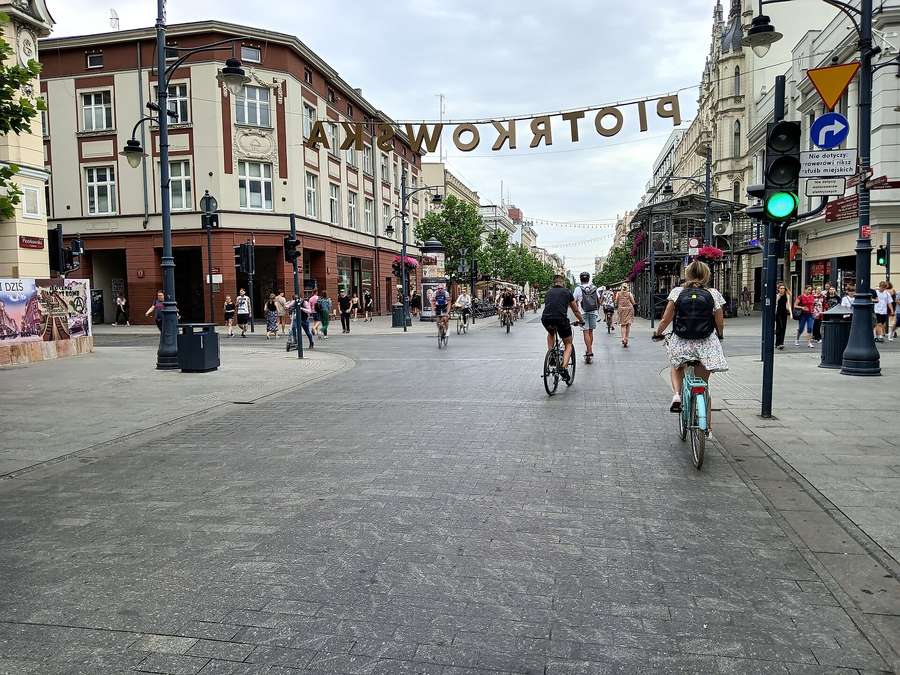
Start where the city starts: ulica Piotrkowska, the long pedestrianised promenade that is Łódź's spine, lined with ornate tenement facades, courtyards, bars and public art. The city's official tourism portal lists the highlights along it: the Walk of Fame stars set into the pavement honouring Polish film greats, the Rose Passage courtyard covered wall to wall in a mosaic of mirrored rose fragments, the OFF Piotrkowska post-industrial courtyard complex of independent fashion, food and bars in a former cotton mill, and the Central Museum of Textiles at the street's northern end.
Do it slowly. Duck through gateways into the decorated courtyards, look up at the restored facades, and stop for coffee in one of the former factory showrooms. The street carries the city's film identity too: Łódź is the home of Poland's famous film school, the pavement stars and handprints celebrate directors and actors who studied or shot here, and many of the tenements you pass have appeared on screen standing in for other cities. In the evening, Piotrkowska is where the whole city goes out, and OFF Piotrkowska's food-truck courtyard and cocktail bars are the liveliest corner of it. If rain moves in, the Central Museum of Textiles in the white classicist White Factory building covers the craft that built the city, from looms to contemporary fabric art.
Data source: Łódź Tourism Organisation, Piotrkowska Street page (lodz.travel), checked 22 October 2026.
Day one, late afternoon: Manufaktura
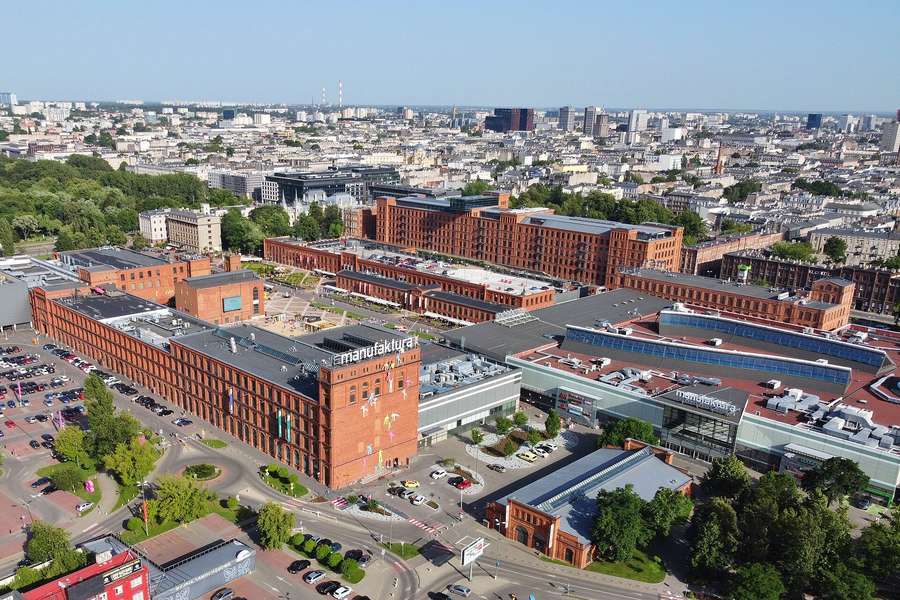
Fifteen minutes on foot from mid-Piotrkowska, Manufaktura is the vast former Izrael Poznański textile complex, rows of red-brick mills and a neo-Renaissance fire station rebuilt into a shopping, dining and culture centre around a long public square with fountains. Even if you never go inside a shop, the brick architecture, the view across the complex from the upper galleries and the evening illumination justify the walk.
Across the street from the mills, the neo-baroque Poznański Palace, the factory owner's former residence, gives some sense of the fortunes the industry produced; its mirrored ballrooms and winter garden now host the Museum of the City of Łódź.
Inside the complex sits ms2, the branch of the Muzeum Sztuki devoted to 20th- and 21st-century art, with one of Europe's oldest collections of avant-garde art, begun in the 1930s with donations from artists themselves. The collection's heart is the Neoplastic Room, a reconstructed display designed in 1948 by Władysław Strzemiński, and the galleries around it trace how that radical beginning connects to art being made now. The permanent collection exhibition costs 20 zł normal and 10 zł reduced, and visitors aged 8 to 26 pay a symbolic 1 zł. A 50 zł two-day pass (25 zł reduced) covers all three branches of the museum, and entry is free every Friday. ms2 is closed on Mondays and otherwise opens Tuesday to Wednesday 9:00 to 16:00, Thursday 12:00 to 18:00, Friday 12:00 to 20:00 and weekends 12:00 to 18:00.
Data source: Muzeum Sztuki w Łodzi, ms2 page with price list and hours (msl.org.pl), checked 22 October 2026.
Day two morning: Księży Młyn
South of the centre, Księży Młyn is a complete preserved 19th-century factory estate: a brick spinning mill, rows of workers' houses, a school, a fire station and the Herbst villa, all laid out as a self-contained industrial town within the city. It is free to wander, wonderfully photogenic in autumn light, and doubles as a film set; scenes from countless Polish films have been shot on its cobbles. Look for the pattern in the streetscape: the taller chimneys and the mill at its core, the identical brick workers' houses in rows, the slightly grander foremen's villas, and the factory owner's residence presiding over it all, a whole hierarchy of industrial society legible in one short walk. Combine it with a stroll through the neighbouring Scheibler estate at Księży Młyn's southern edge for the full scale of Łódź's textile past, then loop back towards the centre.
Day two afternoon: the Orientarium at Zoo Łódź
The Orientarium, Zoo Łódź's huge South-East Asia themed complex, is the city's standout family attraction: a domed oceanarium where you walk an underwater tunnel beneath sharks, rays and sea turtles, with elephants, orangutans and Indian rhinos in the surrounding pavilions and outdoor grounds. In the autumn schedule announced for the season, the Orientarium pavilion is open 9:00 to 17:00, the outdoor zoo grounds 9:00 to 15:30, and ticket offices close at 16:00.
A normal ticket is 90 zł and a reduced ticket 65 zł. Holders of the Łódź Large Family Card pay 295 zł for a 2+3 family at the box office, with each additional child 55 zł. A combined ticket covering the Orientarium and Aquapark Fala next door costs 115 zł, a strong option for a rainy afternoon: you visit the zoo first, then collect a paper aquapark ticket at its desk. Buy tickets online in advance at weekends to skip the box-office queue.
Data source: Orientarium ZOO Łódź official price list and autumn hours notice (orientarium.lodz.pl), checked 22 October 2026.
Food and practical notes
Łódź eats well and cheaply by big-city standards. The reliable pattern: lunch from the food trucks and stalls at OFF Piotrkowska, dinner in one of the restaurants under the Manufaktura brickwork, and a pierogi or zapiekanka stop somewhere along Piotrkowska in between. Vegetarians and vegans do unusually well here for a Polish city, and the coffee scene around OFF and the side streets off Piotrkowska is strong. Card payment is universal, English is widely spoken in the centre, and weekend accommodation clusters around Piotrkowska and Manufaktura. The city is compact: Piotrkowska, Manufaktura and Fabryczna station form a walkable triangle, and only Księży Młyn and the zoo really call for a tram. Łódź also makes an easy add-on to a Warsaw stay: leave after breakfast, see the essentials, and be back for dinner if a full weekend is too much.
A realistic weekend plan
Saturday: morning train to Łódź Fabryczna, walk to Piotrkowska, slow promenade north through the Walk of Fame and the courtyards to OFF Piotrkowska for lunch, then Manufaktura and ms2 (free on Fridays, late opening until 20:00) before dinner among the bricks. Sunday: Księży Młyn in the morning, tram out to the Orientarium for the early afternoon, then the train home. In winter, swap Księży Młyn for the Central Museum of Textiles or an extra hour in ms2. If you are based in Łódź already, the same plan splits naturally into an architecture half and a family half.
Frequently asked questions
How long is the train from Warsaw to Łódź?
The fastest IC Esperanto services take 58 minutes between Łódź Widzew and Warszawa Zachodnia, and 1 hour 12 minutes between Łódź Fabryczna and Warszawa Centralna, according to PKP Intercity. Other services run throughout the day.
How much does the Orientarium at Zoo Łódź cost?
Normal tickets are 90 zł and reduced 65 zł; a Łódź Large Family Card 2+3 ticket is 295 zł, and a combined ticket with Aquapark Fala is 115 zł. In the autumn schedule the pavilion is open 9:00 to 17:00 and ticket offices close at 16:00.
Is the ms2 art museum free?
Entry to ms2 is free every Friday. Otherwise the permanent collection costs 20 zł normal and 10 zł reduced, visitors aged 8 to 26 pay 1 zł, and a 50 zł two-day pass covers all three Muzeum Sztuki branches. The museum is closed on Mondays.
What is Manufaktura?
A former 19th-century textile factory complex rebuilt as Łódź's main shopping, dining and culture centre, with the ms2 art museum inside, a short walk from Piotrkowska Street.
Is Łódź worth a full weekend, or just a day trip?
Both work. A day trip covers Piotrkowska, Manufaktura and ms2; a weekend adds Księży Młyn and the Orientarium without rushing. Trains back to Warsaw run into the evening, so even the day trip can be unhurried.
Is Łódź a good weekend with children?
Yes. The Orientarium's underwater tunnel is the headline for most children, Aquapark Fala next door works in any weather with the 115 zł combined ticket, and Manufaktura's open squares, fountains and seasonal attractions give plenty of room to run around. * Photos: Cover - aerial view of the Manufaktura complex by Kapitel, CC BY-SA 4.0, via Wikimedia Commons. Body - Piotrkowska Street by WrS.tm.pl, public domain, via Wikimedia Commons.