Medical devices on NFZ order in Poland: crutches, wheelchairs, braces
Short answer: Get an order from a doctor or other authorised person, have it confirmed, and fill it at any shop with an NFZ contract. It is valid up to 12 months, and you pay any price above the limit.
Crutches, a wheelchair, an orthopaedic brace, incontinence products or ostomy supplies can be partly paid for by the National Health Fund (NFZ) in Poland. The state calls them medical devices issued on order (wyroby medyczne wydawane na zlecenie). This guide explains how the system works, based on the NFZ patient page "Zaopatrzenie w wyroby medyczne" and an NFZ notice dated 2 January 2024. The patient page carries no visible publication date, so treat it as a description of the general rules and confirm current limits with NFZ or the supplier.
What counts as a medical device here
The NFZ page gives these examples: prostheses, orthopaedic appliances and braces (ortezy), wheelchairs, walking sticks, crutches, walkers, orthopaedic footwear, infusion sets for personal insulin pumps, incontinence products (pieluchomajtki), catheters and ostomy equipment. The page states that patients are entitled to reimbursement of such devices.
The exact list, the price limits and the share you pay yourself are set in a regulation of the Minister of Health on the list of medical devices issued on order. The NFZ page cites the regulation of 29 May 2017 as the legal basis. An NFZ notice of 2 January 2024 adds that from 1 January 2024 an amending regulation of 13 October 2023 (Dz.U. 2023 poz. 2461) introduced a new numbering of devices by codes, added new devices and changed some financing limits and patient shares, including for prostheses, orthoses, absorbent products and ostomy equipment.
Step 1: get an order (zlecenie)
You cannot just walk into a medical supply shop and claim reimbursement. First you need an order. The NFZ page says it is most often issued by a doctor, but a nurse, midwife, physiotherapist or another authorised person can issue it too. The order has to be confirmed. Since 1 January 2020 the confirmation can be given by the doctor or other person entitled to issue the order or, if they cannot do it, by any NFZ branch.
To be entitled to reimbursement you need the right to NFZ-funded care, as with any other service. If you are an expat, see the guide on health insurance for foreigners on this site.
How long the order is valid
According to the page, an order can be issued for at most 12 months. Some products are due monthly, for example incontinence products. An order for these can be issued for longer than one month and you can fill it in parts. You cannot collect products for months that have already passed.
Step 2: choose where to buy
You buy the device in a point that has a contract with NFZ for this service. These are most often medical supply shops and pharmacies. There is no regional restriction, so you choose where to go. If you split the order into parts, each part has to be filled in the same place where you left the order.
Step 3: pay the difference
The page says products differ in price and quality. You may choose a device that costs more than the reimbursement limit and pay the difference between the gross price and the reimbursed amount. Every contracted point has to offer at least one product in each group at the price of the limit set in the regulation. So a product fully within the limit should be available, although you may pay your own share of the limit where the regulation sets one.
What the supplier checks
In a notice to providers, NFZ reminds them that when they accept an order they must check that the period in which it can be filled has not expired, and the patient's age where it affects the financing limit. They also record how the patient's right to care was confirmed and whether the patient has any additional entitlements. For the patient this means: bring your ID and the order, and expect the shop to ask for them.
What the sources do not say
The NFZ pages do not list current limits or patient shares for individual devices, and they do not discuss foreigners or people without NFZ cover. They do not say how long a shop may take to deliver a device made to measure. Ask the supplier for the code of the product, the limit and your share before you pay.

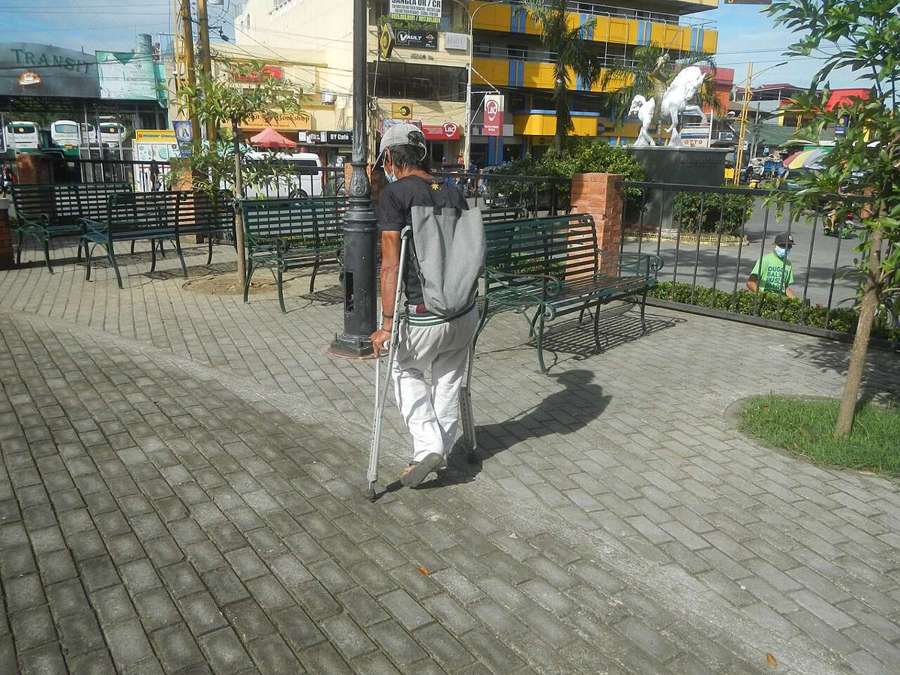
* Photos: illustrative images from Wikimedia Commons (CC0): people with crutches in the Philippines and a wheelchair silhouette, not Poland.
Frequently asked questions
Who issues the order for a wheelchair or crutches in Poland?
According to NFZ, most often a doctor. A nurse, midwife, physiotherapist or another authorised person can also issue it. The order must then be confirmed by the doctor or other entitled person, or by an NFZ branch.
How long is the order valid?
At most 12 months. Products due monthly, such as incontinence products, can be ordered for longer and filled in parts, but not for months that have already passed.
Can I buy a more expensive device than the reimbursement covers?
Yes. The NFZ page says you can choose a device above the limit and pay the difference between its gross price and the reimbursed amount.
Do I have to buy in my home region?
No. NFZ says there is no regional restriction, but the shop must have a contract with NFZ. If you split the order, fill every part in the shop where you left it.