Moving to Poland as a Gay Expat: A Practical Guide
The essentials: Poland's big cities are liveable for LGBTQ+ expats: visible communities, workplace non-discrimination, and support groups like Lambda Warszawa. But no partnership recognition means planning: an independent residence basis for your partner, wills and powers of attorney, and documents apostilled and translated.
Every year, thousands of LGBTQ+ foreigners move to Poland for work, study or love - and most find a reality far more liveable than the headlines suggest. Poland's big cities have visible queer communities, anti-discrimination protection at work, and support organizations that have run for decades. At the same time, the legal gaps are real: no partnership recognition, thinner protections outside employment, and pockets of hostility you should know how to navigate. This is the practical guide: residence, cities, community, safety and the paperwork that protects your relationship. Legal details are covered in our LGBTQ+ rights overview and our explainer on same-sex marriage in Poland; here we focus on the move itself.
Residence and paperwork: plan the route before you pack
Your immigration route matters more in Poland than in Western Europe, because the family-reunification shortcut mostly does not exist for same-sex couples. A non-EU national married to a Polish citizen cannot claim a residence card "due to marriage" - Polish law does not recognize the marriage. The workable routes are employment, study, business activity, or the EU free-movement route when your spouse is an EU citizen (the CJEU's Coman judgment obliges Poland to recognize your marriage for residence purposes in that configuration).
The practical checklist: bring your birth certificate and, if married, your marriage certificate, each with an apostille; commission sworn (przysięgły) translations into Polish once you arrive; and keep both digital and paper copies - you will present them at the voivodeship office, the bank, the tax office and your employer. If you are trans, bring documentation of any legal gender change from your home country; changing Polish civil records is possible through a court procedure, reformed by a Supreme Court resolution of 4 March 2025 so that applicants no longer have to sue their parents. Data source: Supreme Court of Poland, III CZP 6/24, checked 22 October 2026.
Choosing your city
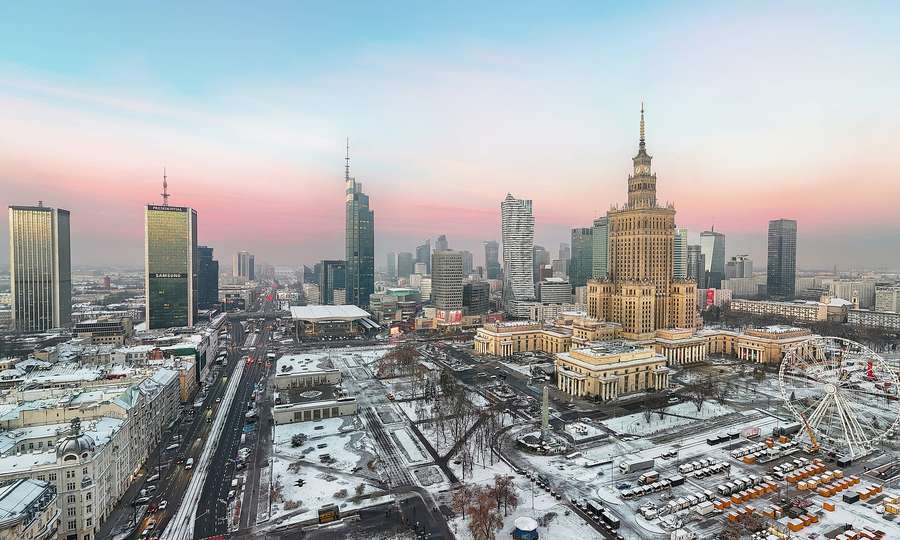
Warsaw is the default for a reason: the largest community, the most venues, most international employers, and the country's biggest Equality Parade - on 14 June 2025 thousands marched through the city center under the slogan "Love is the answer," with the mayor attending and the event anchored by the Equality Town fair at Park Świętokrzyski. Data sources: Radio ESKA and TVP World coverage of the 2025 parade, checked 22 October 2026.
Kraków, Wrocław, Gdańsk, Poznań and Łódź each run their own equality marches and have active scenes at a lower cost of living. Smaller cities and rural areas are a different calculation: socially more conservative, with little visible community. Most LGBTQ+ expats who land outside the big six either commute their social life to the nearest big city or relocate within a year. Our comparison of Warsaw and Kraków for LGBTQ+ expats goes deeper on that choice.
Finding your people
The community infrastructure is older than most newcomers expect. Lambda Warszawa, founded in 1997, runs a confidential support line (+48 22 628 52 22, Monday to Friday 18:00-21:00), crisis shelter and intervention support for LGBTQ+ people in Warsaw, and anti-discrimination training. Kampania Przeciw Homofobii (KPH) is the national advocacy and support organization. Miłość Nie Wyklucza focuses on families and marriage equality, and Tranzycja.pl maintains a Poland-wide list of support contacts for trans people, including the Grupa Nieustającej Pomocy peer network. Young people can use the 24/7 youth helpline 116 111. Data sources: Lambda Warszawa, KPH, Miłość Nie Wyklucza and Tranzycja.pl support pages, checked 22 October 2026.
Beyond formal organizations, community forms around venues - cafés, bars and clubs that double as social infrastructure - and around annual events. June is parade season across the big cities; arriving in late spring times your landing to the easiest month of the year to meet people. Facebook and Instagram groups (city-specific LGBTQ+ and queer-expat groups) are where informal meetups, housing shares and party announcements actually live.
Housing and neighborhoods
Renting is straightforward and largely indifferent to who you are: listings are handled through portals and agencies, and landlords care about income and deposits, not relationships. In Warsaw, LGBTQ+ life clusters around the center - Śródmieście, and especially the streets around Plac Zbawiciela and Plac Trzech Krzyży - but there is no formal gayborhood and no need for one; the scene is distributed. Couples should know that a lease in one partner's name gives the other no occupancy rights if the relationship ends, so put both names on the contract where the landlord agrees. Typical deposits run one month's rent, and agency fees (when charged) another month.
Work and money
Poland's Labour Code prohibits discrimination in employment on grounds including sexual orientation - hiring, terms, promotion and dismissal - and this protection has teeth in the courts. In practice, international companies and the tech sector in Warsaw, Kraków and Wrocław operate openly inclusive cultures, complete with employee resource groups; smaller local firms vary more. Discretion at interview stage is common and not required anywhere by law.
Salaries are lower than in Western Europe but so are living costs; a foreign salary or remote contract goes far. One budgeting note for couples: because you cannot file taxes jointly or access spousal benefits, plan finances as two single people - separate tax returns, individual health insurance arrangements, and no survivor pension.
Safety and daily life on the ground
Violent incidents are rare in the big cities, but they happen, and verbal harassment exists. Standard urban caution applies: parade days draw counter-demonstrators (kept apart by police), and public affection is generally unremarkable in central Warsaw and Kraków but can draw attention in small towns and on late-night public transport. Emergency number is 112; assault is a crime regardless of motive, and Lambda Warszawa's intervention support helps victims navigate reporting.
The honest summary from community surveys and our readers: day-to-day life for LGBTQ+ people in Warsaw or Kraków feels closer to Prague than to the worst-case picture foreign media painted during the "LGBT-free zone" years. Those municipal resolutions - around one hundred between 2019 and 2021 - have all been repealed as of 2025, a change tracked in the ILGA-Europe Rainbow Map. Data source: KPH / Rainbow Map 2025, checked 22 October 2026.
Protecting your relationship without legal status
Because your partnership has no automatic standing, build the paper shield before you need it: wills for both partners (otherwise family inherits), notarized powers of attorney for medical and financial decisions, a cohabitation agreement for shared property, and named beneficiaries on insurance and pension products. A Polish notary can assemble the bundle in one appointment for a few hundred złoty - the cheapest insurance you will buy here.
Your first 90 days: a checklist
1. Secure your residence basis (work, study or EU free-movement) and start the card application early - voivodeship offices have backlogs. 2. Register your address (meldunek), get a PESEL, open a bank account, buy health insurance or confirm NFZ coverage through employment. 3. Translate and apostille your civil documents. 4. Set up wills and powers of attorney if you have a partner. 5. Connect: follow Lambda Warszawa, KPH and your city's LGBTQ+ groups; put the June parade on your calendar. 6. Save the numbers: 112 for emergencies, +48 22 628 52 22 for Lambda's support line.
Healthcare basics on arrival
Register with the NFZ public system through your employer or buy private coverage; both routes work normally for LGBTQ+ patients. Two specifics: PrEP is available in Poland by private prescription, and sexual-health testing runs through the national network of anonymous, free consultation points (PKD) - our guide to discussing STI testing in Poland lists the Warsaw locations and hours. A dedicated roundup of LGBTQ+ healthcare resources follows in this series. Mental-health support with English-speaking, affirming therapists is easiest to find through Lambda Warszawa's referrals and the big-city private clinics.
Learning the language - and why it matters here
English carries you far in Warsaw's international bubble, but the community itself socializes in Polish. Even basic Polish changes how you are received at venues and events, and it is near-essential for dealing with the voivodeship office, notaries and doctors. City universities and private schools run intensive courses year-round; many employers fund them. Treat the first six months of classes as part of the relocation budget, not an optional extra.
Frequently asked questions
Is Poland safe for gay expats?
In the big cities, yes for daily life - communities, venues and parades operate openly, and workplace discrimination is illegal. Exercise ordinary caution at night and in smaller towns; violent incidents are rare but reported. Emergency number is 112.
Can my same-sex partner get a visa through me?
Only via the EU free-movement route (you are an EU citizen) - not through Polish family reunification, which does not recognize same-sex relationships. Otherwise your partner needs an independent basis such as work or study.
Do I need to hide my orientation at work?
No law requires or encourages that. The Labour Code bans sexual-orientation discrimination in employment, and international employers in the big cities run openly inclusive workplaces. Discretion in small local firms is a personal judgment, not a legal necessity.
Where should I live as an LGBTQ+ expat in Poland?
Warsaw first for community and jobs; Kraków, Wrocław, Gdańsk, Poznań or Łódź for a smaller-city feel with an active scene. Small towns offer little visible community.