All Saints’ Day in Poland: An Expat’s Guide to 1 November
The essentials: All Saints’ Day (1 November) is a statutory holiday when Poles visit graves with znicze lanterns and chrysanthemums. In 2026 it falls on a Sunday: shops closed, no extra day off, and 2 November is a normal working Monday.
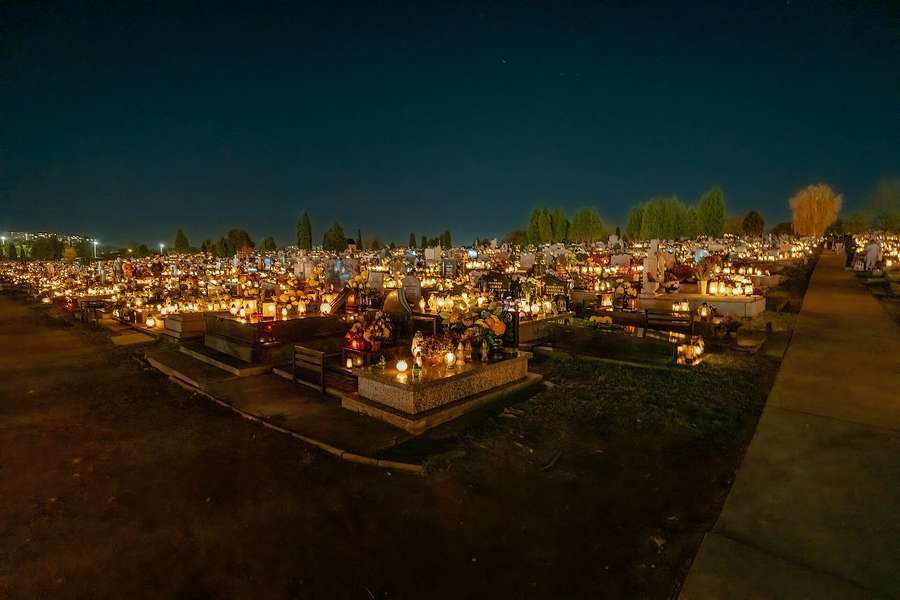
On the evening of 1 November, Polish cemeteries turn into fields of light. Millions of people visit family graves, light znicze lanterns and lay chrysanthemums in one of the country's most deeply held traditions - Catholic in origin, national in practice, observed by believers and secular Poles alike. For expats it is a spectacular, moving, and occasionally confusing weekend: shops shut, traffic reroutes around cemeteries, and a set of unwritten etiquette rules applies. Here is what the day is, what closes, and how to take part respectfully. For Warsaw's special cemetery transport, see our All Saints transport guide.
What the day is - and what it is not
Wszystkich Świętych (All Saints' Day, 1 November) is a statutory public holiday: it appears in the 1951 Act on Days Off Work (consolidated text Dz.U. 2025 poz. 296) among Poland's thirteen public holidays. The following day, 2 November - Zaduszki, All Souls' Day - is the religious day of prayer for the dead but is not a public holiday: a normal working Monday in 2026, with shops and offices open as usual. In practice Poles treat the whole stretch from 31 October to 2 November as one remembrance season, and many cemeteries stay busy all three days. Data sources: Dz.U. 2025 poz. 296 (act text), dlahandlu.pl 2026 trading calendar, checked 22 October 2026.
One quirk for 2026: 1 November falls on a Sunday. A holiday that lands on a Sunday is simply spent - Polish labour law grants a compensatory day only when a holiday falls on a day off resulting from the five-day working week (typically a Saturday), not on a Sunday. So no extra Monday off this year: Monday 2 November is a full working day. Data source: TVN24 Biznes labour-law explainer, checked 22 October 2026.
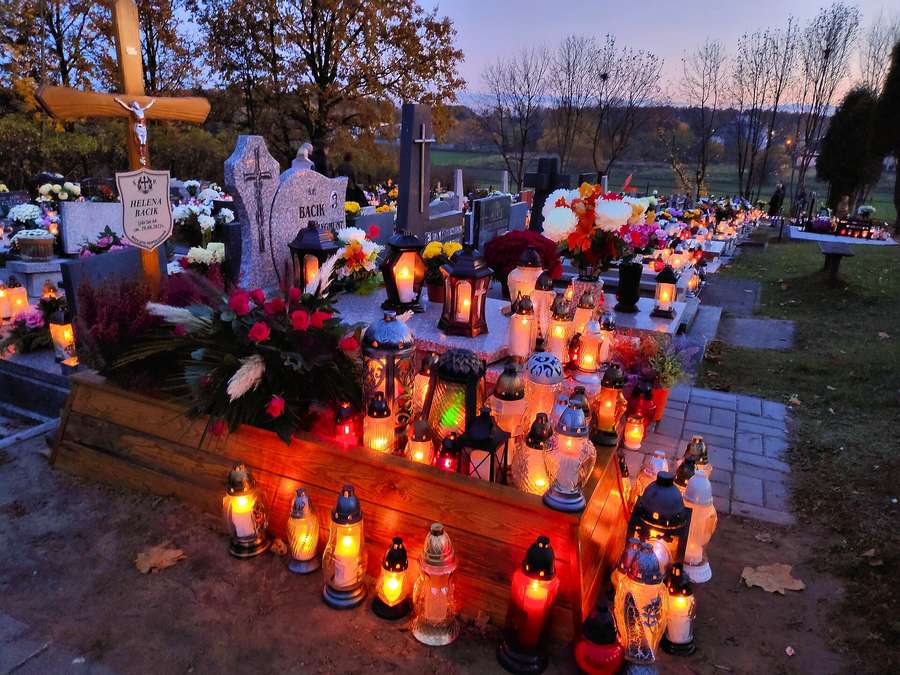
The customs: graves, lanterns, chrysanthemums
The rhythm of the day is simple. Families tidy the grave in the preceding days, then visit on 1 November - often several cemeteries across the city or between towns, which is why the roads around every cemetery clog. On the grave go chrysanthemums (the flower of the season - buying your host roses in early November is the expat mistake everyone makes once) and znicze, the glass grave lanterns that burn for days. At dusk the effect is extraordinary: Powązki in Warsaw, Rakowicki in Kraków and every parish cemetery in between glow from horizon to horizon.
The day is communal, not sombre in the Western sense - more family reunion at the graveside than mourning. You will see three generations standing at one grave, candles being relit, children trusted with matches, and strangers lighting lanterns on the graves of the forgotten - a common and respected gesture, especially at soldiers' and victims' plots. Many cemeteries hold a collective prayer or a short ceremony at a central cross in the afternoon.
Cemetery etiquette for expats
The rules are unwritten but firm:
- Dress quietly. Dark, subdued clothing is the norm; nobody will police a bright coat, but the crowd reads as a sea of black and grey.
- Keep the volume down. Phone calls are taken outside the gate; conversations stay hushed; music from speakers is unthinkable.
- Ask before photographing people. The candlelit vistas are irresistible and photographing the *scene* is accepted - you will see hundreds of phones out - but close-ups of strangers at a grave are not.
- Walking on graves is a genuine offence to Poles. Stay on the paths, mind the low chains and stone borders.
- A candle is always welcome. If invited to join a family visit, bringing one znicz (sold at every cemetery gate for a few złotys) is the right move; lighting it at the grave is yours to do.
- Cash for the gate. Flower and lantern stalls, and often cemetery charity collections, are cash operations.
The scale of it - and why the whole country moves
No Polish holiday except Christmas moves as many people. The tradition reaches beyond churchgoing: the overwhelming majority of Poles visit graves over these days, including many of the non-religious, because the day is as much about family memory as doctrine. The practical signature is a double migration - people driving to hometowns and then across town to second and third cemeteries - which is why intercity trains sell out for the Friday before, why the PKP timetable grows extra carriages, and why "are you going anywhere for Wszystkich Świętych?" is the standard late-October small talk. For an expat, the kindest scheduling advice of the season is simply: do not book anything demanding against this weekend, and if friends vanish to their hometowns, that is the tradition working as designed.
The vocabulary you will hear
A few words decode the weekend. Znicz (plural znicze) is the grave lantern itself. Wieńce i wiązanki are the wreaths and flower arrangements at the gate stalls. Kwesta is the charity collection you may meet at cemetery entrances - volunteers raising money for the cemetery's upkeep or a cause, and a few coins are the custom if you take a sticker or a candle. Grób nieznany marks graves of the unknown or forgotten, the right place for a stranger's candle. And święto zmarłych - "the feast of the dead" - is how people actually refer to the day in speech, a name that captures the mood better than any translation: not Halloween's carnival of death, but a quiet, light-filled act of keeping company with it.
What is closed, what stays open
Because 1 November 2026 is both a statutory holiday and a Sunday, the Sunday-trading ban (Act on Restricting Trade on Sundays and Holidays, consolidated text Dz.U. 2025 poz. 301) applies with full force: supermarkets, discounters and shopping centres are closed. The statutory exceptions matter more than usual this weekend - the act explicitly exempts:
- stalls selling flowers, wreaths and znicze at cemeteries (a dedicated exemption), and shops whose main trade is flowers;
- pharmacies and pharmacy points;
- petrol stations, small shops run personally by their owner (many Żabka-style franchises operate this way), bakeries and patisseries, and restaurants and cafés.
So: do your food shopping by Saturday 31 October - and do it early, because that Saturday is one of the busiest grocery days of the Polish year. The candle-and-flower economy at the cemetery gates runs at full tilt throughout. Data source: Dz.U. 2025 poz. 301, art. 6 exemptions, checked 22 October 2026.
Getting around: the year's biggest traffic weekend
The days around 1 November bring Poland's biggest coordinated transport operation outside Christmas. Municipal operators lay on special cemetery lines and free services: Warsaw publishes a full WTP plan with dozens of extra routes, Szczecin runs its tram and bus cemetery network from 24 October to 2 November, and several cities - Łódź, Poznań, the GZM conurbation, Bydgoszcz and Toruń among them - make cemetery transit free on the day. Our Warsaw cemetery transport guide and Szczecin guide have the details. Driving to a big cemetery means road closures and parking bans in the surrounding streets - take the special lines; they exist precisely because cars do not fit. On the intercity roads, police run their annual safety operations and the Friday and Sunday peaks are heavy: plan long drives outside the Friday-afternoon and Sunday-evening waves.
Halloween vs All Saints: the two nights coexist
Expats are often surprised that Poland now runs both. Halloween (31 October) is a commercial import - costumes, parties, pumpkin displays in the malls - popular with children and young adults but regarded by many older Poles as a foreign intrusion into a sacred weekend. All Saints is the real thing. The practical consequence: costume parties happen on the Friday and Saturday nights, and by Sunday the country is at the cemetery. If you are invited to a Polish home over this weekend, the register is remembrance, not spooky fun - save the costume for Friday.
A good first All Saints as an expat
If you have no family grave in Poland, the tradition still has a door open for you. Go at dusk to one of the great cemeteries - Powązki in Warsaw, Rakowicki in Kraków - walk the main avenues, and if you feel moved, buy a znicz at the gate and light it at one of the collective graves: the unknown soldiers, the Warsaw Uprising plots, the graves "of the forgotten" that every large cemetery maintains. Nobody will find it strange; Poles do exactly this. It is the single best hour of the Polish year to understand something essential about the country you live in.
If a death happens to someone you know
The season is also when expats first meet Polish mourning customs directly. If a colleague or friend loses someone near these days, the conventions are: a condolence message is expected and short is fine; funeral attire is black; flowers come in even numbers for funerals (odd numbers are for the living) - chrysanthemums accepted at the grave but not as a host gift; and the cemetery visit on 1 November is when acquaintances, not only family, traditionally pay respects. Knowing this turns an awkward season into one where you can actually show up correctly for the people around you.
Frequently asked questions
Is 2 November (All Souls' Day) a day off in Poland?
No. Zaduszki is observed religiously but is a normal working day - in 2026, a regular Monday with shops open. Only 1 November is a statutory holiday.
Are shops open on 1 November 2026?
No - it falls on a Sunday, so both the holiday and the Sunday trading ban apply. Exceptions: cemetery flower and lantern stalls, florists, pharmacies, petrol stations, owner-run small shops, bakeries and restaurants.
Can I take photos in a Polish cemetery on All Saints' Day?
Photographing the candlelit scenery is widely accepted - everyone does it. But avoid close-ups of identifiable people at graves without asking, and keep the register respectful: no selfie-stick performances at the graveside. * Photos: Krzysztof Popławski (CC BY 4.0), Marek Ślusarczyk/Tupungato (CC BY 3.0), via Wikimedia Commons.