Mrągowo Museum: Free Tuesdays, Winter Mondays and Lift Access
The essentials: Muzeum w Mrągowie opens Monday-Saturday 09:00-16:00 from September to June, with the ticket office closing at 15:30 and Sundays closed. Entry is 15/10 PLN; permanent exhibitions are free on Tuesdays. The January 2025 report records a lift but one inaccessible western room.
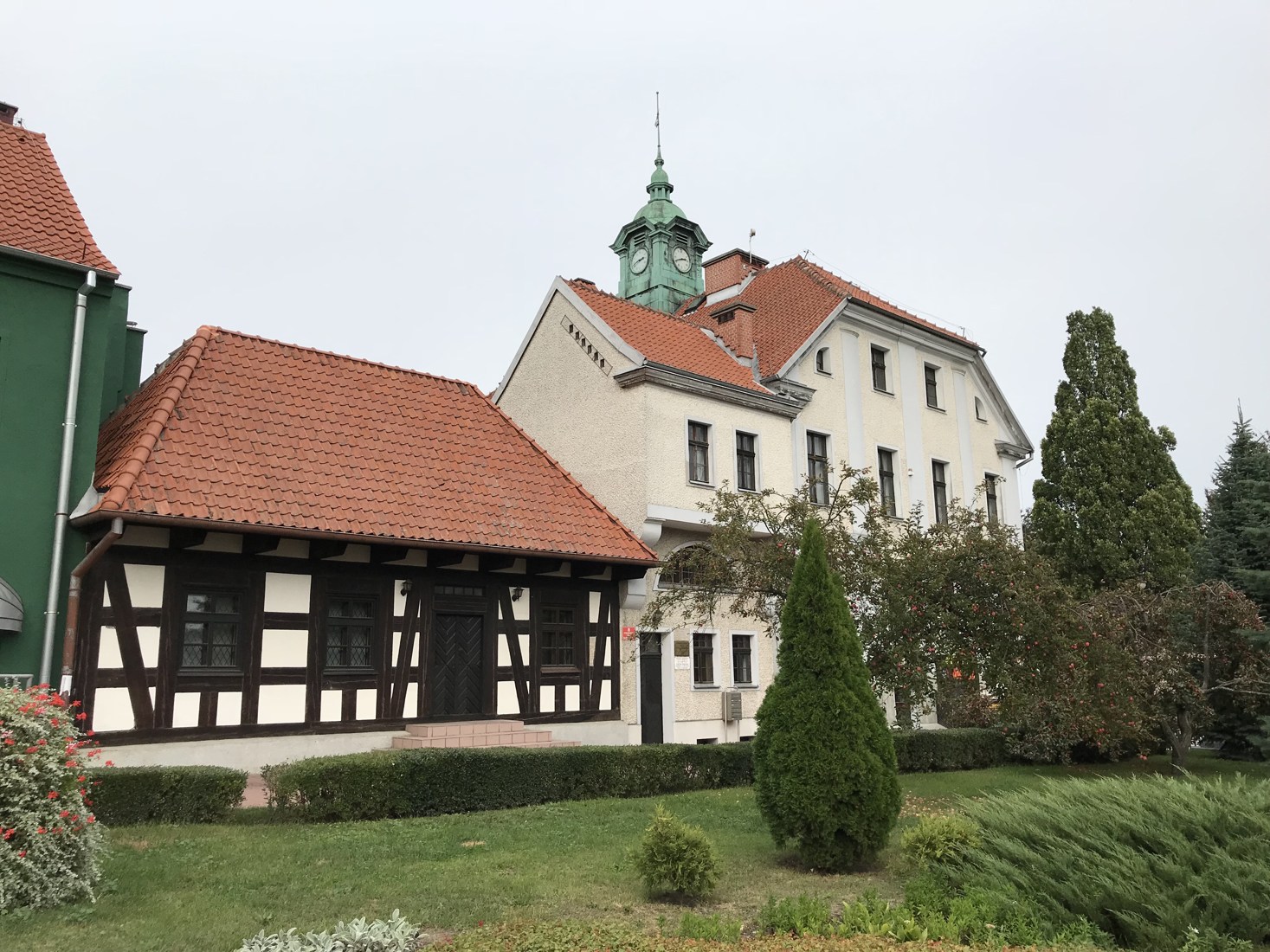
Cover: the watchhouse and town hall in Mrągowo, photographed on 11 September 2018. Archival view, not current conditions or a statement about entrances. Photo: Lesnydzban / Wikimedia Commons, CC BY-SA 4.0. Resized and recompressed under the same licence.
Mrągowo's town-hall museum is a good reason to look beyond the town's summer image. The main historical exhibition starts with prehistoric finds and follows the surrounding lake district into more recent history. For a winter visitor, the practical surprise is the weekly timetable: Monday is normally open, while Sunday is closed. That is different from the familiar Tuesday-Sunday pattern at many Polish museums.
Muzeum w Mrągowie is at ul. Ratuszowa 5. This guide uses the operator's hours and tariff, its exhibition description, local tourism information and the branch-specific accessibility report, checked on 28 November 2026. It separates an ordinary museum visit from older events still visible online, and dates the access evidence rather than promising that a lift is working today.
September-June: visit Monday-Saturday, not Sunday
From 1 October to 30 June, the published opening hours are Monday-Saturday 09:00-16:00. Sunday is closed. The ticket office is open 09:00-15:30, so do not use 16:00 as your latest arrival time. Give yourself enough time before the ticket-office cutoff to see the exhibition rather than rushing through the rooms.
The operator lists September separately, but with the same practical pattern: Monday-Saturday 09:00-16:00, ticket office until 15:30, Sunday closed. For an ordinary visit, that means the Monday-Saturday schedule runs from September through June. The separate September heading does not mean that July-August Sunday opening continues into early autumn.
In July and August, the pattern changes to Tuesday-Sunday 10:00-17:00, with tickets sold 10:00-16:30. Monday is closed. This is worth checking before making a weekend plan: a winter Sunday is not a substitute for a summer Sunday, and a summer Monday is not a substitute for a winter Monday.
Holiday dates can override the weekly timetable. The operator's 2026 calendar lists closures on 24, 25, 26 and 31 December, among other dates. Check the current branch page before travelling over a holiday. The tariff page also carries a notice about a closure on 8 December, but that page was last updated in December 2025 and does not establish a closure on 8 December 2026. Do not move an old undated notice into a new year's itinerary.
Admission, free Tuesdays and family combinations
The published tariff lists a normal ticket at 15 PLN and a reduced ticket at 10 PLN. A family ticket is 30 PLN for the combinations 2+1 or 1+2, and 40 PLN for 2+2, 2+3 or 1+3. Ask the ticket office how it defines the family combinations and what documents a reduced-ticket holder needs. The table alone does not settle every age or eligibility question.
Tuesday is the free-entry day for permanent exhibitions. Temporary exhibitions cost 8 PLN on that day. This is a useful option if the permanent historical exhibition is your main reason for coming, but it is not a promise that every exhibition, lesson or workshop is free. Confirm what is actually open and what a separate ticket covers.
The tariff says families holding Poland's nationwide Large Family Card are entitled to a 50% admission reduction at the museum and its branches. It does not explain every interaction with the family-ticket combinations. Bring the card and let the ticket office identify the applicable price rather than assuming that several reductions can be added together.
Polish-language guiding is listed at 70 PLN. The table does not clearly say whether admission is included, and it does not verify an English-language tour or an English price. If guiding matters, ask about the language, group size, duration, availability and full total before you arrive. A guide fee on a tariff is not evidence of an on-demand tour departing throughout opening hours.
The main exhibition: from bone harpoons to regional history
The main exhibition is Mrągowo i ziemia mrągowska od zarania dziejów po czasy współczesne, roughly, Mrągowo and its surrounding region from the dawn of history to modern times. The museum's description was updated in January 2024, and the local tourism office identifies it as the principal permanent exhibition. Its scope reaches back to the tenth millennium BC and continues towards recent history.
Among the earliest objects named by the operator are bone harpoons from the areas of Piecki and Tłokowo. They offer a direct starting point for thinking about how people used this landscape long before the modern town existed. Instead of trying to memorize an entire chronology, choose an object and ask what material it uses, what work it performed and what it suggests about the environment around its maker.
The archaeological part occupies three exhibition rooms. The operator describes it as a major presentation of the Archaeology Department's collections from the Museum of Warmia and Masuria in Olsztyn. That is a useful expectation for the visit: this is not only a display of civic photographs or town-hall memorabilia. Archaeology is a substantial part of the route.
Roman contacts and the Nidajno deposit
The museum uses finds from the Roman-influence period to explain contact between local Baltic communities and more distant parts of Europe. Its description discusses Roman coins and bronze wine-drinking equipment, including a mixing vessel, tripod and drinking vessels. These objects help visitors think about exchange and status rather than treating the region as isolated from the wider world.
The operator singles out the deposit from Nidajno as a particularly important group of ornaments interpreted as offerings. It describes a collection numbering dozens of objects. For a first visit, the important question is how a group of objects ended up together and what evidence supports an interpretation of deliberate deposition. That is different from looking at a single attractive piece of jewellery without its archaeological context.
Use the museum's account as an introduction, not as a reason to seek out or disturb an archaeological site. The exhibition puts finds into a documented setting where their date, associations and interpretation can be explained. With children, comparing a practical tool, a coin and an ornament can make the different kinds of evidence easier to discuss.
A museum in the town hall, with an older watchhouse beside it
The current Polish-language branch history traces the institution through a regional historical room established in 1966, the creation of Muzeum Ziemi Mrągowskiej in 1969, and its change into a branch of the Olsztyn museum in 1975. The town's tourism office gives the same broad sequence and explains the move from the watchhouse to the town hall.
The city's official history dates the present town hall to 1825. It also identifies the neighbouring timber-framed Strażnica Bośniacka, commonly translated as the Bosnian Guardhouse, as an older building connected with the museum's history. The cover photograph shows both buildings in an archival September view. It is a location image, not proof that every pictured door is a museum entrance.
The city page describes a memorial room devoted to the writer Ernst Wiechert in the watchhouse. Do not assume that the town-hall ticket, opening hours or access arrangements automatically cover that separate space. Ask the museum whether it is open on your date if it is an important part of your plan. Seeing the watchhouse exterior is different from having a confirmed interior visit.
Accessibility: a lift helps, but one room had a barrier
The branch's official accessibility report describes the position as of 1 January 2025. It says a lift installed by the building owner in 2018 substantially improved access to the exhibition rooms. It also identifies one exhibition room in the western part of the building that still lacked an accessible route, while stating that the other rooms were accessible to people with particular needs.
That is more useful than either a blanket claim of full access or a blanket claim that the building cannot be visited. It is also dated information. Before travelling with a wheelchair, mobility aid or a specific access requirement, ask whether the lift is working, which room has the remaining barrier, and whether that room is part of the exhibition you want to see.
Confirm the entrance route, toilet arrangements and any assistance you need directly with the Mrągowo branch. The report records admission with an assistance dog, but the lift's installation date does not verify its current operation or dimensions. Nor should the town-hall report be silently extended to the separate watchhouse.
Add a lakeside walk only if the conditions suit
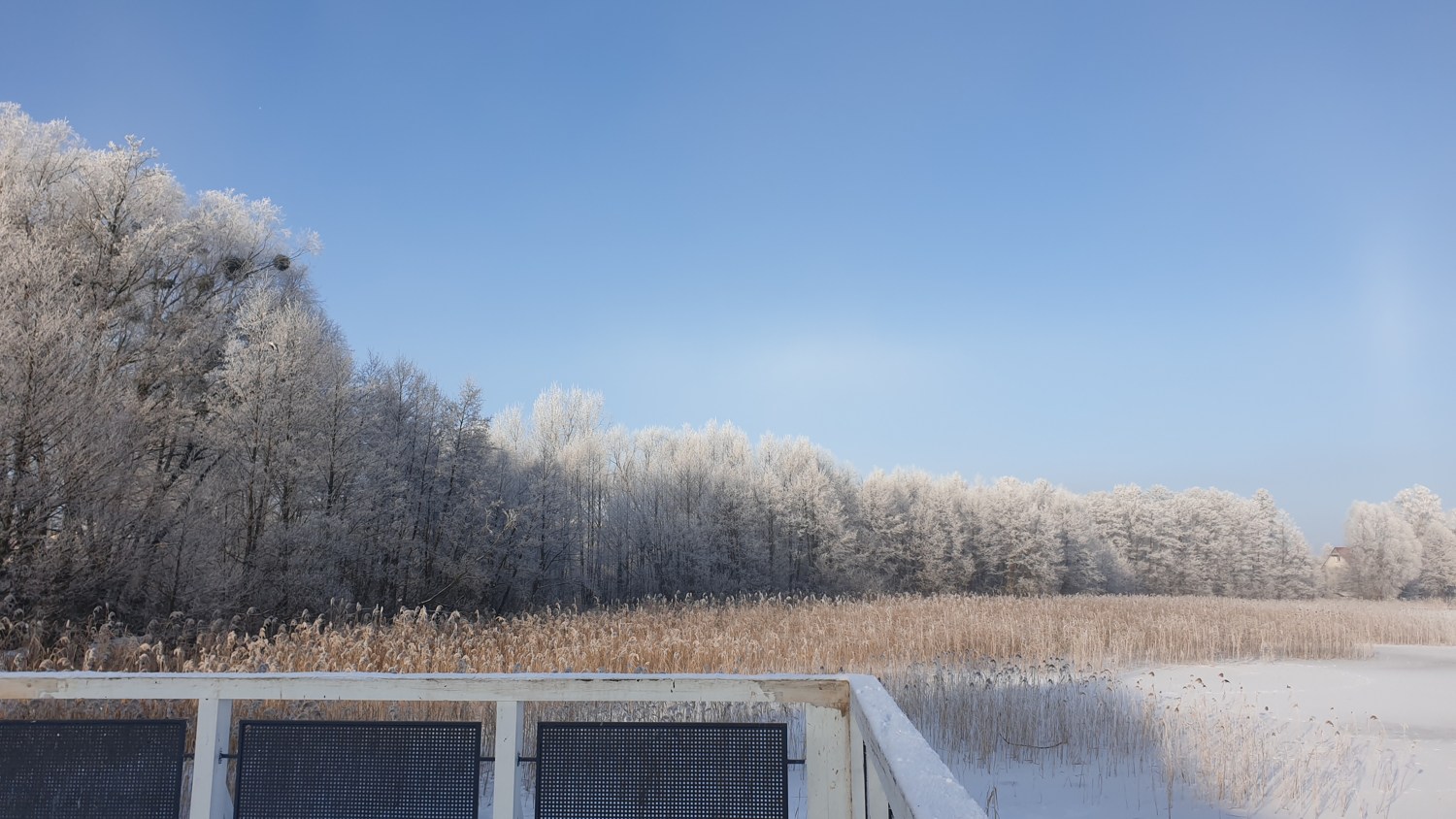
The local tourism office's walking information links the town-hall area with plac Jana Pawła II and the promenade beside Lake Czos. That makes a short waterfront extension a reasonable option after the museum when daylight, weather and the ground underfoot allow it. The photograph here is an archival winter landscape, not evidence of conditions on the day you visit. Stay on an appropriate land route rather than treating frozen-looking water as a walking surface.
Do not confuse that short optional extension with the full Góra Czterech Wiatrów trail. The tourism office describes an approximately 8.2 km route starting at the town hall and explicitly says it is not a loop, with the return requiring further travel. It is a separate walk to plan, not a quick extra that can be fitted between the last ticket sale and darkness.
Before you set off
Contact the branch at 89 741 28 12 or [email protected] if you need a guide, access confirmation or details of an additional room. Choose the right weekly timetable first, then check the holiday calendar and ticket-office cutoff. For a straightforward visit, make the permanent exhibition the anchor, use free Tuesday if it fits your dates, and treat the watchhouse interior, temporary exhibitions and longer walks as separately checked additions.
Frequently asked questions
Is Mrągowo museum open on Mondays in winter?
Yes. Its published September-June pattern is Monday-Saturday 09:00-16:00, with the ticket office closing at 15:30. Sunday is closed. Holiday exceptions can apply.
Is everything free on Tuesday?
No. Permanent exhibitions are free, while the tariff lists 8 PLN for temporary exhibitions on Tuesdays. Guiding, lessons and workshops are separate.
Does the lift reach every exhibition room?
The official report as of 1 January 2025 says a lift installed in 2018 improved access, but one western exhibition room still lacked an accessible route. Ask about current operation and your exact visit.