Żuławy Museum: Winter Weekend Booking, Tickets and English Guides
The essentials: Muzeum Żuławskie opens Tuesday-Friday 10:00-15:00 from October to April. Weekend visits are 11:00-15:00 only by arrangement no later than the preceding Friday. Entry is 15/10 PLN. English or German guiding is listed at 260 PLN; confirm the full total and availability.
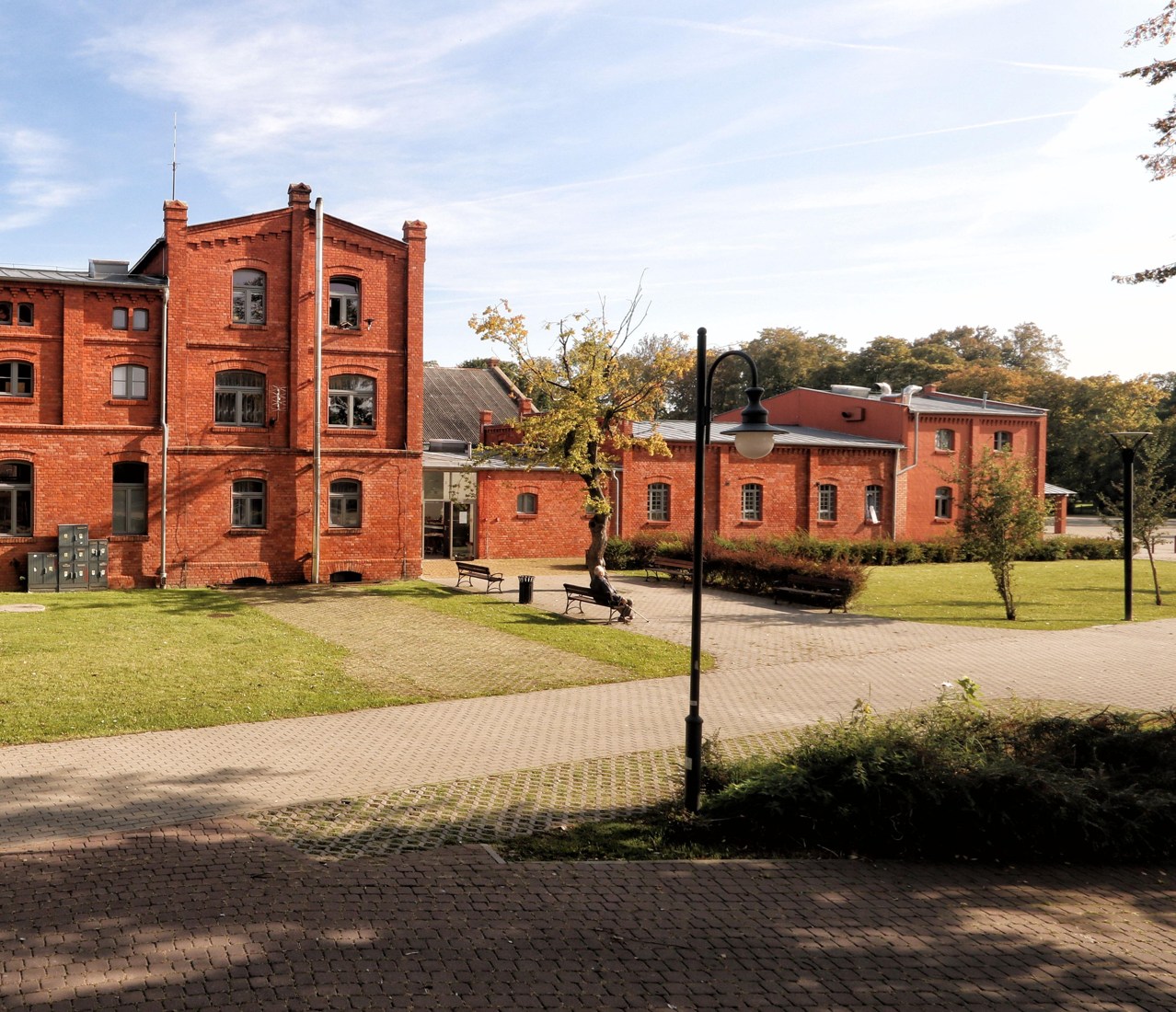
Cover: Żuławski Park Historyczny in Nowy Dwór Gdański, photographed on 22 September 2019. Archival autumn view, not current conditions. Photo: AgataS-K / Wikimedia Commons, CC BY-SA 4.0. Cropped, resized and recompressed under the same licence.
The most important detail about visiting Muzeum Żuławskie in winter is not the ticket price. From October through April, a Saturday or Sunday visit must be arranged in advance, no later than the preceding Friday. The museum publishes weekend hours of 11:00-15:00, but that is not an invitation to turn up without an arrangement. For an independent visitor staying near Gdańsk or the Vistula Spit, checking that condition can prevent a wasted journey.
The museum is part of Żuławski Park Historyczny at ul. Kopernika 17 in Nowy Dwór Gdański. It explains the Vistula delta through drainage, flood protection, Mennonite history, migration, local industry and everyday objects. The former cheese factory is an appropriate setting: the building's own story connects the agricultural landscape with the tools and businesses inside.
Winter hours: arrange weekend visits by Friday
The operator's contact page divides the year into two seasons. From 1 October to 30 April, museum exhibitions open Tuesday-Friday, 10:00-15:00. Saturday and Sunday visits are listed for 11:00-15:00, but only by prior arrangement, made no later than the Friday before that weekend. Monday is closed in the regular timetable.
To arrange a visit, contact the museum on 55 247 57 33 or 518 263 676. Its published emails are [email protected] and [email protected]. A request is not a confirmed arrangement until the operator accepts the date and time. If you need a weekend guide, discuss that at the same time rather than assuming that opening the building automatically includes a guided tour.
From 2 May to 30 September, the published hours change to Tuesday-Friday 10:00-16:00 and Saturday-Sunday 11:00-15:00. Other visiting dates and hours may be possible by telephone agreement. The operator does not publish a separate current last-entry time on the contact page checked, so leave enough time to visit before closing rather than arriving at the final minute.
Holiday closures override the ordinary timetable
The regular closure list includes 1 and 6 January, 1 and 3 May, 15 August, 1 and 11 November, and 24, 25 and 26 December, plus Easter Sunday and Corpus Christi. A normal Tuesday-Friday pattern does not override those dates. Check announcements as well, because the operator can publish a special exception to the standard list.
That distinction is visible on its website: an announcement offered an exceptional 15 August opening even though 15 August appears among the regular closures. Treat a dated exception as applying to that particular occasion, not as a permanent change to every future holiday. For a winter itinerary, confirm your chosen date directly if a closure or special event could affect it.
Admission: 15 PLN normal and 10 PLN reduced
The official tariff currently displayed on the operator's website, labelled as effective from 1 January 2024, lists 15 PLN normal admission and 10 PLN reduced admission. The reduced category is specified for school pupils and students up to age 26. The museum also honours Karta Dużej Rodziny, Poland's Large Family Card, at the reduced-ticket price.
Do not assume that every child, senior or foreign discount-card holder automatically qualifies for a different rate. The published tariff checked does not establish those additional categories. Bring proof for a discount you intend to claim and ask the museum about any situation the tariff does not cover. Nor does the page establish a regular free-admission Sunday, so plan around the displayed admission prices rather than borrowing another museum's free-day rule.
Amateur photography and filming are free without additional lighting or a tripod. That is different from professional photography of exhibits, copying documents or requesting scans, for which the price is by agreement. A separate educational film screening outside the exhibitions is listed at 5 PLN. These distinctions are useful if your visit includes research or a group activity rather than ordinary sightseeing.
English and German guided visits are listed
The tariff offers guided exhibition visits in Polish at 130 PLN for a basic visit of about 45 minutes or 180 PLN for an extended visit of about 90 minutes. A guided visit in a foreign language, specifically English or German, is listed at 260 PLN. The operator describes about 25 people as an optimal group size.
The published page separates admission tickets from guiding and does not clearly say whether the guide price includes admission. Ask for the full total when arranging your visit. The English/German price also does not establish a walk-in departure schedule, a guaranteed guide on every day or a stated duration for that particular language option. Agree the language, number of visitors, time, length and total before making a travel plan around it.
For someone new to the region, a guide can help connect unfamiliar place names and religious history with the objects. If you prefer to visit independently, ask what interpretation is available in your preferred language. The existence of an English-language guided service is not evidence that every label, film or museum game has an English version.
Start with water, drainage and the delta
The main ground-floor exhibition, Stolica Żuław. Delta Wisły, includes surviving parts of a drainage windmill from Grochowo III, dating from around the turn of the eighteenth and nineteenth centuries. The operator describes its later moves, fire damage and deterioration before the remains reached the museum in 2005. It is a physical starting point for understanding why managing water is central to the region's history.
Nearby, the Magazynek Strażnika presents the equipment of a flood-embankment keeper, alongside material about more recent flood-protection methods. The exhibition called Nowy początek 1945 looks at settlers who arrived after the Second World War and the work of draining the damaged delta. Together these displays help connect engineering with people's lives rather than leaving drainage as an abstract landscape fact.
The same collections page lists a model of the narrow-gauge railway at Lichnówki, a model of pre-war Nowy Dwór Gdański and material about the Stobbe distillery and brewery. Use the models to orient yourself within the museum's account of the region. They are historical exhibits, not a source for current train operating dates or services.
Mennonite history and the attic collections
The exhibition Na polskim polderze introduces Mennonites who arrived in the delta from the Netherlands and northern Germany from the sixteenth century. It discusses religious identity, settlement and contributions to the region, and includes biographies and recovered grave markers. That is worth approaching as a history of a religious community and its neighbours, not as a decorative theme attached to old houses.
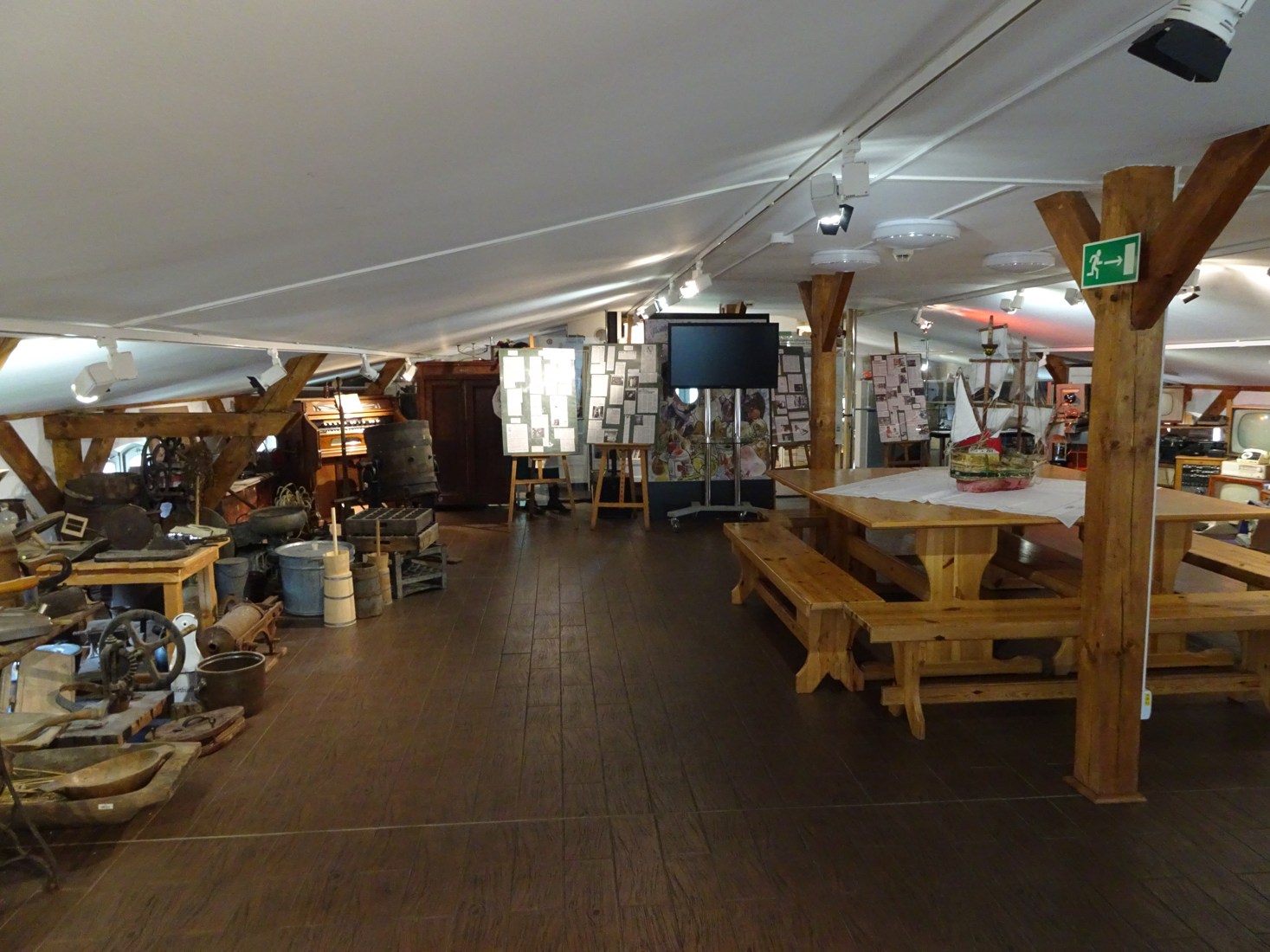
Strych pełen osobliwości, the attic full of curiosities, focuses on household work, farming and trades. The operator lists dairy equipment, kitchen tools, woodworking planes, shoemaking and saddlery tools, beekeeping material, telephones and typewriters. Pick one everyday task, such as washing, making butter or preparing food, and follow how the objects changed the work involved.
A cheese factory before it became a museum
The operator's history dates cheese production at this site to 1890, with a modernised dairy and cheese factory established in 1892. The main building followed expansion after the 1902 fire. The metal flag with owner Leonhard Krieg's initials connects the building with the Swiss family's business.
The museum opened on 11 June 1994, following the founding initiative in 1993. Later renovation led to Żuławski Park Historyczny in 2011. The building is therefore part of the visit's subject, but its current rooms reflect adaptation for museum and cultural use. Look at the cheese-making equipment with that working industrial history in mind, rather than imagining the exhibition rooms are an unchanged factory floor.
Check access arrangements for the levels you want to visit
The operator's renovation account says adapted toilets and access platforms were provided. It also states that museum exhibition rooms occupy three levels. Its conference-space page describes accessible rooms and nearby parking, but that is not a current technical specification for every museum route or lifting device.
If you use a wheelchair or cannot manage stairs, ask which exhibitions you can reach, whether the relevant platforms are operating, their dimensions or limits, and where to enter. Confirm the adapted toilet and any assistance you need at the same time. Do not treat a historical renovation description as a guarantee that a particular chair fits or that every floor can be reached independently on the day.
The cemetery branch is a separate visit
The museum's Cmentarz 11 wsi lapidarium is in Żelichowo-Cyganek, not inside the Kopernika 17 building. The operator describes the historic cemetery permission granted in 1639 and recovered grave stones, including stones reused in later building foundations. Its contact page excludes this outdoor branch from the museum-building timetable and describes it as open without restrictions.
That does not establish a step-free route, lighting or winter ground conditions. Ask about the approach before adding it to a limited-mobility itinerary. For a first visit, securing the winter museum appointment, choosing independent entry or a guide, and leaving time to understand the water-and-settlement story is a sounder plan than trying to fit every regional stop into one unconfirmed afternoon.
Frequently asked questions
Can I just turn up on a winter Sunday?
No. From 1 October to 30 April, Saturday and Sunday visits must be arranged in advance, no later than the preceding Friday. Listed weekend hours are 11:00-15:00.
Does the English guide price include admission?
The official tariff lists 260 PLN for English or German guiding but does not clearly say whether admission is included. Confirm the full total with the operator.
Is the cemetery branch inside the museum building?
No. Cmentarz 11 wsi is a separate outdoor branch in Żelichowo-Cyganek. The operator excludes it from the museum-building timetable; check the approach and ground conditions if those matter.