Szczytno Masurian Museum: Free Sundays, Tickets and Access
The essentials: Muzeum Mazurskie in Szczytno opens Tuesday-Sunday 09:00-16:00 from October to May, with tickets sold until 15:30. Entry is 18/12 PLN. Permanent exhibitions are free on Sundays September-May and Thursdays June-August. The branch report dated 1 January 2025 records access barriers.
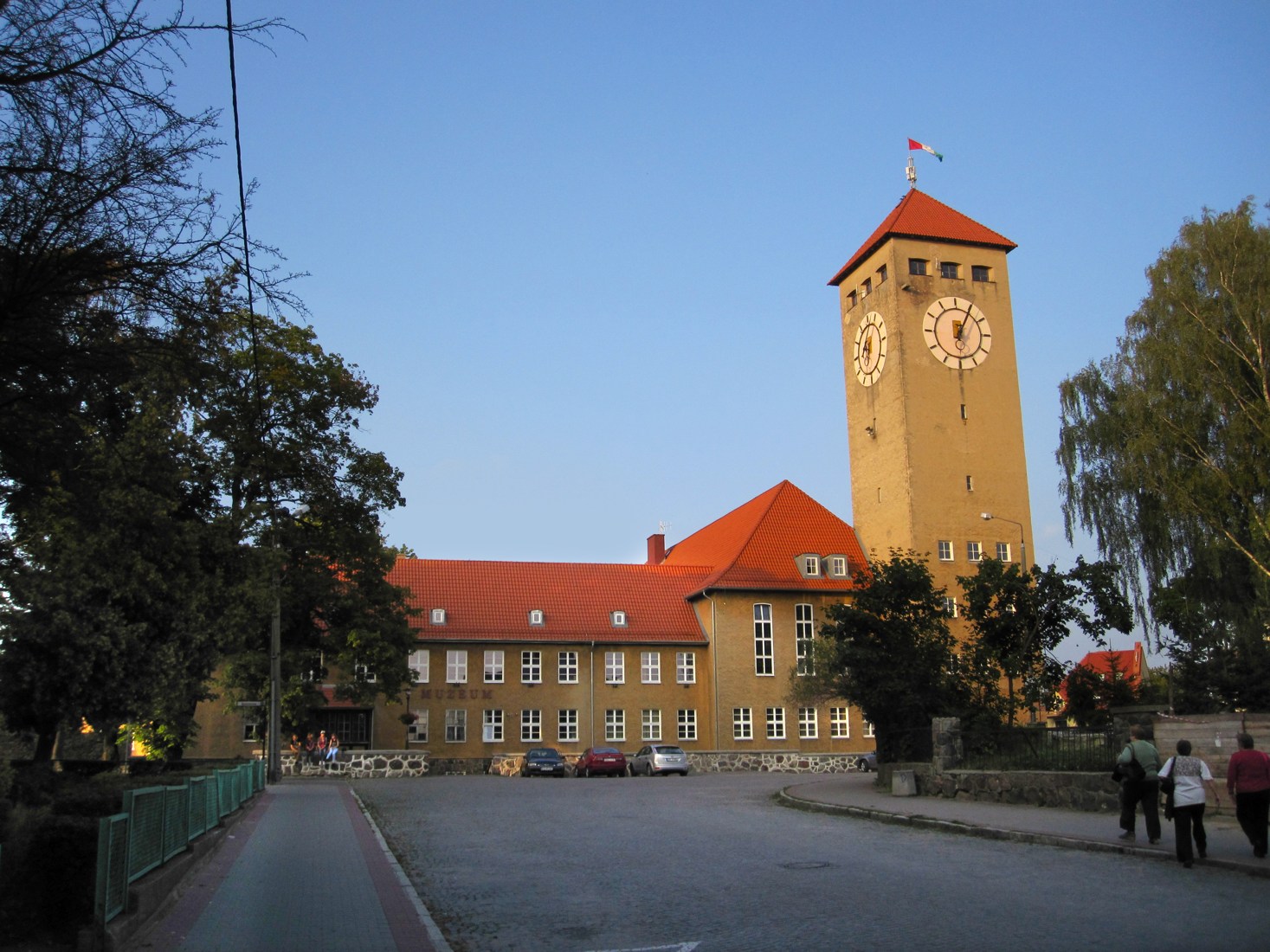
Cover: Szczytno town hall, containing the museum, photographed on 25 August 2012. Archival summer view, not current conditions. Photo: Piotr Marynowski (GringoPL), foreground edit by Szczebrzeszynski / Wikimedia Commons, CC BY-SA 3.0 Poland. Resized and recompressed under the same licence.
Szczytno's Muzeum Mazurskie is a useful stop for understanding Masuria beyond the lakes. Its permanent displays connect the history of the town with the work, language and household objects of the people who lived in the surrounding countryside. The practical trap is that the free-entry calendar does not follow the same seasonal dates as the opening hours. September has summer opening hours but the autumn-to-spring free Sunday.
The museum is at ul. Sienkiewicza 1, in wings of the town hall beside the castle remains. This guide uses the operator's published timetable and tariff, checked on 28 November 2026, together with its exhibition descriptions and branch-specific accessibility report. It does not treat every temporary exhibition still listed online as currently open.
Opening hours: two seasons, with an earlier ticket-office cutoff
From 1 October to 31 May, the museum lists Tuesday-Sunday opening from 09:00 to 16:00. The ticket office operates from 09:00 to 15:30. Monday is closed as an internal-work day. For a winter visit, arriving at 15:45 is therefore not a sensible plan, even though the building's closing time is later.
From 1 June to 30 September, the published hours shift to Tuesday-Sunday 10:00-17:00, with the ticket office open 10:00-16:30. Monday remains closed. The half-hour difference is a ticket-office cutoff, not a recommendation that thirty minutes is enough for all the galleries. Choose an earlier arrival if you want time with both the history and ethnography displays.
Holiday arrangements override the weekly pattern. The operator's 2026 calendar lists closures on 24, 25, 26 and 31 December, as well as other named holidays earlier in the year. Its page also identifies specific 2026 holidays when branches were open. Those dated exceptions should not be carried into another year. Check the branch page for the actual date of a holiday visit rather than assuming that every public holiday follows either Sunday hours or a blanket closure.
Tickets and the September free-day switch
The current published tariff is 18 PLN for a normal ticket and 12 PLN for a reduced ticket. Family tickets are 40 PLN for the combinations 2+1 or 1+2, and 50 PLN for 2+2, 2+3 or 1+3. The tariff presents those combinations without a full explanation of ages or relationships, so confirm eligibility if your group does not clearly fit the operator's definition. Bring any document needed for a concession.
Free entry to the permanent exhibitions is on Thursday from 1 June to 31 August. From 1 September to 31 May, it is on Sunday. Notice the different boundary: the opening-hours summer lasts through September, while the Thursday free-day season ends in August. A September visitor should use the 10:00-17:00 timetable but the Sunday free day.
Temporary exhibitions are not automatically included in that free offer. The tariff lists an 8 PLN ticket for temporary exhibitions on days when admission to the permanent displays is free. Ask which temporary exhibition is actually available and whether that ticket is relevant to your visit. Free permanent admission is not the same thing as an unrestricted free ticket to every activity in the building.
The tariff also says families with Poland's nationwide Large Family Card can buy museum and branch admission with a 50% discount. It does not explain every possible interaction with family tickets or other reductions. Do not add discounts together yourself. Ask the ticket office which option applies to your party.
What the permanent history exhibition covers
Historia Szczytna i okolic. Od pradziejów do współczesności is the main route through the history of Szczytno and its surroundings. The operator divides it into sections spanning prehistory, the medieval period and the later history of the town, with information about the post-war years at the end. It is a way to place the town hall and nearby castle remains within a longer story.
The earliest section draws heavily on objects from the former Heimatmuseum Kreis Ortelsburg. The museum describes material from the Neolithic, Bronze and Iron Ages, the Roman-influence period and the early Middle Ages. The medieval section combines museum objects with replicas of weapons and clothing, copied images and documents. Those distinctions matter: a reconstructed setting or replica helps explain a period without being an original medieval room or artefact.
Among the named objects are an original 1592 edition of Caspar Schütz's history of Prussia and a castle model made in 1931 by Wolfgang Kuschel. Later sections use documents, craft objects, Polish-language hymnbooks, press material and photographs to explain changing political and cultural conditions. The account includes the Masurian movement, wartime destruction and rebuilding. Allow time to follow the sequence instead of treating the display as a collection of unrelated old objects.
Painted stove tiles: look for the writing as well as the picture
The permanent display Ludowe kafle mazurskie brings together painted tiles from workshops active in Masuria from the late eighteenth to the mid-nineteenth century. The museum names makers including the Karpowicz family in Nidzica, the Nadrowski and Moczadło workshops in Pasym, and the Salewski family. Some makers can be identified through tiles carrying a name and date.
The decoration ranges from geometric and plant motifs to animals, buildings, religious subjects and scenes of village life. Polish inscriptions sometimes comment on the image, including in a humorous way. For an English-speaking visitor, choosing one inscription to work through can be more rewarding than trying to translate every label. The tiles record work, celebrations and social concerns as well as decorative taste.
The operator also describes two reconstructed stoves assembled from different tiles to show types of Masurian stove. They should be read as reconstructions, not as two untouched household interiors transferred intact. Looking between an individual tile and the larger stove form makes the display easier to understand.
Household work, fishing and making cloth
Kultura ludowa Mazurów concentrates on the material culture of rural Masuria. Its published description starts with building tools and a model of a typical house, alongside photographs documenting regional wooden buildings. It then follows fishing, farming, food preparation and household production. These are connected activities rather than separate collections of quaint equipment.
For a short visit, pick one everyday process. The fishing material includes dugout boats, nets, traps, weights and tools for making holes in ice. Food-related objects include grain-processing equipment, storage containers, butter-making tools, cheese presses and kitchen vessels. A reconstruction of a kitchen stove helps connect the tools to the space where meals were prepared.
The textile section follows flax from the plant through fibre preparation, spinning and weaving, then on to washing and pressing cloth. Looking for the sequence can make unfamiliar implements less confusing. With children, ask what each tool changed about the material rather than expecting them to remember every Polish name. This is a suggested way to explore the exhibition, not a claim that the museum provides a particular hands-on session with ordinary admission.
The museum and castle are related, but check the visit separately
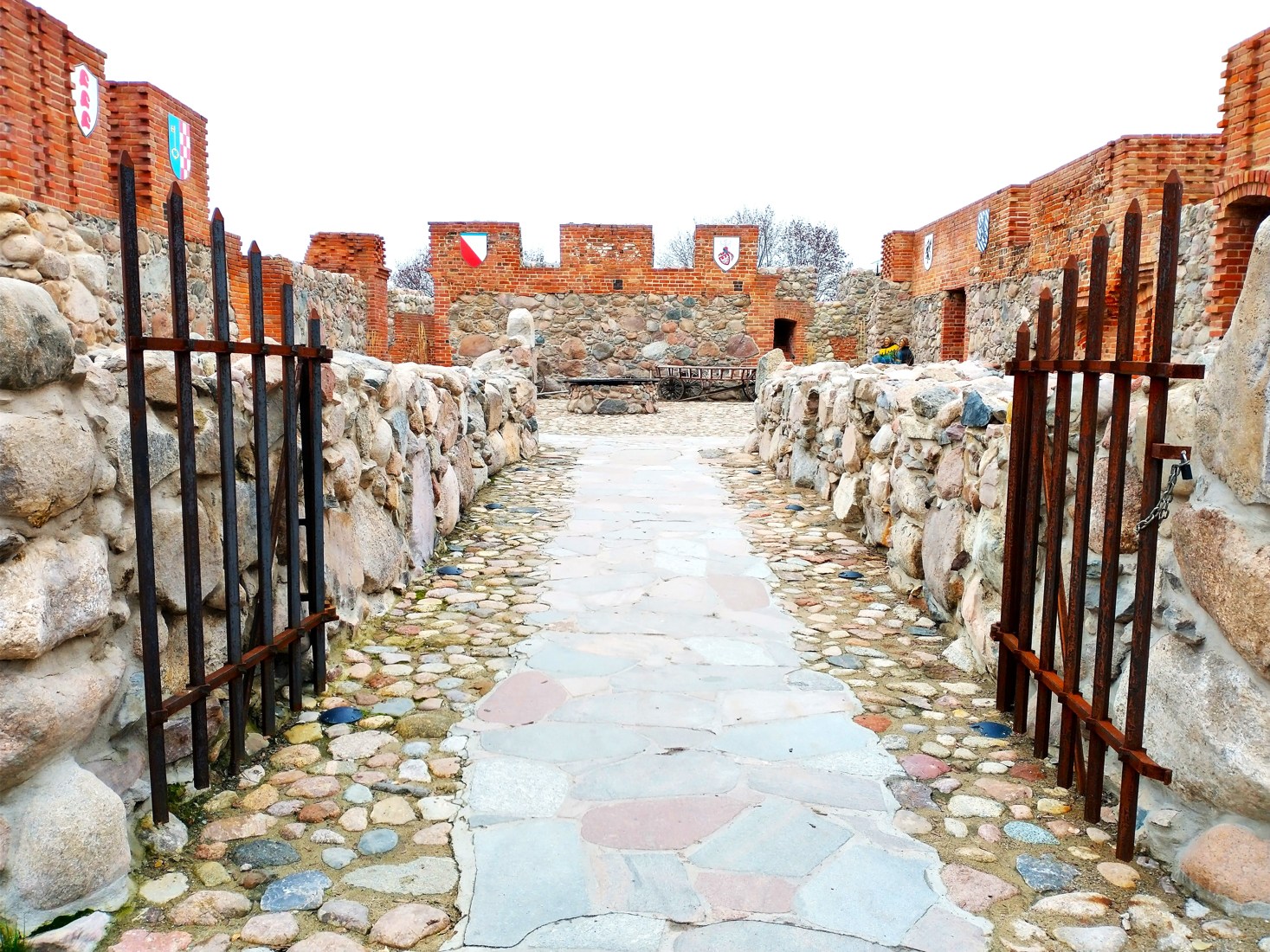
The branch history dates the present museum's creation to 1945, using surviving collections of the Kreisheimatmuseum Ortelsburg founded in 1925. It was initially located in the fourteenth-century castle and moved in 1948 to the southern and eastern wings of the town hall next to the ruins. That history explains why museum and castle appear together in visitor information, but it does not mean every space shares the same admission or access arrangements.
The published Polish-language guiding fees are 70 PLN for the museum, 90 PLN for the Teutonic castle and 120 PLN for the museum and castle together. The tariff does not clearly state whether individual admission is included in those fees, nor does it offer a verified English-language price. Confirm availability, language, duration, group size and the full cost before making plans around a guided visit. A listed guiding service is not evidence of a tour departing whenever you arrive.
Accessibility: use the branch report, not a general travel claim
The museum's branch-specific report describes the position as of 1 January 2025. It records one building without barrier-free horizontal and vertical circulation and without access to all rooms. It also records admission with an assistance dog. This is stronger evidence than an undated general travel description claiming the museum is fully accessible, but it is still a dated report rather than a live inspection.
If you use a wheelchair, have difficulty with stairs or need a particular kind of assistance, contact the Szczytno branch about the exact galleries you want to see. Ask about the entrance route, changes of level, toilet arrangements and any assistance available on your date. Do not infer that access to a town-hall service area proves access to every museum room or the castle remains. The report is available through the operator's BIP accessibility page.
A practical plan before you leave
Use the branch's published contact details: telephone 89 624 24 37 or email [email protected]. Check your date against both the seasonal timetable and the free-day calendar, then decide whether you need a guide or access information. The exhibition index contains older temporary shows, including a brewery exhibition explicitly dated to end on 27 September 2026, so an entry remaining on that index is not proof of a current exhibition.
For an ordinary independent visit, the permanent history, tile and rural-culture displays provide a clear route through the museum without relying on a temporary event. Start early enough to give them attention, keep the castle as a separately checked part of the plan, and use the dated official access information when deciding whether the visit will work for everyone in your group.
Frequently asked questions
Is September free entry on Thursday or Sunday?
Sunday. The free-day calendar changes on 1 September, even though summer opening hours continue through 30 September.
Are temporary exhibitions free on Sunday in winter?
Not automatically. The tariff lists 8 PLN for temporary exhibitions on days when permanent exhibitions are free. Confirm which temporary show is actually open.
Is the museum fully wheelchair accessible?
Its official branch report as of 1 January 2025 records barriers to horizontal and vertical circulation and no access to all rooms. Confirm the entrance, galleries and toilets you need directly.