Nowa Huta, Kraków: A Guide to the Socialist Realist New Town
The essentials: Nowa Huta is the district Kraków built from 1949 around a new steelworks: a socialist realist new town on a Renaissance-style plan, now a registered monument. Give it half a day for Plac Centralny, the Lord's Ark, Mogiła Abbey and the lagoon; museum walks run while its building is renovated.
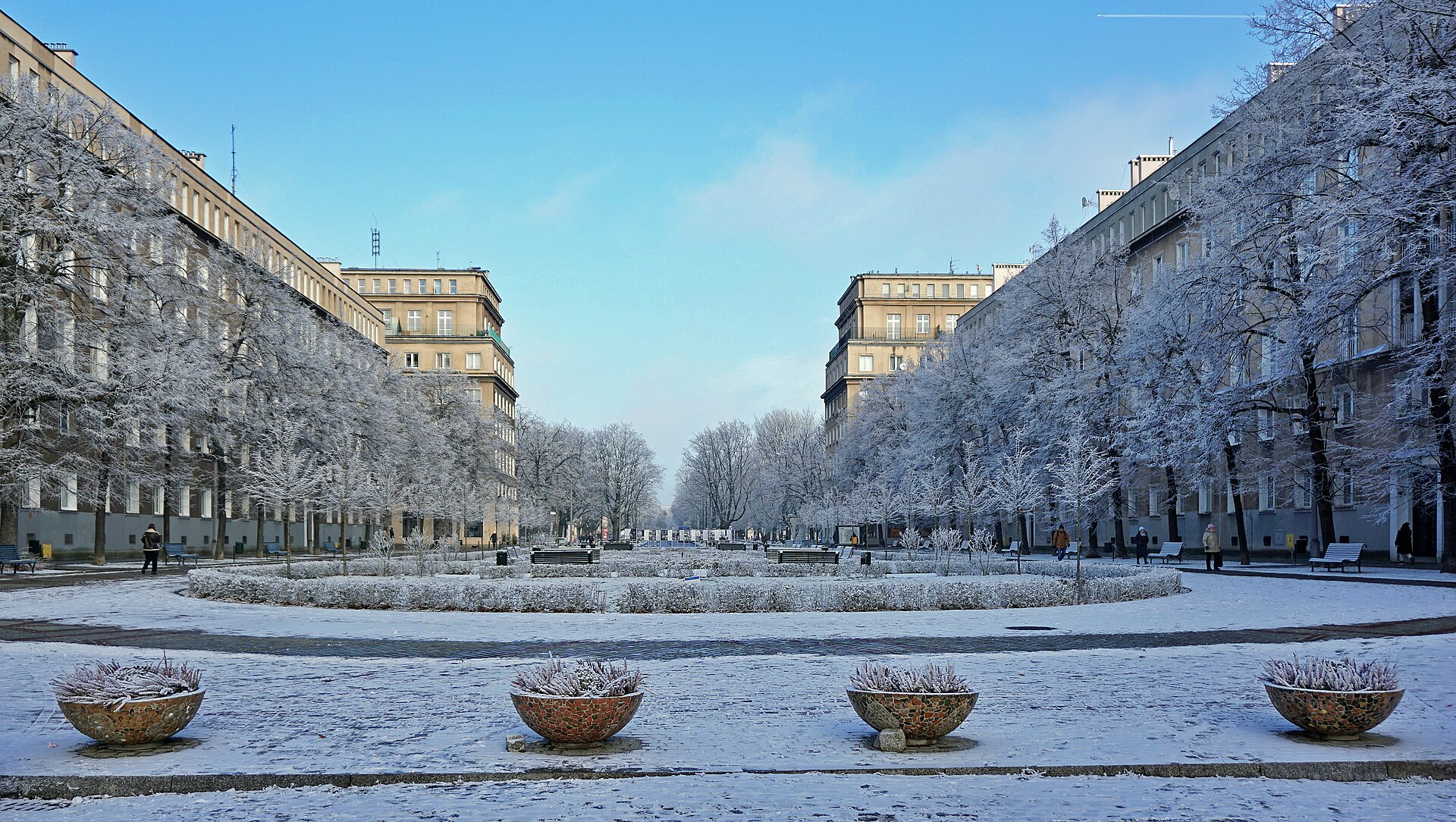
Kraków's other city centre
Ten kilometres east of the Main Square, Kraków keeps a second, entirely planned city: Nowa Huta, the new town raised from 1949 around a giant steelworks and designed as the model socialist settlement. For expats it is one of the most rewarding half-days in the city, because almost nothing here is accidental. The street plan, the housing blocks, the churches and even the green spaces each carry a piece of Poland's post-war story, and the district is compact enough to cover on foot between tram stops.
Direct trams from the centre reach the Plac Centralny area in roughly 20 to 25 minutes using standard city tickets, covered in our Kraków public transport guide. This guide walks the district in the order most visitors take it: the ideal-city plan, the church that was never meant to exist, the museum and its wartime shelters, the medieval abbey that predates everything, and the lagoon where the district relaxes.
Data source: archiwalneopowiesci.ank.gov.pl, muzeumkrakowa.pl, arkapana.pl, mogila.cystersi.pl, zzm.krakow.pl, poland.arcelormittal.com; checked 23 October 2026.
The ideal city: how Nowa Huta was designed
When the decision to build Nowa Huta was taken in 1949, the state held a competition for the new city's general concept and received five different proposals. The winning urban concept came from a team led by architect Tadeusz Ptaszycki, finally approved in 1952, although housing estates for workers of the rapidly rising metallurgical combine were started before any general plan existed. The steelworks the town was named for began production in 1954 and still operates today as ArcelorMittal Poland's Kraków unit, the historic Huta Sendzimira.
The plan is a history lesson in itself. According to the National Archives in Kraków, the layout adapts a classical Renaissance city: streets radiate from one point, Plac Centralny, set at the edge of the roughly 14-metre Vistula escarpment, and link into a web, while the axis of symmetry is Aleja Róż, the Avenue of Roses. Housing followed the Anglo-Saxon neighbourhood-unit idea, with units of five to six thousand residents given their own shops, nurseries, schools and clinics, and greenery planted alongside the buildings in the spirit of a garden city. Specialists cited by the Archives trace echoes of St Peter's Square, the Place Vendôme and Haussmann's Paris. The intended town hall and theatre that were to close the main axis were never built after the architectural style shifted in 1955-56, leaving visible gaps in the composition. The whole urban layout entered Poland's register of monuments in 2004.
Plac Centralny has its own footnote. In 2004 Kraków's councillors proposed renaming it for Ronald Reagan; residents founded a Committee for the Defence of Plac Centralny, and the compromise passed on 8 September 2004 made the official name plac Centralny imienia R. Reagana, which locals ignore in favour of the everyday Centralny, as the Museum of Kraków's exhibition on the square records.
Data source: National Archives in Kraków, Nowa Huta - an (un)ideal city exhibition; muzeumkrakowa.pl; poland.arcelormittal.com history page; checked 23 October 2026.
The Lord's Ark: the church the plan never included
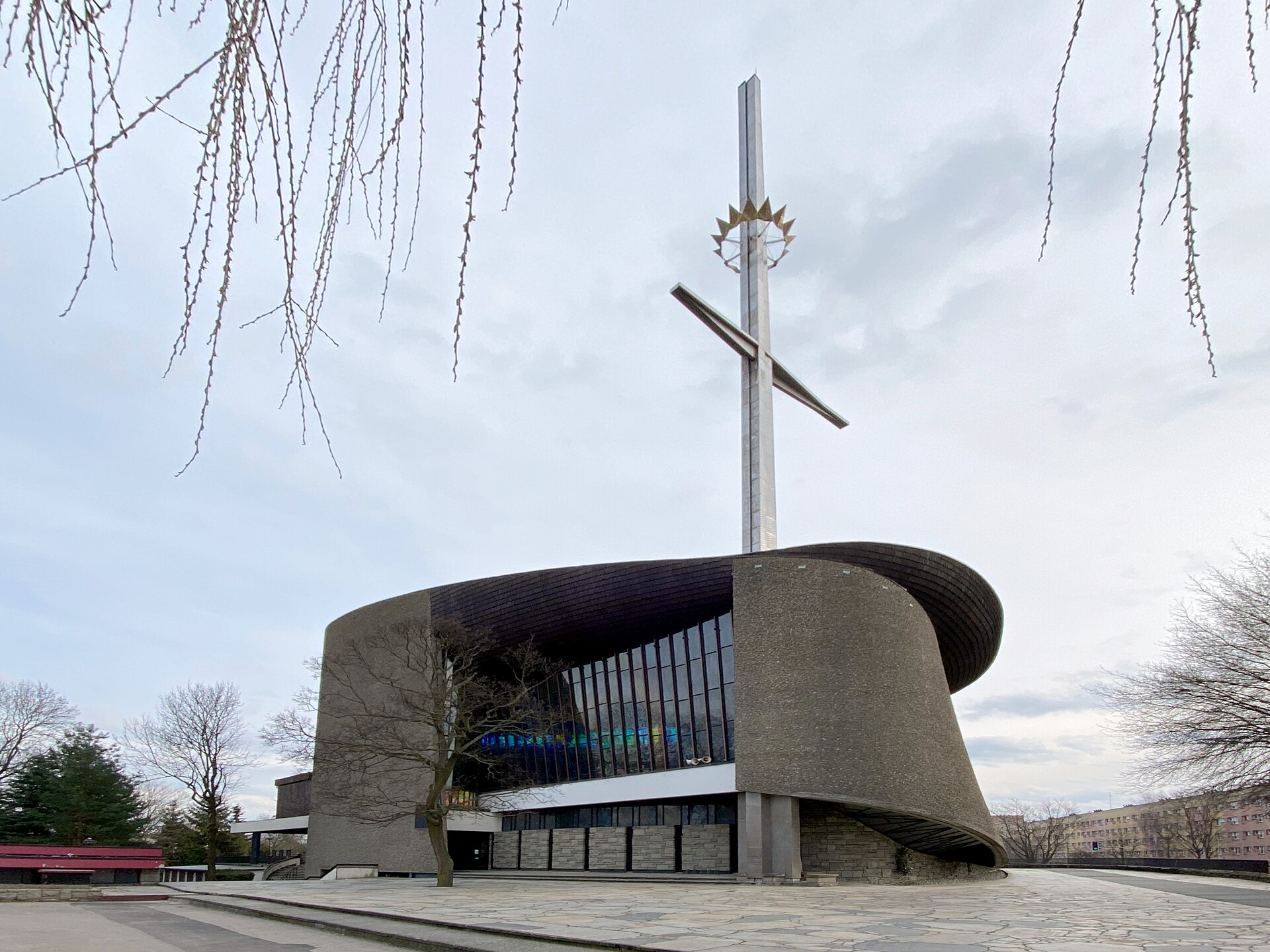
Nowa Huta was designed as a city without a church, which made its first church an act of defiance. Residents had already fought to keep a wooden cross, the Nowa Huta Cross, in 1960. The Church of Our Lady Queen of Poland, known as the Arka Pana or Lord's Ark, was then built between 1967 and 1977 to a design by architect Wojciech Pietrzyk, raised by hand with shovels, picks and peasant wagons, as the parish's own guide for pilgrims puts it. Cardinal Karol Wojtyła, two years from becoming Pope John Paul II, consecrated it on 15 May 1977.
The building is shaped as Noah's Ark. A 68-metre steel cross, anchored 14 metres underground and capped with a gilded crown, towers over the boat-like roof and carries the structure's slanting walls. Inside, the tabernacle by sculptor Bronisław Chromy holds a stone from the Moon, a gift from Pope Paul VI, who had received it from the Apollo 11 crew, passed on by Karol Wojtyła. The eight bells out front were cast in 1975 by the Dutch royal foundry Petit and Fritsen as a gift from Dutch Catholics, and the great organ by Hamburg's Rudolf von Beckerath workshop was dedicated in 1979. The church stands at Obrońców Krzyża 1 in Bieńczyce, a short walk from the tram.
Data source: arkapana.pl parish guide for pilgrims (EN); checked 23 October 2026.
Museums and shelters: what is open while the Światowid is renovated
The district museum, the Nowa Huta Museum branch of the Museum of Kraków, lives in the former Światowid cinema, itself a monument of late socialist realism designed by Andrzej Uniejewski. The cinema's first screening, on 21 July 1957, was Jacques Feyder's costume comedy "Zwyciężyły kobiety"; the 680-seat hall later became the museum's temporary exhibition space, with two wartime air-raid shelters in the basement. The city bought the building in 2006, museum activity began in 2008, and it entered the register of monuments on 29 May 2015.
As of 23 October 2026 the Światowid building is closed for renovation, but the museum has not stopped. Educational sessions run at os. Szkolne 22, guided walks of Nowa Huta cost 390 zł per group, and the Podziemna Nowa Huta branch, a shelter at os. Szkolnym 37 housing the exhibition "Stan zagrożenia" (State of Threat), opens for guided visits at 220 zł. The museum also leads shelter-heritage walks at 390 zł. Book ahead through the branch, and treat the renovation as a reason to join a walk rather than a reason to skip the district.
Data source: muzeumkrakowa.pl branch page and Światowid page, including listed guide-service prices; checked 23 October 2026.
Mogiła Abbey: eight centuries older than the new town
The surprise at Nowa Huta's edge is that the "new" town sits on very old ground. The Cistercians were brought to the village of Mogiła in 1222 by the Bishop of Kraków, Iwo Odrowąż, and built a church of the Assumption and St Wenceslas with a monastery in the Romanesque-Gothic style. The church was consecrated in 1266 by Bishop Jan Prandota in the presence of Duke Bolesław and his wife, St Kinga. The village's own name comes from the grave, mogila, of Wanda, the legendary daughter of Krak, and her mound still stands nearby; it features in our guide to Kraków's mounds. The monks also built the wooden church of St Bartholomew for local people; the present timber church dates to the fifteenth century.
The abbey remains a working monastery and sanctuary of the Holy Cross. As of October 2026 the basilica at Klasztorna 11 is open daily from 5:30 to 19:15, and the miraculous crucifix known as Pan Jezus Mogilski has drawn pilgrims for centuries, from Kazimierz the Great to St Jadwiga, as the abbey's own history notes. A visit pairs naturally with the Arka Pana: the medieval answer to the district's twentieth-century church, fifteen minutes apart.
Data source: mogila.cystersi.pl sanctuary history (EN) and abbey home page for opening hours; checked 23 October 2026.
The Nowa Huta Lagoon and practical notes
Finish at the water. Park Zalew Nowohucki, run by Kraków's municipal greenery authority, covers 14.39 hectares around one of the city's largest artificial reservoirs. At its centre lies a small island called Małpi Gaj, the Monkey Grove, a protected breeding habitat for ducks, swans and migrating waterbirds, watched from a dedicated bird-observation point. The park lists a beach, an outdoor gym, multifunctional sports pitches and running, roller and cycling paths, with the Struga, Os. Zielone and Bulwarowa tram stops alongside. In November the swimming season is long over, but the loop around the water is the district's best walk.
Allow half a day for the whole route: tram to Plac Centralny, the ideal-city streets and Aleja Róż, the Lord's Ark, a museum walk or the shelter exhibition, then Mogiła and the lagoon by tram or a longer stroll. Everything here is free except the museum's guided services, and the district works in any season; for a winter visit, our Kraków winter guide adds what the rest of the city offers when the days are short.
Data source: zzm.krakow.pl Park Zalew Nowohucki page; linked Expats Poland guides; checked 23 October 2026.
* Photos: CC BY-SA 4.0 Igor123121 via Wikimedia Commons (Aleja Róż in the snow, cover); CC BY-SA 4.0 Minderbinder via Wikimedia Commons (the Lord's Ark, body).
Frequently asked questions
How do you get to Nowa Huta from Kraków's Old Town?
By tram. Direct trams from the city centre serve the Plac Centralny area in roughly 20 to 25 minutes, and stops such as Struga, Os. Zielone and Bulwarowa sit by the Nowa Huta Lagoon according to the municipal greenery authority. Tickets are the standard Kraków city fares covered in our transport guide; buy before boarding or from the machine on board.
Is the Nowa Huta Museum open?
Not in its usual home. As of 23 October 2026 the branch's building in the former Światowid cinema is closed for renovation, but the museum still operates: educational sessions run at os. Szkolne 22, guided walks of the district cost 390 zł per group, and the Podziemna Nowa Huta shelter at os. Szkolnym 37, with the State of Threat exhibition, opens for guided visits priced at 220 zł.
What is the Arka Pana and why does it matter?
The Arka Pana, or Lord's Ark, is the Church of Our Lady Queen of Poland at Obrońców Krzyża 1 in Bieńczyce. It was built by hand between 1967 and 1977 to a design by Wojciech Pietrzyk, in a district officially planned without churches, and was consecrated by Cardinal Karol Wojtyła on 15 May 1977. Its boat-shaped roof and 68-metre cross-mast make it both an architectural landmark and a symbol of local resistance to the communist authorities.
Who designed Nowa Huta and when was it built?
The decision to build Nowa Huta was taken in 1949, and the winning urban concept came from a team led by architect Tadeusz Ptaszycki, finally approved by the state in 1952. The plan adapts a classical Renaissance city layout: streets radiate from Plac Centralny at the edge of the Vistula escarpment, with Aleja Róż as the axis of symmetry. Housing estates for steelworkers went up first, and the steelworks itself began production in 1954.
Can you visit the Nowa Huta steelworks?
The steelworks is a working industrial plant, today ArcelorMittal Poland's Kraków unit, the historic Huta Sendzimira, rather than a visitor attraction. The sight for visitors is the district built around it: the monumental housing, Plac Centralny and the administration quarter, all covered on foot or on the Nowa Huta Museum's guided walks.
Sources
- National Archives in Kraków - Nowa Huta, an (un)ideal city: the city concept
- Museum of Kraków - Nowa Huta Museum branch
- Museum of Kraków - the former Światowid cinema
- Arka Pana parish - the Lord's Ark church, guide for pilgrims (EN)
- Cistercian Abbey in Mogiła - Sanctuary of the Holy Cross (EN)
- Municipal Greenery Authority in Kraków (ZZM) - Park Zalew Nowohucki
- ArcelorMittal Poland - our history