Kraków's Mounds: Kościuszko, Krakus, Wanda and Piłsudski
The essentials: Kraków has four major mounds. Only Kościuszko Mound is ticketed: open 9:00-17:30, normal 34 zł, reduced 26 zł from 1 April 2026, sold on site only. Krakus, Wanda and Piłsudski mounds stand on open ground. Pair Kościuszko with Piłsudski in the west, Krakus with Wanda in the east.
Four mounds, one skyline
Look at Kraków from almost any high point and you will spot them: grassy cones rising above the rooftops in four different corners of the city. Kraków's mounds, kopce in Polish, are artificial hills raised over two thousand years of local history, and each one tells a different chapter. Two are prehistoric earthworks older than any written record of the city. One is a nineteenth-century monument to a national hero. The youngest is a twentieth-century tribute to the father of regained independence, piled up by veterans in the middle of a forest.
For an expat, the mounds are the cheapest panorama in town. Three of the four stand on open ground with no gates and no tickets, and the fourth, the Kościuszko Mound, runs as a small museum complex with modest entry prices. Each sits in a neighborhood worth exploring anyway, so a mound visit doubles as an excuse to see Zwierzyniec, Podgórze, Nowa Huta or the Wolski Forest. If you have worked through our guide to Kraków's best parks, the mounds are the natural next step.
Data source: official Kościuszko Mound website (kopieckosciuszki.pl) and Polish Wikipedia entries for the four mounds; checked 23 October 2026.
Kościuszko Mound: tickets, hours and the fort
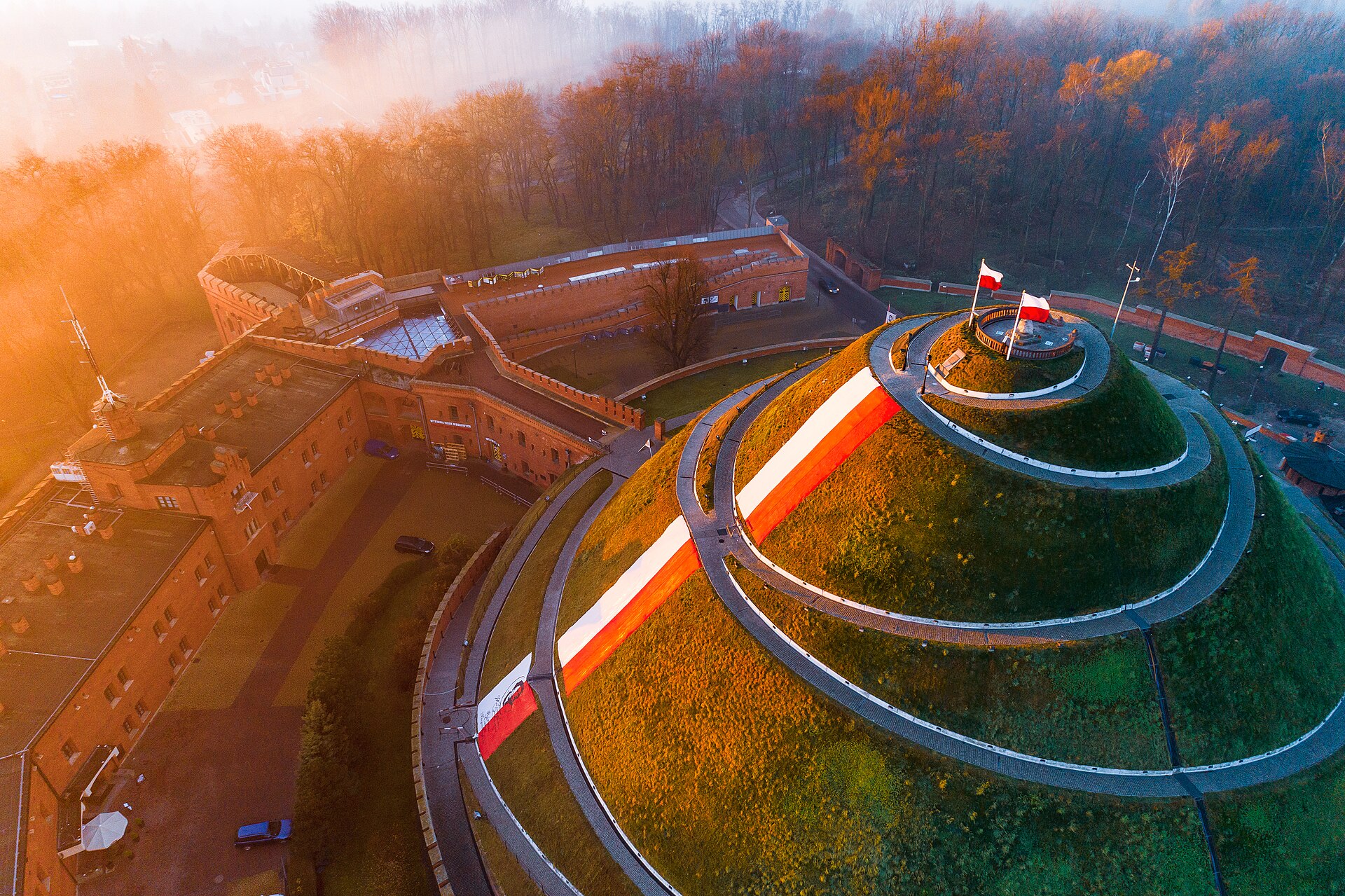
The most famous of the four stands on St Bronisława Hill in the Zwierzyniec district, west of the center. It honors Tadeusz Kościuszko, the military leader who fought for both American and Polish independence and died in 1817. When public fundraising for a monument stalled over the question of form, the Senate of the Free City of Kraków decided in July 1820 to raise a mound modeled on the ancient mounds of Krakus and Wanda, structures seen as indestructible because the whole community had built them. Work began with ceremony on 16 October 1820 and finished on 25 October 1823. The result is 34.1 meters high, entered into the monuments register as A-954, and managed without interruption since 1820 by the Kościuszko Mound Committee, which still runs the site today from the former Austrian Fort No 2 Kościuszko at its base.
That fort is part of the visit. The brick bastions around the mound host the Kościuszko Museum exhibitions, a wax gallery devoted to the Polish road to freedom, and temporary shows, and one ticket covers the mound and the exhibitions open that day. The complex sits at aleja Waszyngtona 1, with a bus connection from the center.
Practical details as of October 2026. The mound is open daily from 9:00 to 17:30. The price list effective from 1 April 2026 sets the normal ticket at 34 zł, the reduced ticket at 26 zł, a small family ticket (up to 4 people) at 68 zł, a large family ticket (up to 6 people) at 85 zł, group entry above 10 people at 25 zł per person, night visits at 35 zł per person, and a personal five-entry annual pass at 85 zł. Guided versions cost more. Payment is by cash or card, the Krakow Tourist Card is honored, and there are no online ticket sales: you buy at the ticket office by the parking entrance. One rule surprises many visitors: for safety reasons, animals are not allowed on the mound.
Data source: kopieckosciuszki.pl ticket price list (cennik) and opening hours pages, prices stated as effective from 1 April 2026; history per the Polish Wikipedia entry on the mound; checked 23 October 2026.
Krakus Mound: the legendary founder's grave
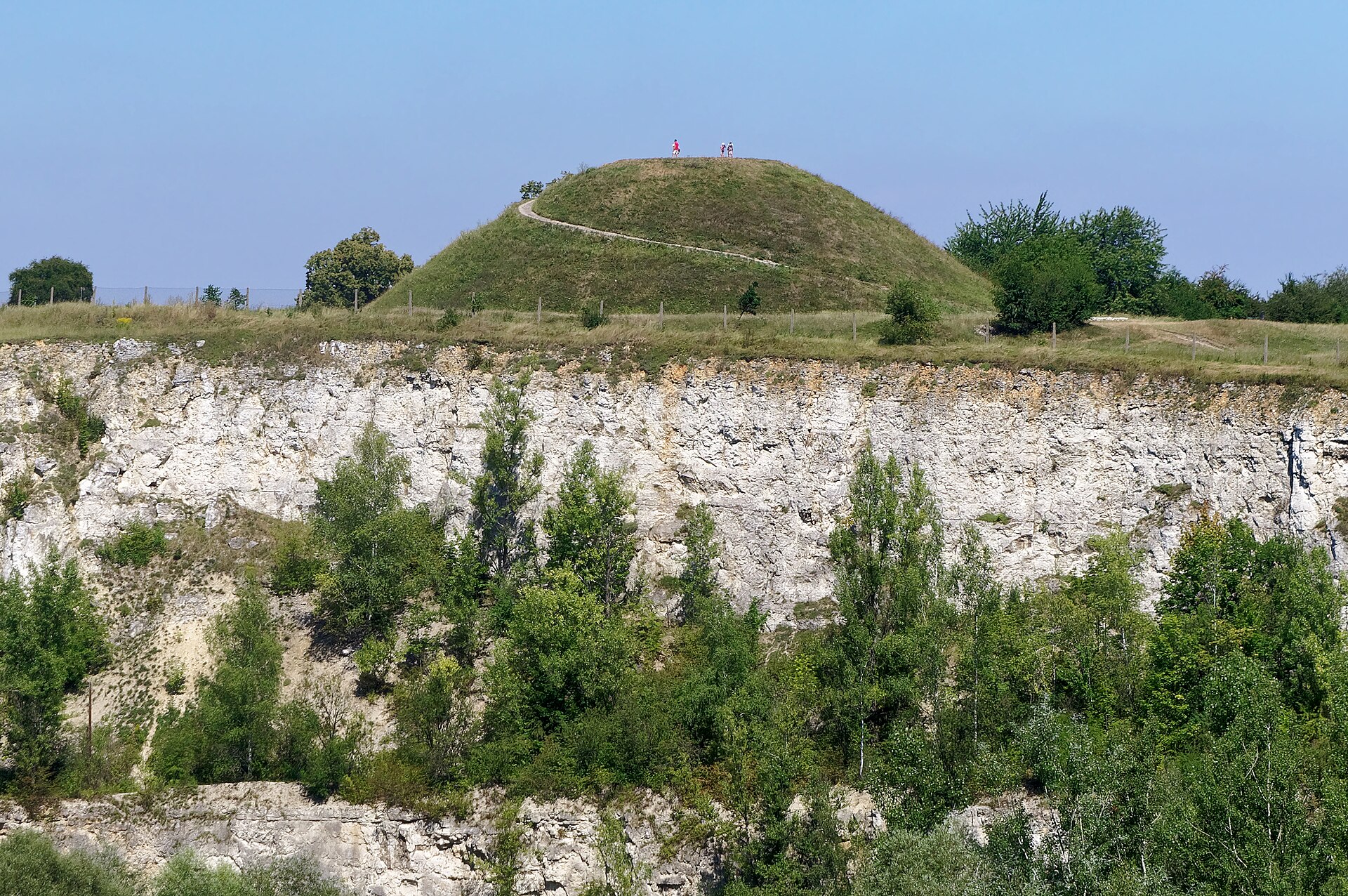
South of the river in Podgórze, on Lasota Hill off ulica Maryewskiego, stands the mound tied to Kraków's founding myth. The medieval chronicler Jan Długosz wrote that the city's legendary founder Krak was buried on a hilltop, and that his two sons raised this mound in his memory. Whatever the truth of the legend, the mound is genuinely ancient. Excavations in 1934-1937 under the Polish Academy of Learning, and later work in the 1970s, found traces of settlement from the Lusatian culture and a burial-mound construction built around a central pole with wicker partitions. Dating estimates vary: some researchers argue for a Celtic origin, others place the construction between the late eighth and mid tenth century, and no burial has ever been found inside. The mound is 16 meters high, entered in the monuments register as A-955, and its silhouette over the white walls of the former Liban quarry is one of the best views in Podgórze.
Two living traditions keep the mound busy. The Rękawka folk fair, held by the mound for centuries, survives as an annual spring event, and historians point to it as evidence of the site's old ceremonial role. A more recent theory links the mound to Celtic astronomy: the line from Krakus Mound to Wanda Mound matches the sunrise azimuth around early May and early August, close to the Celtic festivals of Beltane and Lughnasadh, and the reverse line matches sunsets near Imbolc and Samhain. The theory remains a hypothesis, but watching the sun line up from one mound to the other is a memorable way to test it.
Data source: Polish Wikipedia entry on Krakus Mound, summarizing the 1934-1937 excavations, dating theories and the astronomical alignment hypothesis; checked 23 October 2026.
Wanda Mound: the oldest story in Nowa Huta
The eastern mound stands in the Mogiła area of Nowa Huta, off ulica Ujastek Mogilski, a short walk from the Cistercian abbey. Długosz connected it with Wanda, the legendary daughter of Krak who, in the chronicle, chose death over marrying a foreign suitor. The mound is smaller than Krakus at 14 meters high and 238 meters above sea level, with a base diameter of 45 to 50 meters, a flat summit about 9.5 meters across and a volume of roughly 9,000 cubic meters. The estimated construction date, the seventh to eighth century, would make it the oldest of the four. The first written mention of the village of Mogiła, whose very name means "the mound", dates to 1222.
The mound has had a layered afterlife. Austrian engineers ringed it with an earthwork in 1860 and replaced that with a brick-and-stone fort in 1888-1890, demolished only in 1968-1970. In 1890 a local enthusiast, Kornel Kozerski, renovated the mound at his own cost and crowned it with a marble eagle designed by the painter Jan Matejko; the monument, without its crown during the communist period, still tops the mound today. Georadar scans in December 2016 detected anomalies inside, so the question of what, or who, lies within remains officially open. The mound is listed in the municipal register of monuments.
Data source: Polish Wikipedia entry on Wanda Mound, including the 1222 mention, the nineteenth-century fort history and the 2016 georadar results; checked 23 October 2026.
Piłsudski Mound: independence in the forest
The youngest and largest mound rises on Sowiniec Hill in the middle of the Wolski Forest, the big woodland west of the city. In 1934 the Polish Legionnaires' Association approved the idea of a mound-monument to the nation's fight for independence, and a construction committee formed in Warsaw under Colonel Walery Sławek. Work began on 6 August 1934, the twentieth anniversary of the First Cadre Company's march out of Kraków, to a design by Franciszek Mączyński. After Marshal Józef Piłsudski's death in 1935, the mound took his name. The work finished on 9 July 1937, and soil from the First World War battlefields where Poles fought was placed inside, including earth from the Krzemieniucha peak.
The numbers are impressive: about 35 meters high, 111 meters across the base, roughly 130,000 cubic meters of earth, and a summit at 393.6 meters above sea level, the highest of the four. The mound survived a 1941 order from the occupation authorities to remove it, but in 1953 the granite plate bearing the Legionary Cross was torn from its summit with a tank and the slopes were damaged. A citizens' committee formed in 1980 led the restoration, and soil from Second World War battlefields was later laid at its foot, earning it the nickname "the Mound of Mounds". Heavy rains in 1996, 1997 and 2010 damaged the slopes again and each time volunteers repaired them. Since 2007 the clearing at its foot, Polana na Sowińcu with benches, shelters and a playground, has hosted the finish of the Three Mounds Run.
Data source: Polish Wikipedia entry on the Piłsudski Mound, including the construction dates, dimensions and postwar history; checked 23 October 2026.
Planning one day, or two half days
The four mounds split neatly by geography. West of the center, Kościuszko Mound in Zwierzyniec combines naturally with Piłsudski Mound: visit the ticketed site in the morning when the light falls on the Old Town panorama, then walk or ride into the Wolski Forest for the second mound and the Sowiniec clearing. East of the center, Krakus Mound pairs with the Podgórze district and the Liban quarry below it, while Wanda Mound fits a Nowa Huta afternoon together with the Cistercian abbey in Mogiła and the district's socialist-realist architecture.
A few practical notes. Kościuszko Mound is the only one with fixed hours, 9:00 to 17:30 daily, and the only one that bans dogs. All four summits are exposed, so bring wind protection outside summer, and after heavy rain the grass paths on the unticketed mounds turn slippery. Autumn and winter visits are underrated: bare trees open up the views, and the mounds pair well with the ideas in our Kraków winter guide and our roundup of day trips from Kraków.
Data source: official Kościuszko Mound website for hours and visitor rules; Polish Wikipedia entries for locations and site layouts; checked 23 October 2026.
* Photos: CC BY-SA 4.0 Pawelsuder via Wikimedia Commons (Kościuszko Mound from the air, cover); CC BY-SA 4.0 Jakub Hałun via Wikimedia Commons (Krakus Mound above the Liban quarry, body).
Frequently asked questions
Are Kraków's mounds free to visit?
Three are on open ground with no ticket office: Krakus in Podgórze, Wanda in Nowa Huta and Piłsudski in the Wolski Forest. Only Kościuszko Mound is ticketed, 34 zł normal and 26 zł reduced from 1 April 2026, sold on site.
Which Kraków mound has the best view?
Kościuszko Mound gives the classic panorama over the Old Town and Wawel, and on clear days the Tatra Mountains appear to the south. Piłsudski Mound, the highest of the four at about 394 m above sea level at its summit, offers the widest forest-framed view, including the Tatras on the horizon in good visibility.
Can you see all four mounds in one day?
Yes, if you plan by geography. Kościuszko and Piłsudski are both west of the center and connect in one trip toward the Wolski Forest. Krakus in Podgórze and Wanda in Nowa Huta pair naturally on the east side. Each mound takes 30 to 60 minutes.
Can you bring a dog to Kraków's mounds?
Not to Kościuszko Mound: its regulations ban animals for safety reasons. Krakus, Wanda and Piłsudski stand in open public terrain where dog walking is common, under normal public-space leash and cleanliness rules.
What is the Rękawka fair at Krakus Mound?
Rękawka is a folk fair held by Krakus Mound that continues a centuries-old local tradition tied to the mound. Its survival is one argument historians cite for the mound's ancient ceremonial role.