Olsztyn Off-Season Weekend Guide: Lakes, Old Town, Castle News
The essentials: Olsztyn works off-season: direct InterCity trains from Warsaw, a dozen lakes inside city limits with the eight-kilometre Lake Ukiel circuit, and a small brick-gothic old town. Note the castle museum closed in September 2026 for a three-year renovation.
Olsztyn is the city Masuria happens around: a brick-gothic old town ringed by forests, with around a dozen lakes inside the city limits and the sailing heartland of Poland starting at its edge. Summer belongs to the yachts; autumn belongs to walkers, and it is the season when Olsztyn makes the most sense as a quiet weekend: direct InterCity trains from Warsaw, empty lakeside promenades, and a compact old town built for slow coffee. One important thing to know before you go, about the castle, below.
Getting there
PKP Intercity runs several direct trains a day each way between Warsaw and Olsztyn Główny, shown on the operator's current station departure boards for the station. The station sits about a fifteen-minute walk or a short tram ride from the old town, and trams and city buses cover the lakeside districts. Since October the operator has also run a new IC Pojezierze service linking Olsztyn with Poznań Główny through Iława Główna, Toruń Główny, Inowrocław and Gniezno, in six pairs of trains a day, making Olsztyn an easy rail hop from either end. By car, the S7 and S51 expressways have brought Warsaw to about two and a half hours. If you plan to range into the Masurian lake towns, rent a car for a day; the city itself needs no car at all.
Data source: PKP Intercity official station timetable for Olsztyn Główny and the operator's timetable-change announcement (intercity.pl), checked 22 October 2026.
Read this first: the castle is closed until 2029
Olsztyn's headline sight, the Castle of the Warmian Chapter that houses the Museum of Warmia and Mazury, closed on 14 September for a planned three-year renovation funded under the FEnIKS programme. The museum itself is alive and asks visitors to use its other branches during the works. The castle courtyard and the massive brick exterior can still be admired from outside, and the old town around it is unaffected, but if the castle interior and its famous Copernicus connections were your reason for coming, adjust expectations: this is the season to come for the lakes, the old town and the forests rather than the museum.
Data source: Museum of Warmia and Mazury official announcement (muzeum.olsztyn.pl), checked 22 October 2026.
The old town and the river
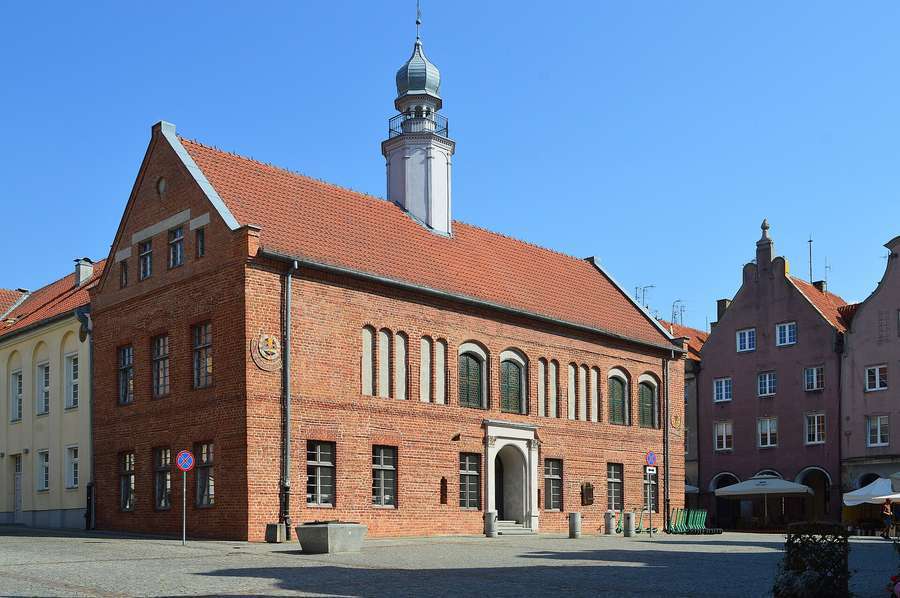
Olsztyn's old town is small, warm-bricked and unhurried. Start at the market square with the gothic Old Town Hall, then walk to the High Gate, the last survivor of the medieval city walls, and down to St James's cathedral, whose ribbed vaults are among the finest brick gothic interiors in northern Poland. The streets between them hold the usual pleasures of a north-Polish old town: gabled facades in faded pastels, craft shops, a Sunday market crowd that thins to near silence by four, and plaques that tell the town's layered story. This was Allenstein in the Warmian prince-bishopric, a Catholic enclave inside Protestant Prussia, and the mix of Polish, German and Warmian identities is written into every second doorway. Nicolaus Copernicus lived at the castle for several years as administrator of the chapter's estates, organised its defence and, in the quiet of his duties, worked on the astronomy that would reorder the universe; the tower where tradition places his observations still stands over the Łyna. The Łyna river cuts through the city in a green gorge, and the path along it from the centre towards the lake districts is the locals' default evening walk, lined with old mills and footbridges. In autumn the riverside chestnuts and beeches turn, and the whole walk smells of wet leaves and wood smoke from the allotment gardens on the slopes.
The lakes: Ukiel and beyond
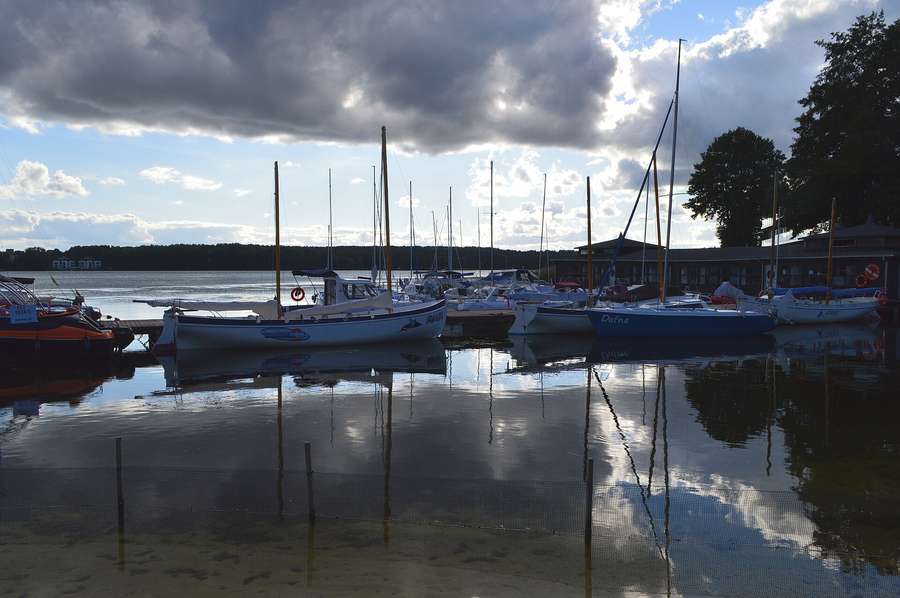
What makes Olsztyn unusual among Polish cities is the water. Around a dozen lakes lie within the city limits, and the biggest, Lake Ukiel, also called Krzywe, functions as the city's own seaside: a long sandy beach, a guarded swimming zone in summer, a marina, water-ski lifts and a promenade lined with seasonal bars. Off-season the lifts and bars close, the sails come off the masts, and the lake turns into the best urban walking circuit in the region: an eight-kilometre shoreline path through pines, mist over the water on cold mornings, and crows arguing on the empty piers. Lake Kortowskie on the southern edge holds the university campus and a famous rowing course, and Lake Długie offers a wilder, reed-fringed shore minutes from the centre. Bring binoculars in October: cormorants, herons and migrating waterfowl work the quiet water, and the reed beds rustle with the last warblers heading south.
The practicalities of a lakeside visit off-season are simple. The city trams and buses reach the Ukiel beach terminus in minutes from the centre, the shoreline path is paved or well-packed gravel almost the whole way round, and the few year-round cafes near the beach stay open for hot soup and apple pie. Autumn storms come through fast here; the lake can go from glass to whitecaps in twenty minutes, which is half the fun to watch from behind glass with coffee, and a reason to keep the walk flexible rather than fixed.
With children
The city's planetarium, named after Copernicus, runs weekend sky shows that rescue a rainy autumn afternoon, and the astronomical observatory up the hill opens for evening viewing sessions. The Aquasfera water park complex by the centre covers the swimming urge when the lakes are too cold, and the forest education trails around Lake Ukiel keep shorter legs busy. Olsztyn is also an easy base for the region's day trips. The castle at Reszel, one of the most complete medieval complexes in the region, sits in a town of two thousand people that feels suspended in 1910, and Lidzbark Warmiński's bishop's castle guards the Łyna further north. Eastwards, the land breaks into the classic Masurian mosaic of lakes and eskers; the sailing ports begin at Mikołajki, about an hour's drive away, and the forest roads between them are the best autumn driving in Poland, empty once the summer caravan returns home.
Food and evenings
Olsztyn eats like a border town of many histories: Warmian kartacze and pierogi alongside Masurian lake fish, especially smoked vendace and zander, and a growing row of modern bistros around the old town square. Autumn is mushroom season, and every menu within fifty kilometres shows it. Evenings are quiet by design; this is a town for a long dinner and a short walk home past the floodlit cathedral, not for clubs. Coffee culture punches above the city's size: several roasteries and cake shops around the old town do the kind of slow weekend trade that rewards a second cappuccino, and the covered market near the centre sells the region's smoked fish, honey and autumn mushrooms for the trip home.
A realistic weekend plan
Day one: train in by midday, old town loop from the High Gate through the square to the cathedral, a look at the castle from outside, then the Łyna gorge path as the light drops, dinner on the square. Day two: the full Lake Ukiel circuit in the morning mist, a long brunch, the planetarium or a museum branch if it rains, and the evening train home. Everything here runs on walking shoes, a rain shell and low expectations of crowds, which is exactly the point of coming now.
Frequently asked questions
Is the Olsztyn castle open to visitors?
No. The Castle of the Warmian Chapter, home of the Museum of Warmia and Mazury, closed on 14 September for a planned three-year renovation under the FEnIKS programme. The museum directs visitors to its other branches, and the castle's exterior and courtyard setting can still be viewed.
How do I get from Warsaw to Olsztyn?
Direct PKP Intercity trains run several times a day between Warsaw and Olsztyn Główny. A new IC Pojezierze service also links Olsztyn with Poznań via Iława, Toruń, Inowrocław and Gniezno in six daily pairs. By car it is about two and a half hours via the S7 and S51.
Is Olsztyn worth visiting off-season?
Yes, if you like walking and water. The lakes, riverside gorge and forests are at their best in autumn colours, the old town is crowd-free, and trains run year-round. The trade-offs are the closed castle and seasonal lakeside bars.
Which lake is best for a walk in Olsztyn?
Lake Ukiel (Krzywe), the city's biggest, has the best shoreline circuit: about eight kilometres of pine-fringed path past the beach, marina and piers, with cafes near the beach end. Lake Kortowskie and Lake Długie are quieter alternatives.
Can I visit Olsztyn without a car?
Yes. Direct InterCity trains connect Olsztyn Główny with Warsaw, and the new IC Pojezierze trains link the city with Poznań via Toruń. Trams and buses cover the lakeside districts, and the old town and Łyna gorge are all walkable. A car only becomes useful for day trips into the Masurian lake towns. * Photos: Cover - Olsztyn Old Town Hall on the market square by Scotch Mist, CC BY-SA 4.0, via Wikimedia Commons. Body - sailing boats on Lake Ukiel by Scotch Mist, CC BY-SA 4.0, via Wikimedia Commons.