Market halls in Poland for expats: hala targowa shopping guide
The essentials: Every big Polish city has a hala targowa - a market hall selling fresh produce, meat, cheese and flowers, best visited in the morning. Key ones: Hala Mirowska in Warsaw, Wroclaw's 1908 hall, Krakow's Stary Kleparz and Gdansk's hall, reopened as a food hall on 12 August 2026.
Poland has no shortage of supermarkets, but the country's food soul lives somewhere else: in the hala targowa, the market hall. Every major city has at least one - usually a grand iron-and-brick building raised around 1900 - and on a weekday morning they are the loudest, freshest and cheapest theatre of Polish daily life. This is where pensioners queue for white cheese at 7 a.m., where restaurant chefs buy their mushrooms, and where an expat can eat, shop and learn the country in a single hour. Here is how the system works, city by city, plus the rules that catch newcomers out.
How market shopping works
A market hall is not a farmers' market in the Western weekend sense - it is a working food shop that happens to be divided into dozens of independent stalls. Fruit and vegetable stands share the floor with butcher counters, cheese sellers, egg ladies, pickle and preserves stalls, bakeries, flower sellers and the odd household-goods corner. Each stall is a small business with its own prices, so the same tomatoes can cost different money ten steps apart. Regulars have their stalls; newcomers are welcomed with a slice of apple or a taste of cheese before they commit.
Timing is everything. Go in the morning - the travel.pl markets guide (14.03.2026) advises morning or late morning for freshness and local energy, and suggests 30-60 minutes is the right visit for most halls. By mid-afternoon the best of the day is gone and some stalls close early. Buy perishables only when you can store or eat them soon, and do not treat every hall as a restaurant: some are pure shopping, others double as lunch spots, and knowing which is which saves a hungry walk.
One more rule before the tour: the Sunday trading ban. Most traditional halls simply do not open on Sundays - check before you plan a weekend visit. The modern food halls, which count as gastronomy, are exempt and open seven days a week.
Warsaw: Hala Mirowska and Hala Gwardii
The twin halls on Plac Mirowski are Warsaw's market headquarters. Built in 1899-1901 on the site of the Mirow barracks, they were the city's largest trading building until 1944, when they burned during the Warsaw Uprising - 510 Varsovians were executed against the wall of Hala Mirowska, commemorated by a plaque on the preserved north-west corner, where bullet marks are still visible. The halls were rebuilt in the 1960s, entered the monuments register in 1986, and have been run since 1974 by the Spolem cooperative, which bought the building in 1997 and spent roughly 10 million zloty on conservation, according to the operator's own history page.
Today Hala Mirowska opens Monday to Friday 7:00-20:00, Saturday 7:00-18:00, and on trading Sundays 8:00-16:00, per the operator's current listing. Inside and around it you will find the full spread: produce stands, meat and cold cuts, dairy, a press salon, household stalls and even a 24-hour grocery counter on the square. Next door, Hala Gwardii has been reborn as a food hall - the modern counterpart where the same neighbourhood eats out at night.
Krakow: Stary Kleparz and the hall with the blue van
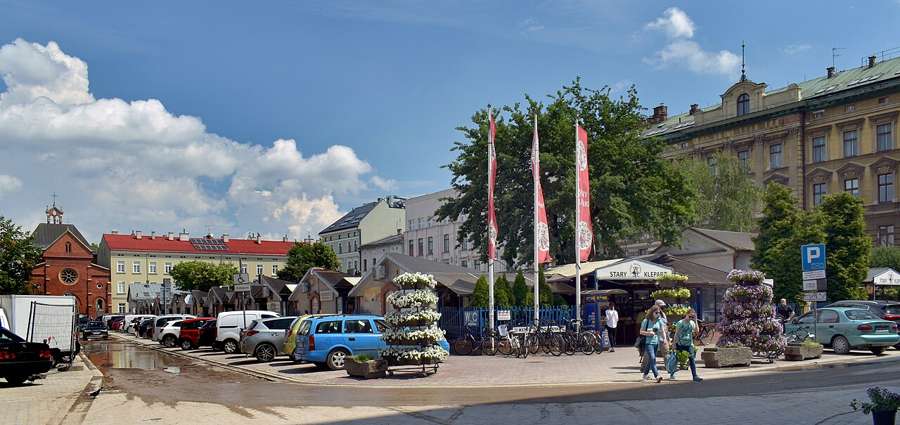
Krakow does its market shopping in two places, five minutes apart. Stary Kleparz, on Rynek Kleparski just north of the Old Town, has been trading since the 17th century and remains the city's beloved open-air market: shouting sellers, gossiping regulars, seasonal stands and a fish stall with a serious reputation, as Poland Culinary Vacations describes it (10.05.2023). The same source repeats the local joke that a true Cracovian is someone who always haggles - and Kleparz is where they practise. Go before noon; the best stalls sell out.
Across the street, Hala Targowa on Grzegorzecka runs as a weekday market of small shops - meat, bread, spices, clothes - and on Sundays converts into a flea market of household goods, watches, guitars and everything between. Its most famous institution works nights: Kielbaski z Niebieskiej Nyski, two gentlemen grilling sausages from a blue communist-era van, serving a queue of students, tourists and nuns from 8 p.m. until 2 a.m. with bread, mustard and orangeade. It is the cheapest legendary meal in Poland.
Wroclaw: the cathedral of market halls
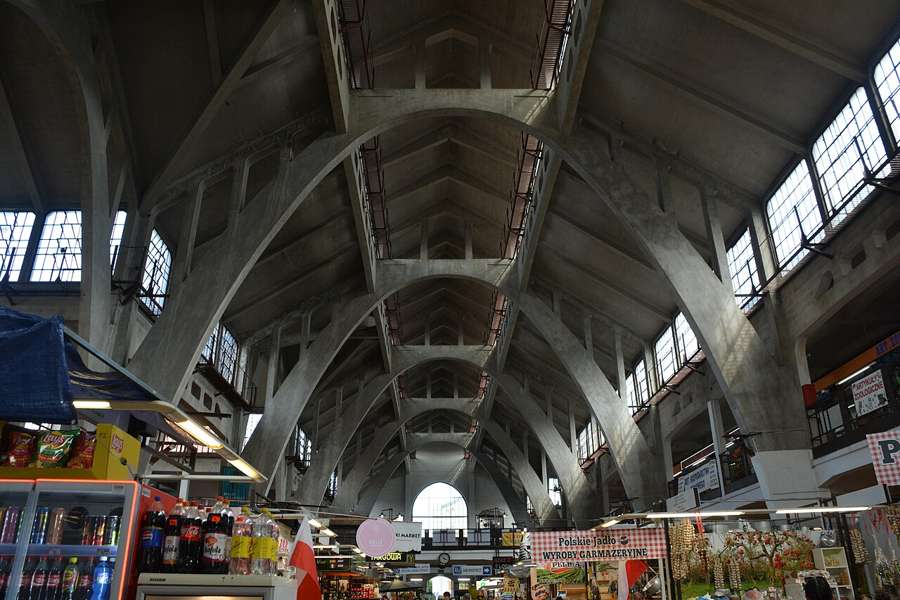
Wroclaw's Hala Targowa, built in 1908, is the one to see even if you buy nothing. The interior is a single soaring nave of reinforced-concrete arches and glass - architecture that belongs to the same era of daring engineering as the city's Centennial Hall. The city's official page (22.04.2026) lists the offer: groceries, fruit and vegetables, meat and cold cuts, food stalls, household goods, pet supplies, flowers, clothing and small services. Hours are Monday to Saturday 8:00-18:30, closed Sundays. Budget a slow morning: browse the ground floor, look up, then climb to the gallery for the small shops and the view.
Gdansk: the 141-million-zloty reboot
Gdansk has just shown where the Polish market hall is heading. After a renovation costing 141 million zloty, the city's hall at Plac Dominikanski 1 reopened on 12 August 2026 as a food hall with a trading soul, as Trojmiasto.pl reported on opening day. Three levels hold 34 units: four waiter-service restaurants upstairs, 17 street-food concepts on the ground floor, and a lower level called Deli & Bar that returns to the hall's shopping roots with bread, cheese, meat, cold cuts, fish and Italian goods. The restoration kept the historic structure exposed, set archaeological finds into the lower level, and embedded 15 kg of collector's amber into the tables - a very Gdansk detail.
Hours reflect the new model: the Deli shops open Monday-Saturday 7:30-19:30 and Sunday 9-15, while the street-food floor runs into the late evening seven days a week. It is the clearest sign yet that the hala targowa is not dying - it is evolving.
When the hall beats the supermarket - and when it does not
The honest comparison surprises many newcomers. On staple vegetables, dairy and eggs, market prices roughly match the discount supermarkets; the hall wins on quality, freshness and choice, not on every price tag. Where it clearly wins: seasonal fruit at its peak, proper butcher cuts and sausages the chains do not carry, white cheese sold by the slab from the morning's delivery, fresh farm eggs, honey from named apiaries, and flowers at a third of florist prices. Where the supermarket wins: packaged goods, frozen food, anything at 10 p.m., and the rainy-day convenience of one receipt and one queue. Most Polish households run both - a weekly hall visit for the good stuff, supermarkets for the rest - and expats end up doing the same within a few months.
A year at the stalls
Market shopping teaches you the Polish calendar faster than any guide. Spring opens with early vegetables and the first greenhouse cucumbers, then explodes into strawberry season in June - the month when the country smells of berries and every stall piles them in cardboard punnets. Summer brings cherries, then blueberries, then the miracle of Polish tomatoes, which taste like the ones you remember from childhood holidays. Autumn is the grand season: apples in fifty varieties, forest mushrooms - fresh boletes sold by the basket - plums, pears and the first sauerkraut and pickles for winter jars. Winter narrows the stalls to roots, cabbage, apples and preserves, and the smart shopper leans on the butcher, the cheesemaker and the pickle lady instead. Buy what the stalls are overflowing with and you will never cook badly here.
On haggling, calibrate carefully. At the historic open markets - Stary Kleparz above all - a friendly attempt at a discount is part of the ritual, especially if you buy in quantity or near closing time. At hall stalls, posted prices are close to fixed and nobody expects a negotiation; the accepted move is to ask for a taste, then a slightly larger portion for the same money. Stallholders round down for regulars without being asked, which is the market's quiet loyalty programme and the best argument for picking your stalls and staying faithful to them.
Buying like a local
A few habits separate the regulars from the tourists. Bring a tote bag - bags are not automatic. Learn three words: poprosze (I would like), ile to kosztuje (how much is it), and dziekuje (thank you), and the stalls open up. Taste before you buy when offered - it is an invitation, not a trap. Buy what is in season and Polish first: apples and mushrooms in autumn, strawberries in June, oscypek and preserves year-round. Pay attention to the flower stalls even if you are not buying - the prices explain why Poles arrive everywhere with bouquets. And if you shop the same stall three times, expect the stallholder to remember you, round your total down and slip an extra tomato into your bag. That is the whole point of the place. A market hall is the rare institution that feeds you, teaches you the language and introduces you to your neighbours at the same time - all before breakfast.
Frequently asked questions
What is a hala targowa?
A market hall - a covered building, usually historic, filled with stalls selling fresh fruit and vegetables, meat and sausages, dairy, eggs, flowers and household goods. Many Polish cities built theirs around 1900, and they still anchor everyday food shopping alongside the open-air targowisko markets.
Are Polish market halls open on Sundays?
Usually not. The Sunday trading ban keeps most traditional halls shut on Sundays - Wroclaw's hall lists Sunday as closed, and Warsaw's Hala Mirowska opens only on designated trading Sundays, 8:00-16:00. Food halls like Gdansk's reopened hall are exempt and trade seven days a week.
When is the best time to visit a market hall?
Morning, ideally before noon. Stalls are fully stocked, the crowd is locals doing real shopping, and popular items - fresh cheese, eggs, seasonal fruit - sell out by afternoon. A travel.pl markets guide (14.03.2026) suggests 30-60 minutes is the right visit length for most halls.
Can I haggle at a Polish market?
Light haggling is part of the culture at open-air markets like Krakow's Stary Kleparz, where locals have traded since the 17th century, but prices at hall stalls are close to fixed. Asking for a small discount when buying larger quantities is acceptable; aggressive bargaining is not.
What should I buy at a Polish market hall?
Seasonal produce at its peak, white cheese (twarog) and smoked oscypek, fresh eggs, kielbasa and cold cuts from a proper butcher stall, honey, preserves and flowers. Prices often beat supermarkets on quality items, and stallholders will usually let you taste before you buy.
Which Polish city has the best market hall?
For architecture, Wroclaw's 1908 hall with its soaring concrete arches. For atmosphere and history, Krakow's Stary Kleparz. For a working big-city market, Warsaw's Hala Mirowska. For a modern food-hall experience, Gdansk's hall, rebuilt for 141 million zl and opened on 12 August 2026 with 34 food and retail units over three levels. <em>Cover: Inside Wroclaw's market hall - photo by Jonashtand, CC BY-SA 4.0, via Wikimedia Commons. Body: Stary Kleparz market in Krakow - photo by Zygmunt Put Zetpe0202, CC BY-SA 4.0, via Wikimedia Commons.</em>
Sources
- City of Wroclaw - Hala Targowa hours and offer (22.04.2026)
- Trojmiasto.pl - Gdansk Hala Targowa reopening (12.08.2026)
- Spolem WSS - SDH Hala Mirowska, operator page (undated, checked 26.10.2026)
- Poland Culinary Vacations - markets of Warsaw, Krakow, Wroclaw (10.05.2023)
- travel.pl - Poland food markets guide (14.03.2026)