Polish wedding etiquette for expats: gifts, oczepiny, poprawiny
The essentials: At a Polish wedding (wesele), guests give cash in an envelope (koperta) - 400-600 zl per person is a solid 2026 amount for friends. The reception runs all night with wave dinners, vodka toasts and dancing, hits the oczepiny ritual at midnight, and is often followed by a smaller poprawiny party the next day.
An invitation to a Polish wedding is one of the best things that can happen to an expat in Poland - and one of the most disorienting. The wesele, the wedding reception, is not a dinner with a party attached. It is a twelve-hour marathon of food, vodka, dancing and rituals that have survived centuries, and it usually comes with a second, smaller party the next day. Here is what actually happens, what is expected of you, and how much money to put in the envelope.
The shape of the day
A Polish wedding day has two distinct halves. The slub is the ceremony itself, either a church wedding (the most common form) or a civil ceremony at the registry office. The wesele is everything after: the reception at a hired hall or restaurant that typically starts in the late afternoon and runs until four or five in the morning. Guests are expected at both unless the invitation says otherwise, and leaving the wesele before midnight without a good reason is quietly noticed.
Couples marrying abroad often split these across two days or even two countries, but the classic Polish format is ceremony, then straight to the hall. If you are dealing with the paperwork side - a Polish partner, documents, the registry office - our guide to civil weddings in Poland for foreign partners covers that process.
The envelope: how much money to give
This is the question every guest asks, and Poland answers it openly. Cash in a card, called the koperta, is the standard wedding gift. Physical gifts are rare unless the couple asks for them. The working rule is that your envelope should at least cover the cost of hosting you - Poles call this unit the talerzyk, literally "the little plate" - plus something extra for the couple's new life.
The numbers move with inflation, so use current ones. An August 2026 survey on wedding gift trends, reported by Polsat News on 19 August 2026, found that guests see the closest circle - witnesses and immediate family - as owing the most, with the 751-1000 zl range the most common answer (24.9% of respondents) and 18.9% putting the figure between 1001 and 1500 zl. A 25 October 2026 report by Nowosci.com.pl put practical 2026 ranges like this: a single guest or distant relative, roughly 400-800 zl per person; friends, 400-700 zl per person, so 800-1400 zl per couple; siblings, 1000-2000 zl; witnesses, 1500-3000 zl; parents, 3000-6000 zl. With a typical reception for 100 guests now costing 70,000-100,000 zl, the per-person hosting cost alone runs to several hundred zloty, which is why the talerzyk logic matters.
For an expat invited as a friend or colleague, 400-600 zl per person is a safe, respectable envelope in 2026. Go higher if you are close to the couple, if a plus-one comes with you, or if the couple is covering your accommodation. Hand the card over in person during the congratulations line after the ceremony or at the reception entrance - there is no gift table.
Bread, salt and the first toast
When the newlyweds arrive at the reception venue, their parents greet them at the door with a loaf of bread, a dish of salt and two glasses of vodka. The couple breaks off pieces of bread, dips them in salt and eats them - a wish that they will never know hunger and that their life will have both flavor and hardship to overcome together. They drink the vodka and throw the glasses behind them; broken glass means luck. Watch the glasses: tradition says whoever gets the glass with vodka will rule the marriage, and some couples negotiate this with a wink.
Guests do not take part in this ritual. You watch, applaud, and file in for the congratulations line.
The wesele itself
The reception runs on a rhythm that surprises foreigners: eat, dance, eat, dance, repeated until dawn. There is no single seated dinner. Instead, hot courses arrive in waves - typically four or five of them across the night - separated by dance sets. A cold buffet stays open all night, and a country table, the wiejski stol, with sausage, bread, pickles and smalec appears later for midnight snacking.
Vodka is structural. Bottles sit on every table and toasts happen constantly. Nobody forces you to drink - "I'm driving" or a simple no thanks is accepted, and asking for water instead is completely normal. But refusing every single toast while making a show of it reads as cold. The easy middle ground: raise the glass, sip, put it down.
Sto lat is unavoidable. Guests sing the hundred-years song to the couple at least once, usually several times, and you will know the melody by the end of the night. Nobody expects you to know the words; humming along is fine.
The first dance opens the floor. The couple performs a rehearsed first dance, then everyone joins. Polish weddings dance hard - expect a live band or DJ alternating Polish pop, disco polo, and international hits, and expect guests of every age on the floor until morning.
Oczepiny: the midnight turning point
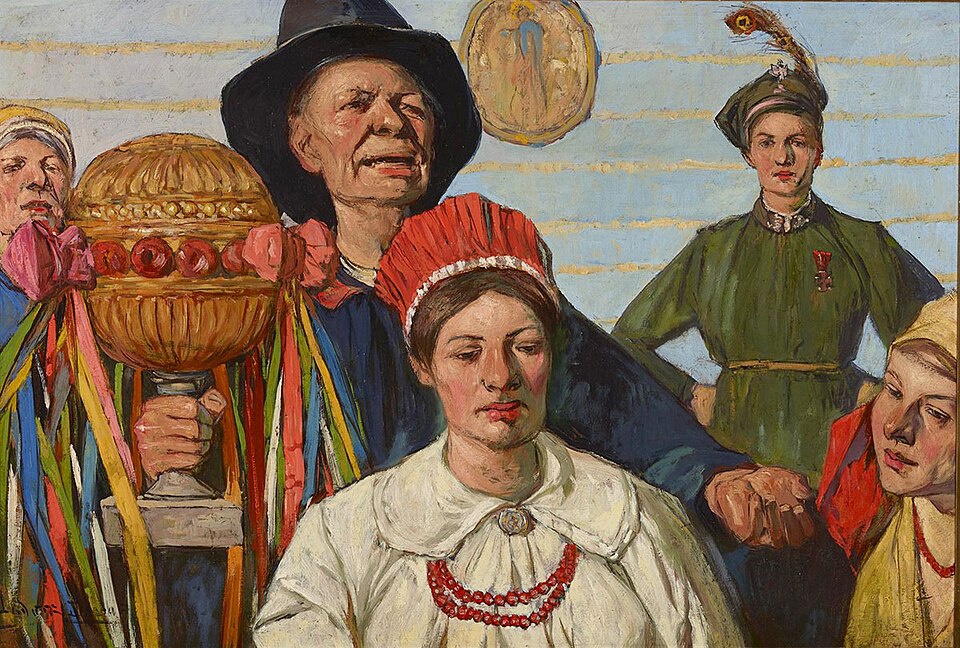
Around midnight comes oczepiny, the oldest ritual of the night. Historically it marked the bride's passage from maiden to married woman: her wreath or veil was removed and replaced with the czepec, the married woman's cap, while married women sang the ancient song "Oj, chmielu" - a moment of genuine ceremony, sometimes tears, described in records going back centuries.
The modern version is a party game. The bride throws her veil (or bouquet) to the unmarried women, the groom throws his bow tie or tie to the unmarried men, and the catchers are teased as next in line to marry. In some regions guests pass the bride around or play games with the couple. It is loud, silly and entirely optional to join - but as a foreigner, being dragged into it is a compliment, not an ambush. Many urban weddings now skip oczepiny altogether or reduce it to the veil toss; village weddings keep the fuller version.
Poprawiny: the wedding continues
In many parts of Poland, especially outside the big cities, the wesele has a sequel. Poprawiny is a second, smaller party the following day - leftovers, more music, more vodka, sometimes at the same hall, sometimes at a family home. Not every wedding has one, and guests from far away are not expected to stay for it, but if you are invited and you can go, it is the relaxed, talkative version of the main event. Envelopes are not given twice; your presence is the gift.
Village extras you might meet
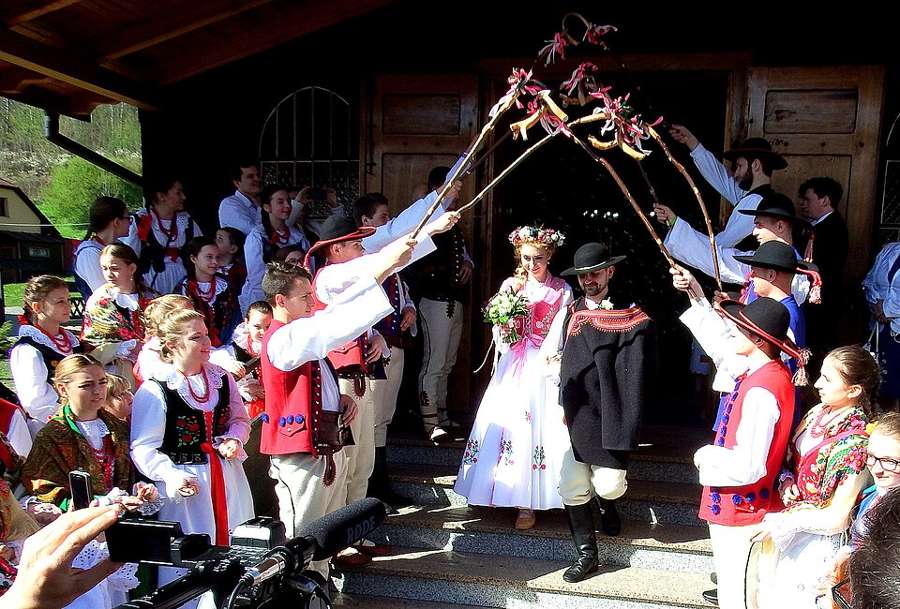
In the countryside, especially in the south, two extras survive. Bramy are the "gates" neighbors build on the road between the bride's house and the church - decorated barriers that the wedding car must stop at and pay a toll for, traditionally a bottle of vodka, while onlookers cheer. And in the Podhale highlands, full folk weddings with embroidered costumes, a highlander band and a violin-led procession to church still happen, as in the cover photo from Juszczyna in the Beskid Zywiecki. If you are invited to one of those, drop every plan you had for the weekend.
What to wear and how to survive
Dress is formal: suit and tie or an elegant dress. Polish weddings are photographed exhaustively and the couple keeps those photos forever, so err on the dressier side. One practical note: bring comfortable shoes or accept that your feet will hurt - you will dance for hours.
Pacing is the real skill. Eat at every course, drink water between vodkas, and remember the night is six to ten hours long. Nobody is impressed by the guest who peaks at 22:00. Arrange transport home in advance - rural halls are rarely near anything, and taxis should be booked ahead or via an app.
Frequently asked questions
How much money should I give at a Polish wedding in 2026?
As a friend or colleague, 400-600 zl per person is a solid envelope. The rule of thumb is to cover the cost of hosting you (the talerzyk, several hundred zloty per head at current prices) plus extra. Close family and witnesses give much more - 1000-3000 zl and up, per 2026 survey data.
What is oczepiny?
A midnight ritual marking the bride's transition to married life. Today it is mostly a game: the bride tosses her veil to single women, the groom tosses his tie to single men. Older and rural weddings keep more of the historical ceremony, which once included replacing the bride's wreath with a married woman's cap.
What is poprawiny?
A second, smaller party the day after the wedding - food, music and family, without the formal program. Attendance is optional for distant guests; no second gift is expected.
Do I have to drink vodka at a Polish wedding?
No. Toasts are frequent but nobody is obliged to drink. Decline politely, ask for water or juice, or simply sip. Driving is a universally accepted excuse. Refusing aggressively or lecturing about alcohol is the only way to get it wrong.
What should I wear?
Formal: a suit with a tie, or a cocktail or evening dress. The wesele runs all night, so bring shoes you can actually dance in.
Can I leave before the end?
Leaving after midnight, once oczepiny has happened, is socially fine. Sneaking out at 21:00 is not - if you must leave early, say a proper goodbye to the couple and their parents. <em>Cover: Highland wedding guests in folk costume welcome the newlyweds in Juszczyna, Beskid Zywiecki - photo by Marek Jurasz, CC BY-SA 4.0, via Wikimedia Commons. Body: "Oczepiny" by Ludwik Stasiak, public domain, via Wikimedia Commons.</em>