Poznań Weekend Guide: Goats at Noon, Cathedral Island and Croissants
The essentials: Two days in Poznań covers the Stary Rynek with its noon goat show, Ostrów Tumski cathedral island, the Porta Posnania centre (35 zł), Citadel Park and Lake Malta, plus St Martin's croissants. Nonstop express trains from Warsaw take about 2 h 20 min.
Poznań is the quiet achiever of Polish city breaks: a riotously colourful market square, two mechanical goats that butt heads above the town hall clock, the island where the Polish state was born, a croissant so local it has EU legal protection, and a fast nonstop train from Warsaw. Two days is exactly right. This plan uses current operator, museum and city sources, with the closures and timetable changes worth knowing before you book.
Getting there from Warsaw
PKP Intercity links Warsaw and Poznań with direct trains all day. The fastest are the nonstop expresses: the operator's autumn 2025 release put the best Poznań-Warsaw time at 2 hours 18 minutes on the EIC services, and its 2026/2027 timetable announcement keeps the fastest expresses at around 2 hours 16 to 2 hours 20 minutes, with express departures building up to roughly one an hour from 13 December 2026 and 26 pairs of trains a day between the two cities. Slower IC services with intermediate stops cost less and take longer.
Two practical notes. First, between 21 October and 8 November 2026 the IC Łokietek runs via Warszawa Gdańska instead of Warszawa Centralna while cross-city works finish, so check the departure station printed on your ticket. Second, Poznań Główny station is integrated with the Avenida mall and the main tram hub; the Stary Rynek is two tram stops or a 20-minute walk away. City trams and buses have ticket machines at stops and on board, and the centre is compact enough to walk.
Data source: PKP Intercity press office, 2026/2027 timetable release for Wielkopolskie and autumn 2025 service release (intercity.pl), checked 22 October 2026.
Day one: the Stary Rynek and the goats
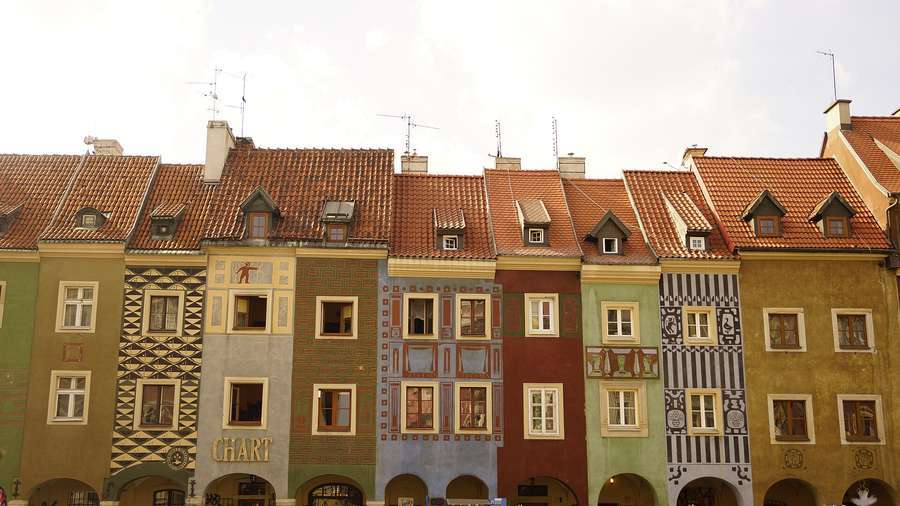
The Stary Rynek is a near-perfect square, 141 metres a side, laid out when the city was chartered in 1253. Around it stand the famous domki budnicze, narrow arcaded merchants' houses painted in bright patterns, and four baroque fountains. In the middle rises the Renaissance town hall, often called the most beautiful north of the Alps.
Every day at 12:00 and 15:00, two small mechanical goats emerge from a door above the town-hall clock and butt heads twelve times, a ritual going back to a 16th-century clock and a legend about two runaway kitchen goats. The crowd gathers a few minutes before the hour, and children sit on shoulders at the front. The goats even have names chosen by residents in 2002: Pyrek, from the local dialect word for potato, and Tyrek, from the verb for hard work.
One important caveat: the Museum of Poznań inside the town hall is closed for renovation until 30 November 2027, and parts of the building are scaffolded. The goats still perform, though the mechanism has had occasional pauses during the works, so treat the noon show as probable rather than guaranteed and have the square's cafes as a backup plan.
Data source: City of Poznań tourism portal (visitpoznan.pl) and National Museum in Poznań notices, checked 22 October 2026.
Day one, afternoon: croissants and the museum of croissants
Poznań's signature pastry is the rogal świętomarciński, the St Martin's croissant: a heavy, folded crescent of dough filled with white poppy seeds, almonds and raisins, glazed and topped with nuts. Its recipe is protected at EU level with a PGI registration, and it is eaten all year in Poznań, not only on St Martin's Day, 11 November. Buy one from a bakery window and eat it warm on a bench by the fountains.
On the square itself, the Rogalowe Muzeum Poznania runs short, funny live shows in a Renaissance townhouse overlooking the town-hall tower, explaining the croissant's history with audience participation and a tasting included. Shows are timed and fill up at weekends, so book online a day or two ahead. It is one of the best rainy-afternoon options in the city, especially with children.
Day two morning: Ostrów Tumski and Porta Posnania
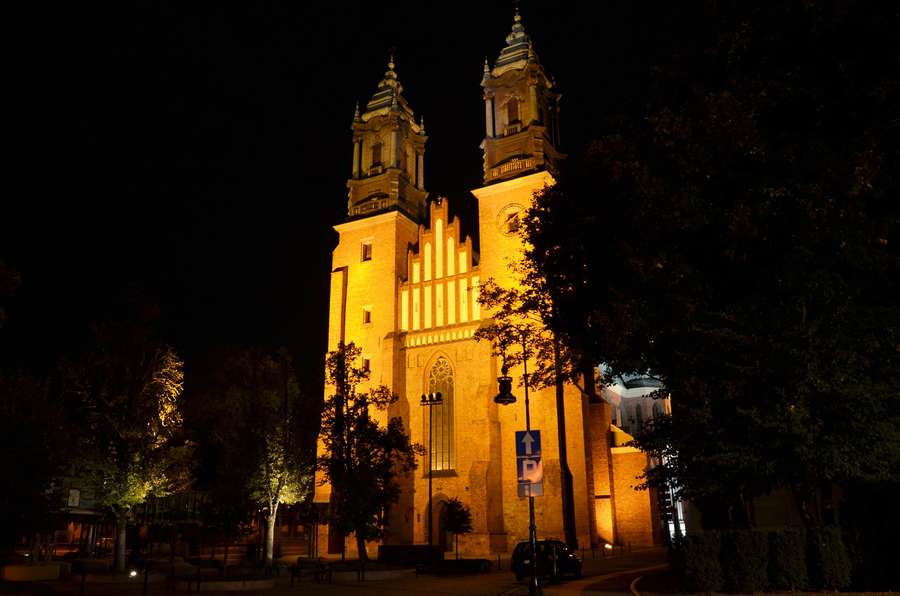
The oldest part of Poznań is not the market square but Ostrów Tumski, the cathedral island on the Warta's eastern branch, where a fortified settlement stood in the 10th century and where Poland's first rulers are buried in the crypt of the cathedral of Saints Peter and Paul. The island is quiet, small and free to wander: cobbled lanes, canons' houses, a small lock-covered footbridge of its own, and the cathedral's Golden Chapel, the neo-Byzantine mausoleum of Poland's first two rulers, Mieszko I and Bolesław the Brave. Come near sunset, when the tour groups have gone and the twin towers catch the last light over the river.
The modern gateway to the island is Porta Posnania (Brama Poznania ICHOT), an angular concrete-and-glass heritage centre reached by a footbridge over the river. Inside, an audio-guided exhibition tells the story of the island and the beginnings of the Polish state. It is open Tuesday to Friday 9:00 to 18:00 and at weekends 10:00 to 19:00, closed on Mondays. Tickets are 35 zł normal and 29 zł reduced; a family ticket for up to two adults with children up to 18 costs 75 zł for up to five people. Within ten days of your visit, the same ticket also admits you to the Archdiocesan Museum and the Genius Loci archaeological reserve next door, which makes the combined circuit very good value.
Data source: Brama Poznania ICHOT official price list (bramapoznania.pl), checked 22 October 2026.
Day two afternoon: Citadel Park and Lake Malta
North of the centre, Park Cytadela spreads over the earthworks of a 19th-century Prussian fortress: walking paths, rose gardens, military cemeteries, fragments of red-brick forts and two military museums scattered among the trees. It is free, huge, and the best place in the city for a long walk; in late October the leaf colour is at its peak.
East of the centre, Lake Malta is a long artificial rowing lake ringed by a walking and cycling loop, with a thermal-baths complex at one end, a small ski slope on its bank and a narrow-gauge railway running along it in season. One thing to skip for now: the city's historic Palm House near Wilson Park is closed for a full rebuilding, with no reopening date announced, so leave it off the plan until the city says otherwise.
Data source: Palmiarnia Poznańska official site (palmiarnia.poznan.pl), checked 22 October 2026.
If you have extra time
A third day or a long evening opens up the neighbourhoods. Stary Browar, a former Hugger brewery converted into an art-and-shopping centre a few minutes south of the square, mixes galleries, design shops and a park-like courtyard, and is the locals' default bad-weather destination. West of the centre, the Imperial Castle, a cavernous neo-Romanesque residence built for Wilhelm II, now houses a cultural centre with cinemas and exhibitions, and the surrounding Jeżyce district rewards a wander with its market hall, murals and some of the city's best cafes. The Jeżyce market (Rynek Jeżycki) on a Saturday morning is where Poznań actually shops: flower stalls, regional cheese, and queues at the bakery counters that tell you which stand to join.
Food and practical notes
Order pyry z gzikiem at least once: boiled potatoes with a tangy cottage-cheese, sour-cream and chive mix, the simplest and most local plate in the region, followed by a croissant for dessert. Card payment is universal, including on trams. English is common in the centre. If you visit around 11 November, St Martin's Day, the city fills with croissant stalls and a street parade, and bakeries sell the rogal by the tonne; it is the single busiest and most atmospheric weekend of Poznań's year, so book trains and hotels early.
A realistic weekend plan
Saturday: morning express from Warsaw, drop bags near the centre, the Stary Rynek, goats at noon, lunch, the croissant museum show and a slow evening among the square's floodlit facades. Sunday: Porta Posnania and the cathedral island in the morning, Citadel Park or Lake Malta in the afternoon, then the evening train back. The plan works year-round; in winter swap the lake loop for an extra museum.
Frequently asked questions
How long is the train from Warsaw to Poznań?
The fastest nonstop EIP and EIC express trains take about 2 hours 16 to 2 hours 20 minutes according to PKP Intercity; slower IC services cost less and take longer. Trains run throughout the day in both directions.
When do the Poznań goats appear on the town hall?
Every day at 12:00 and 15:00 the two mechanical goats butt heads twelve times above the clock. The town-hall museum inside is closed for renovation until 30 November 2027, but the goats still perform.
How much does Porta Posnania cost?
Tickets are 35 zł normal and 29 zł reduced; a family ticket for up to two adults with children up to 18 is 75 zł. The centre is open Tuesday to Friday 9:00 to 18:00 and weekends 10:00 to 19:00, closed Mondays.
What is a rogal świętomarciński?
Poznań's St Martin's croissant: a heavy folded pastry filled with white poppy seeds, almonds and raisins, protected with an EU PGI registration and sold in the city's bakeries all year, with the peak on 11 November.
Is Poznań a good weekend trip with children?
Yes. The noon goat show, the interactive croissant-museum shows with a tasting, the audio-guided Porta Posnania exhibition with its family ticket at 75 zł, and the open space of Citadel Park all work well with children, and the centre is flat and walkable. * Photos: Cover - the domki budnicze merchants' houses on Poznań's Stary Rynek by MNS Design, CC BY-SA 3.0 PL, via Wikimedia Commons. Body - Poznań cathedral on Ostrów Tumski at night by Tomasta1, CC BY-SA 3.0 PL, via Wikimedia Commons.