Voting in Poland as an EU citizen: register for local elections
Short answer: Non-Polish EU citizens living in Poland can vote in municipal and European Parliament elections and stand for the gmina council, but must first apply to their municipal office to be entered in the Central Voter Register.

If you are an EU citizen living in Poland, you can have a say in who runs your town hall. EU citizens who are not Polish can vote in municipal elections and in European Parliament elections held in Poland, and they can stand for the municipal council. The catch is that nothing happens automatically: you have to ask to be added to the voter register first. This guide explains who qualifies, how to register as of October 2026, what changed on 1 January 2026, and what the official pages leave open.
What an EU citizen can and cannot do
The National Electoral Commission (PKW) published a notice on 7 February 2024 for the local elections of 7 April 2024. It is the clearest official summary of the local-election rules for non-Polish EU citizens and for citizens of the United Kingdom, and its logic applies to every municipal election.
- You may vote for the municipal (gmina) council and, per the notice, for the mayor (wójt, burmistrz or city president).
- You may stand as a candidate for the gmina council if you have the right to vote in that council's election.
- You may not stand for the county (powiat) council or the regional assembly (sejmik), and you may not stand for mayor.
- The same rules apply to the district councils of Warsaw.
The Your Europe in Poland page on gov.pl adds that EU citizens who are not Polish can also vote and stand in European Parliament elections held in Poland, provided they are on the register. It says a person registered in Poland cannot vote in European Parliament elections in another member state, including their home country.
The sources reviewed cover municipal and European Parliament elections. They do not describe a right for EU citizens to vote in Polish presidential or parliamentary elections, and this guide does not claim one.
Who qualifies to vote
According to the PKW notice, you can vote in a municipal election if you:
- turn 18 on or before voting day;
- live permanently in the municipality and are included in the permanent voting district in the Central Voter Register (Centralny Rejestr Wyborców, CRW) for that area;
- have not been deprived of public rights by a final court ruling;
- have not been deprived of electoral rights by the State Tribunal;
- have not been legally incapacitated by a court.
The gov.pl service page for the same procedure uses the same conditions: you must be a citizen of an EU country other than Poland (or of the United Kingdom), you will vote in Poland, you live permanently in the municipality, and you have the right to vote.
Who qualifies to stand as a candidate
A candidate for the municipal council must have the right to vote in that council's election. The PKW notice adds that a candidate does not have to live in the electoral district where they stand. You lose the right to stand if you were finally sentenced to prison for an intentional crime prosecuted by public indictment or an intentional fiscal offence, for as long as the conviction is in the criminal register. You also cannot stand if you were deprived of the right to stand in your home country.
How to register in the Central Voter Register
You apply to the municipal office (urząd gminy) for the place where you live permanently. According to the PKW notice, the application states:
- surname and first names;
- citizenship;
- passport number or the number of another identity document;
- PESEL number;
- a declaration of your permanent address.
If you do not have a PESEL yet, you give extra details so that one can be assigned, such as sex, foreigner status (UE for EU citizens, NUE for UK citizens) and, where available, parents' names, birth date and place, and marital status. You may add an email address or mobile number and consent to having them stored in the contact data register.
Documents not in Polish must come with a translation by a sworn translator, and the notice says this also applies to other documents EU citizens submit in connection with elections.
Before deciding, the mayor must check that you actually live at the address you gave. The gov.pl service page says the service is free, that the office has 5 days to decide, and that if it has doubts it has 7 days to clarify them and then 5 days to decide.
There is no legal deadline for filing, according to the PKW notice. It warns, however, that the office needs time to process the request, so register well before the vote rather than in the last week.
What changed on 1 January 2026
The gov.pl service page states that from 1 January 2026 this matter can be handled online only through e-Doręczenia (electronic delivery). The same page says you need a login through login.gov.pl, for example a trusted profile or an e-ID card, and that you sign the application electronically. It also says you can file in person at the municipal office. The 2024 notice describes the online route as a gov.pl service signed with a qualified signature, trusted signature or personal signature, which shows how the process has shifted.
If you do not have an e-Doręczenia address, the paper route at the municipal office is still listed on the service page as a place of filing. Ask the office which form it wants before you go.
Older descriptions you may meet
The Your Europe in Poland page on gov.pl is undated. It describes the application in older terms: a "register of voters" kept by the municipality, with father's name and an identity document photocopy. It also names a 5-day processing time. Where it differs from the PKW notice (2024) and the live gov.pl service page, follow the newer sources and confirm requirements with your municipal office.
Voting somewhere else than home
The PKW notice says municipal elections are held only on Polish territory, so there is no voting abroad. You normally vote in the district that covers your permanent address. Exceptions in the notice cover voters in hospitals, social care homes, prisons and detention centres in the same voivodeship, who can be added to the register for those facilities. Check the PKW election notice published before each vote for the current rules on certificates and one-off changes, because they depend on the type of election.
When is the next vote
The municipal councils were elected on 7 April 2024. By our calculation, based on the five-year term, the next regular municipal elections will fall around 2029, as will the next European Parliament elections. The exact date is set by an official ordinance, so treat this as a planning estimate and not an announced date.
Practical checklist
- Confirm your permanent address is the one you want on the register, since the office will check it.
- Have your passport or ID and your PESEL ready.
- If your documents are not in Polish, ask the office whether a sworn translation is needed for your case.
- Apply to the municipal office, online via e-Doręczenia or in person.
- Keep the confirmation. The gov.pl page says you can follow the case under "Twoje sprawy" if you file online.
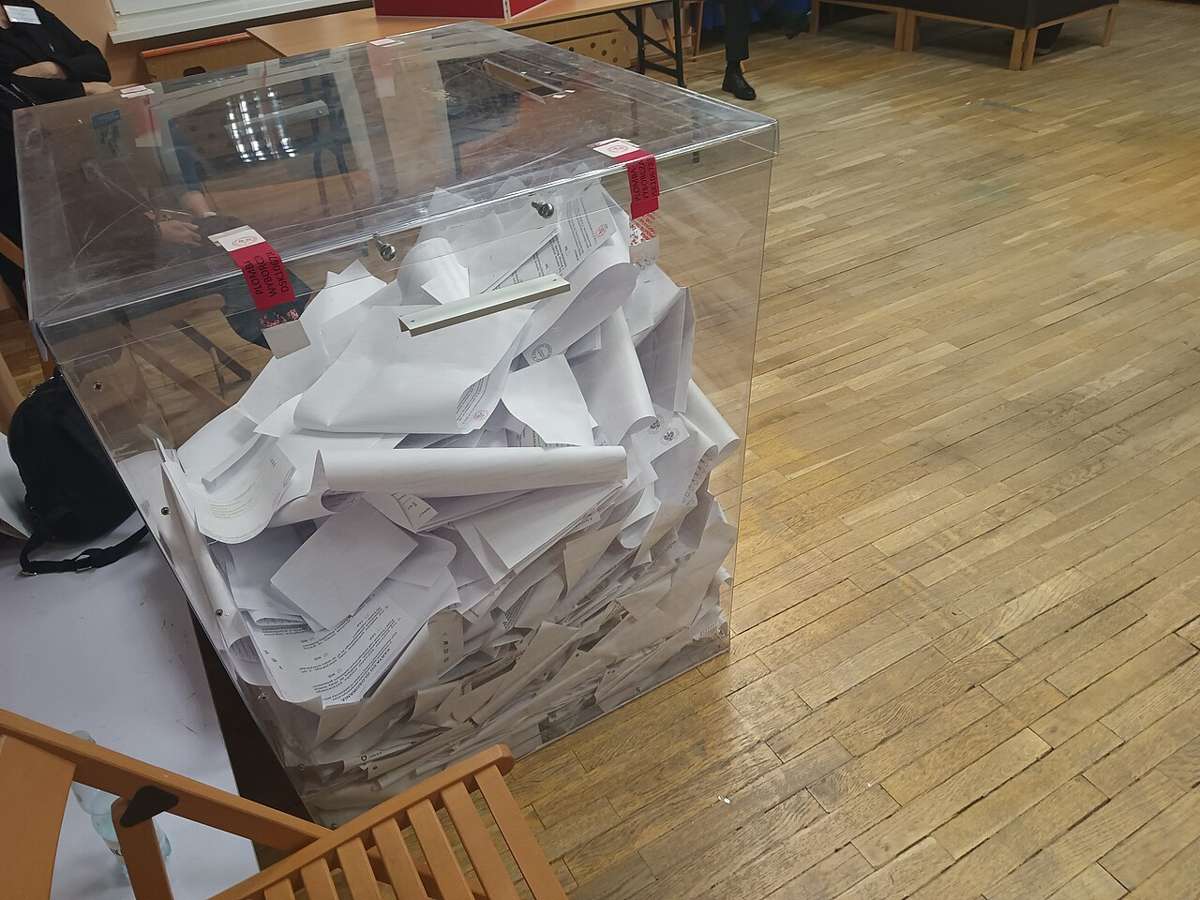
* Photos: Ballot box in Tomaszów Mazowiecki, October 2023, Wikimedia Commons (public domain). Cover: ballot box in the local elections, 7 April 2024, Wikimedia Commons (public domain). Illustrative.
Frequently asked questions
Can EU citizens vote in Poland?
Yes, in municipal elections and in European Parliament elections held in Poland, according to official gov.pl and PKW pages. You must first be entered in the voter register for your municipality.
Do I have to register before each election?
The sources describe a single application to be entered in the Central Voter Register. They do not set a filing deadline, but the office has 5 days to decide, so file early. Confirm with your municipal office if your situation has changed.
Can I stand as a candidate for mayor?
No. The PKW notice says EU citizens who are not Polish can stand for the gmina council, but not for county council, regional assembly or mayor.
Do I need a PESEL?
The PKW notice lists a PESEL in the application. If you do not have one, you give extra personal details so the office can assign it.