Weaving Workshops in Poland: Choosing Your First Loom Class
The essentials: Match the woven project to the class length, then confirm language, materials, borrowed versus take-home equipment, all meeting dates and the selected product’s cancellation terms. Do not infer availability from mixed or historical calendars.
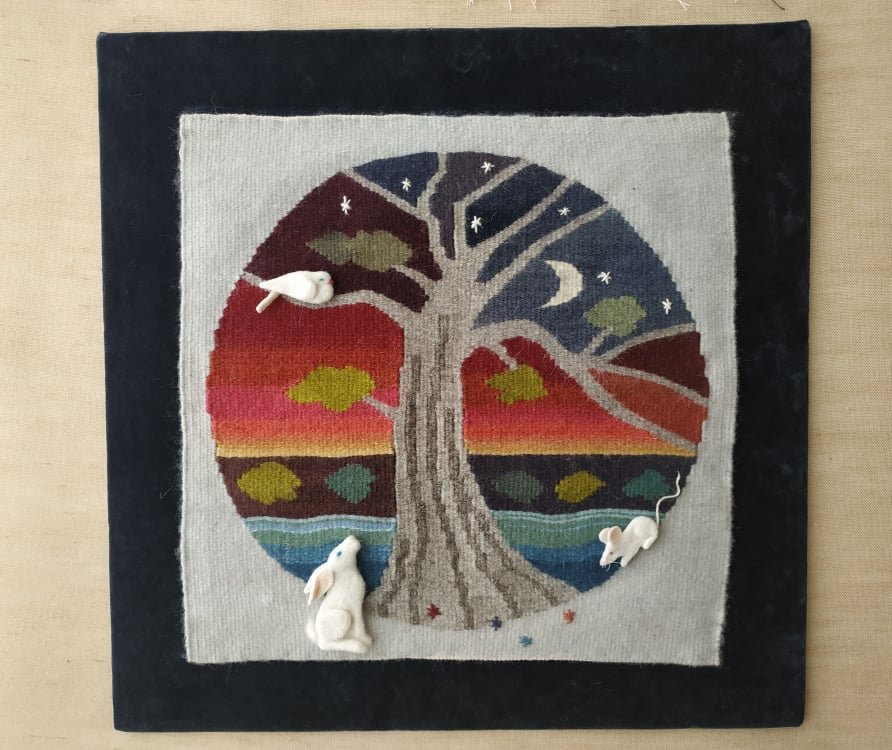
Abstract-tree tapestry. SEN Heritage Looms - Sophia Tsourinaki / Wikimedia Commons, CC BY-SA 4.0. Exact date unknown. Re-encoded; adaptation under the same licence. Contextual illustration, not work promised in a reviewed Polish beginner class.
A first weaving class in Poland does not have to start with a large floor loom or a plan to make a rug. Several beginner programmes use small frames and focus on a sample or wall hanging. The important questions are what you will weave, how much time you need and whether the frame stays at the studio or goes home with you.
The six programme pages below were checked on 28 October 2026. They are examples for comparing formats, not confirmation of upcoming places. Tartaruga's Poznań workshop took place on 20 September 2026 and is historical. Other listings need a current calendar and booking confirmation, especially where their date text or package examples are unclear.
Find the right kind of textile class
Look for tkactwo or tkanie when searching for weaving. A rama tkacka is a weaving frame; osnowa means warp and wątek means weft. These terms appear in the reviewed beginner descriptions. Knowing them helps you separate a weaving lesson from a general yarn craft event.
Ask which technique is the main project. Splotka's Wrocław basics page mentions several possibilities, including weaving, band weaving and other fibre activities. That range is not a promise that one short visit teaches everything. Tell the teacher you want an introduction to weaving and ask which project is realistic for your selected session.
Ośrodek Kultury Ochoty in Warsaw describes artistic weaving for adults with no previous experience, using specially prepared frames. Its introduction covers the basic terms, work with colour and texture, and finishing. This is a useful model for someone who wants a taught first encounter rather than independent access to equipment.
Do not assume every class photographed beside a large loom uses that loom. Ask what each participant works on and how much individual help is available. A small frame can be the intended teaching format, not a lesser substitute for the equipment in a promotional image.
Match the project to the time commitment
Splotka's basics description distinguishes a two-hour single meeting from a four-meeting package. It gives a small first piece of around 18 by 18 centimetres for one meeting and a more developed project of around 30 by 30 centimetres across four. Treat those as programme examples, not a guaranteed size regardless of your design and pace.
The same organiser's separate kilim workshop describes three hours and an approximately 18 by 25 centimetre wall decoration. Even at one studio, a short basics session and a defined wall-hanging project are different products. Check which one is in your basket rather than comparing the name “weaving workshop” alone.
Pracownia PoWoli in Cichawka offers a twelve-hour, two-day format. Its programme includes preparing a frame for work, weaving, removing the textile and finishing it. The description lists kilim, tapestry and cut-pile elements. Ask how those fit into your chosen project instead of expecting three complete separate textiles.
Centrum Kultury Podgórza's 2026/2027 course page describes a sequence of classes with samples and a small kilim, ending with removal from the frame. A course calendar is not a drop-in timetable. If you are joining after a cycle has begun, ask whether a beginner can enter and how any missed foundation work is handled.
Check materials and take-home equipment separately
There is a useful contrast between the reviewed providers. OKO says the frames, wool and warp string needed for its class are in the studio. Centrum Kultury Podgórza says frames are loaned for classes while participants provide the remaining materials themselves. Neither statement should be replaced by a generic “everything included” assumption.
For a bring-your-own-materials course, request the teacher's list before shopping. Ask about fibre type, quantity and any other essentials for the first meeting. If you already have yarn, describe it and ask whether it suits the planned exercise. A bag of assorted leftovers may not match the programme simply because it contains wool.
Splotka says its workshop tools and accessories are used during class and can be bought afterwards. That is different from including ownership in the ticket. Tartaruga's past 20 September 2026 Poznań event explicitly included a take-home frame and accessories, as well as the finished wall hanging.
The Tartaruga example shows why a take-home list matters, but it does not establish the package for a later workshop. Confirm the current event's materials, frame and accessory list. Compare the whole offer rather than assuming that a more expensive-looking ticket must include equipment to keep.
Ask about fibres, language and access
If a material causes a problem for you, raise it before attending. PoWoli says people allergic to wool or other natural fabrics can receive synthetic materials and asks them to mention the need by email. That is an organiser's offered accommodation, not a medical guarantee or a claim that another studio can do the same.
For English support, ask whether the teacher can explain the terms, demonstrate the work and help correct mistakes in English throughout the class. An English response about payment does not establish English teaching. Clarify how help works if the main group discussion is in Polish.
Also describe any practical need: a seated position, a suitable worktable, step-free entry or breaks during a longer session. Ask about the actual room and equipment rather than inferring access from a venue's name. A two-hour session and a two-day workshop may need quite different planning.
Age rules also differ. OKO describes an adult programme; PoWoli's page says 16 and above, and the Kraków course is also listed from age 16. If you want to attend with a teenager, confirm admission, whether a separate ticket is required and whether an adult must remain present.
Do not guess from an untidy calendar
Splotka's basics page mixes a weekday label, month-date lists and a note about later calendars. Its package rules also contain an example that does not provide a reliable current sequence. The safe approach is to request the actual dated meetings covered by your purchase, including the year, rather than reconstructing a timetable from fragments.
The kilim page also lists dates without consistently spelling out the year beside each option. This guide therefore does not present those options as available future workshops. Ask the organiser for the selected event's full date, venue and start time before making travel plans.
For a pass, ask when it starts, whether meetings must be consecutive and what happens if a planned session is cancelled. Splotka's basics terms say the four-meeting pass covers consecutive meetings after purchase and describe one notified absence rolling forward. Confirm how that applies to the actual calendar rather than assuming a flexible credit balance.
Read the correct cancellation rules
Two products from the same teacher can have different deadlines. Splotka's reviewed basics terms allow cancellation without cost until seven days before the workshop, then describe a 50 percent refund. Its separate kilim page uses fourteen days before the workshop for the no-cost cancellation point, then also describes a 50 percent refund.
Both describe transferring a ticket after notifying the organiser and forfeiture for a no-show. The basics page also describes a full refund if the organiser cancels for illness or insufficient participants; the kilim page mentions insufficient participants. Read the selected product's terms, not a deadline remembered from another class.
Tartaruga's historical Poznań page gives another example: a full refund or rebooking with notice up to seven days beforehand, a shop voucher for cancellation up to two days beforehand, and no assured refund less than twenty-four hours before the session. The wording does not clearly settle every point between those boundaries. Ask for clarification instead of inventing a rule for the gap.
These are descriptions of particular published terms, not a legal judgment about consumer rights or a national workshop policy. Save the terms attached to the event you buy and check how notice must be sent. Submitting a question is not necessarily confirmation of a place.
Finish the textile, then plan what comes next
Ask whether finishing and removal from the frame happen during the booked time. If a longer project stays in the studio between meetings, clarify storage, access and the plan if you cannot complete the course. If you take an unfinished project home, ask what equipment you need to continue and whether the borrowed frame may leave.
Before leaving with a finished hanging, ask how to transport, display and care for that particular textile. If you need extra materials to keep learning, get a short list matched to your project rather than buying every tool shown in the room. Ask about photography if you do not want your face or personal design used publicly.
A clear first booking should name the project, teaching language, all meeting dates, included materials, borrowed equipment, take-home items and cancellation terms. Once those agree, the choice becomes simpler: a short introduction to test the craft, a defined wall hanging, or a longer course with time to develop a more individual piece.
Frequently asked questions
Do I need weaving experience for a first class?
Several reviewed programmes welcome beginners. Check the selected project and whether you can join a course that has already started.
Does the workshop ticket include a loom to keep?
Not necessarily. Some frames are loaned for class; one historical event explicitly included a take-home frame. Confirm ownership separately from access during teaching.
Do I need to buy yarn before attending?
Ask first. Some programmes supply materials, while the reviewed Kraków course asks participants to provide materials other than the loaned frame.
Can I learn in English?
Confirm English demonstrations, explanations and individual feedback throughout the selected session. An English booking reply does not settle the teaching language.
Can I cancel any weaving workshop seven days beforehand?
No universal deadline is established here. The reviewed products have different terms, even within one organiser. Read the selected event’s conditions before paying.
Sources
- OKO adult artistic weaving, 2026/2027 linked forms; checked 28 October 2026
- Splotka basics programme and terms, undated mixed calendar; checked 28 October 2026
- Splotka kilim programme and terms, date options without consistent years; checked 28 October 2026
- Pracownia PoWoli two-day programme, undated; checked 28 October 2026
- Tartaruga past Poznań workshop, 20 September 2026; checked 28 October 2026
- Centrum Kultury Podgórza weaving, 2026/2027; checked 28 October 2026