Wrocław Weekend Guide: Dwarfs, Islands and the Racławice Panorama
The essentials: Two days covers Wrocław's highlights: the Rynek and dwarf hunt, Ostrów Tumski, the Panorama Racławicka (50 zł), Zoo Wrocław with the Africarium (from 69 zł online) and Centennial Hall with its Multimedia Fountain. EIP trains from Warsaw take 3 h 34 min.
Wrocław is the easiest big-city weekend escape from Warsaw that still feels like going somewhere genuinely different: a market square rebuilt stone by stone, an island of churches lit by hand-fired gas lamps, one of Europe's strangest 19th-century paintings, a zoo with an Africa-themed oceanarium, and several hundred small bronze dwarfs hiding at ankle height. This guide lays out a realistic two-day plan with current train times, ticket prices and opening hours.
Getting there from Warsaw
PKP Intercity runs two main service types between Warszawa Centralna and Wrocław Główny. The fastest is the EIP (Pendolino): the operator quotes 3 hours 34 minutes city centre to city centre. The cheaper IC services take about 4 hours 28 minutes. Trains run throughout the day in both directions, so a Friday-evening or early-Saturday departure gets you a full weekend.
Book on the operator's own site or app; EIP tickets are dynamically priced and cheapest when bought in advance, and a Friday-evening departure after work is realistic. Wrocław Główny is a grand, recently renovated station with a direct tram stop outside the main entrance; the Rynek is about 20 minutes on foot or a few tram stops away. The city's trams and buses carry contactless ticket machines on board, so there is no need to hunt for a kiosk, and the centre is compact enough that most weekend visitors never need anything beyond trams and their own feet. Pack for the season you actually get on the Odra: the riverside wind makes late October feel colder than the thermometer suggests.
Data source: PKP Intercity Warsaw-Wrocław route page (intercity.pl), checked 22 October 2026.
Day one: the Rynek and the dwarfs
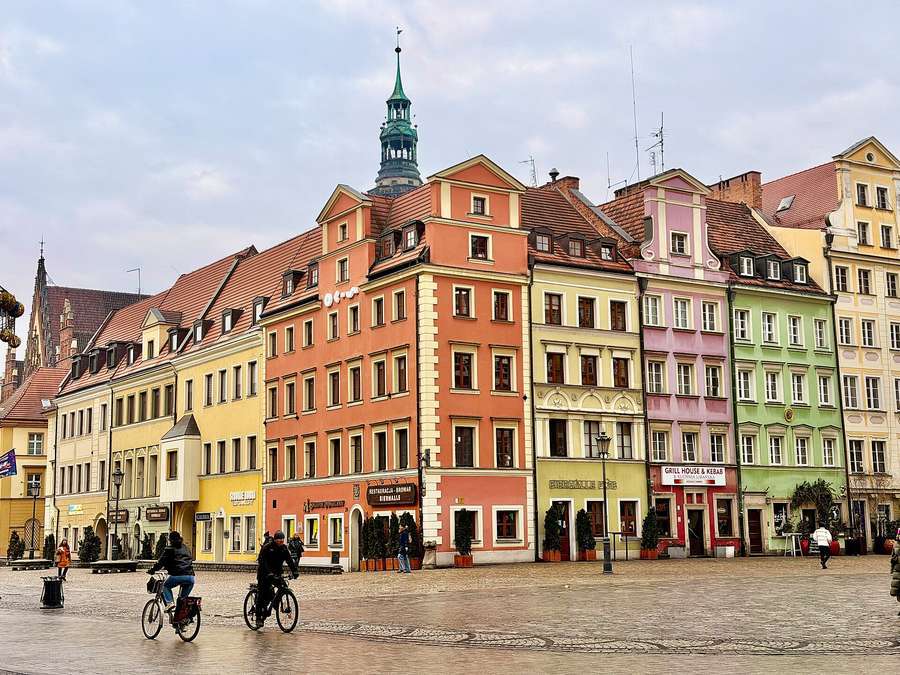
Start at the Rynek, one of the largest medieval market squares in Europe, ringed by pastel townhouses and dominated by the Gothic Old Town Hall with its astronomical clock. The square was heavily damaged in 1945 and painstakingly reconstructed; the gabled facades you see today are a mix of survivors and faithful rebuilds.
Then look down. Scattered around the old town are hundreds of small bronze dwarf statues, a tradition that began as a tribute to the Orange Alternative, the 1980s anti-communist movement that painted dwarfs over censored slogans. Today the dwarfs are a free open-air treasure hunt: a fireman dwarf by the fire station, a professor dwarf outside the university, a pair sharing a pierogi, a withdrawn cash-dispensing dwarf by a bank. Children take to the hunt immediately; tourist information sells a map, but half the fun is spotting them by accident, and a weekend with a running family tally turns every walk between sights into a game.
The square itself deserves a slow circuit. The two slender joined houses on the north-west corner, known as Jas and Małgosia (Hansel and Gretel), lean into each other across a tiny archway; beneath the town hall, cellar restaurants and a traditional beer hall have fed drinkers for centuries. In the evening the whole square fills with buskers, students and wedding parties spilling out of the registry office, and the townhouse facades are floodlit one by one.
From the Rynek it is a ten-minute walk to the University of Wrocław's main building on the Odra embankment, whose baroque Aula Leopoldina assembly hall is one of the finest in Central Europe, and to the riverside boulevards where locals walk on summer evenings.
Day one, late afternoon: Ostrów Tumski
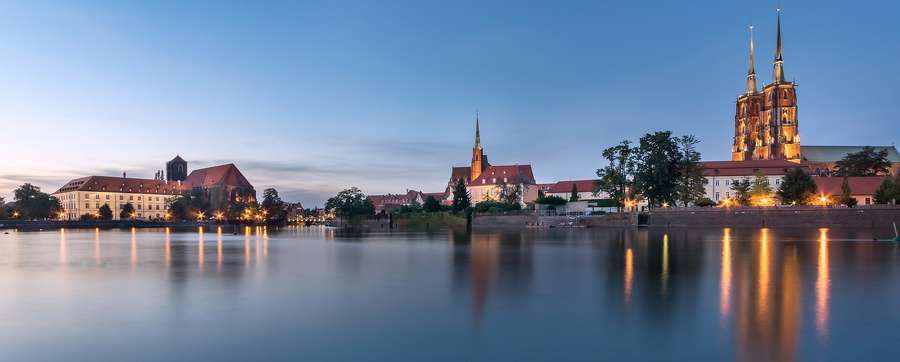
Cross the river to Ostrów Tumski, the Cathedral Island, the oldest part of the city. The twin spires of the Cathedral of St John the Baptist rise over a quiet grid of cobbled lanes, seminary buildings and smaller churches. The island is at its best after dark: Wrocław still employs lamplighters who light the gas street lamps by hand each evening, one of the last cities in Europe to keep the tradition.
Stop at the Tumski Bridge on the way across; its railings disappear under thousands of padlocks left by couples. The whole circuit, with time inside the cathedral, takes one to two hours and costs nothing. On the way back into town, the riverside promenade follows the Odra past moored barges converted into bars and gives the classic postcard view of the island lit up across the water.
Day two morning: the Panorama Racławicka
The Panorama Racławicka is a cycloramic painting 15 metres high and 114 metres long, depicting the 1794 Battle of Racławice, one of the few such paintings still displayed anywhere in the world. Viewings run as timed 30-minute sessions with an audio guide, and the illusion of depth inside the rotunda is startling.
Tickets cost 50 zł normal and 35 zł reduced; a family ticket covering one or two adults with children aged 7 to 18 works out at 35 zł per person. Opening hours switch with the season: from 1 April to 31 October the rotunda is open daily 8:30 to 19:00; from 1 November to 31 March it is closed on Mondays and open Tuesday to Friday 9:30 to 16:00, Saturday 9:30 to 17:00 and Sunday 9:30 to 16:00. Book a session online in advance at weekends, as groups are capped.
Data source: National Museum in Wrocław, Panorama Racławicka practical information page (mnwr.pl), checked 22 October 2026.
Day two afternoon: Zoo Wrocław and the Africarium
Zoo Wrocław, founded in 1865, is Poland's oldest and most-visited zoo, and its Africarium, an oceanarium devoted entirely to African aquatic ecosystems, is the standout: underwater tunnels past hippos, penguins and Nile crocodiles. Every zoo ticket includes the Africarium; there is no separate entry fee.
The zoo is open 9:00 to 17:00 with last entry at 16:00. Normal tickets cost from 69 zł bought online and 99 zł at the gate; reduced tickets are from 59 zł online and 89 zł at the gate. A 2+2 family ticket is from 225 zł online against 329 zł at the gate. Children under 3 and visitors aged 75 and over enter free with a control coupon collected at the ticket office. A combined Zoo and Safari ticket is 107 zł normal and 93 zł reduced. Buy only from the zoo's own website: the operator warns that unofficial resale sites sell invalid or overpriced tickets.
Data source: Zoo Wrocław official price list and opening hours (zoo.wroclaw.pl), checked 22 October 2026.
Centennial Hall and the Multimedia Fountain
Finish the weekend at Centennial Hall (Hala Stulecia), Max Berg's pioneering 1913 reinforced-concrete dome and a UNESCO World Heritage site, set in Szczytnicki Park next to the zoo. Beside it, the Pergola surrounds the Multimedia Fountain, whose free evening shows combine water, light and music.
The fountain is seasonal. The 2026 season closes on 24 October 2026 with a "Noc pokazów" finale, with shows at 18:00 and 20:00 on the Pergola. If you are planning later in the year, check the hall's site for the next season's dates before building the evening around a show; the hall itself and the park are worth the tram ride in any season, and the nearby Japanese Garden dates from the same 1913 exhibition.
Data source: Hala Stulecia Multimedia Fountain page (halastulecia.pl) and City of Wrocław season notice, checked 22 October 2026.
Food and practical notes
The old town is thick with restaurants, but the reliable pattern for a weekend is simple: pierogi or żurek in one of the cellar restaurants under or near the town hall on the first night, and a milk bar or the market hall (Hala Targowa, a few minutes' walk north-east of the Rynek) for a cheap, fast lunch between sights. Card payment works everywhere, including tram ticket machines and market stalls. English is widely spoken in the centre. Weekend accommodation clusters around the Rynek and along the river; staying within a ten-minute walk of the square keeps the whole plan above car-free.
A realistic weekend plan
Saturday: morning EIP from Warsaw, drop bags near the centre, the Rynek and town hall, dwarf hunt through the old town, university quarter, then Ostrów Tumski after dark for the lamplighter. Sunday: Panorama Racławicka session booked for opening time, tram to the zoo for the Africarium, Centennial Hall and, in season, the fountain show, then the evening train back. The whole loop works year-round; only the fountain hibernates. If you only have one day, keep the Rynek, the dwarfs, Ostrów Tumski and the Panorama, and save the zoo for a dedicated family trip.
Frequently asked questions
How long is the train from Warsaw to Wrocław?
The fastest EIP (Pendolino) services take 3 hours 34 minutes between Warszawa Centralna and Wrocław Główny according to PKP Intercity. Slower IC trains take about 4 hours 28 minutes.
How much does the Panorama Racławicka cost?
Normal tickets are 50 zł and reduced tickets 35 zł. A family ticket for one or two adults with children aged 7 to 18 costs 35 zł per person. Viewings run as 30-minute timed sessions.
Is the Africarium included in the Zoo Wrocław ticket?
Yes. Every zoo admission ticket includes the Africarium. Online normal tickets start at 69 zł; gate prices are higher, and the zoo warns against buying from unofficial resale sites.
When does the Multimedia Fountain operate?
The fountain is seasonal. The 2026 season ends on 24 October 2026 with shows at 18:00 and 20:00; check the Centennial Hall website for the next season's schedule.
Is Wrocław good for a family weekend?
Yes. The dwarf hunt, the zoo with the Africarium and the fountain show are built for children, the centre is walkable, and the Panorama's family ticket covers one or two adults with children aged 7 to 18 at 35 zł per person. * Photos: Cover - townhouses on Wrocław's Rynek by Olgierd Rudak, CC BY-SA 4.0, via Wikimedia Commons. Body - Ostrów Tumski at dusk by Jar.ciurus, CC BY-SA 3.0 PL, via Wikimedia Commons.