Bar mleczny: Poland's milk bars - ordering, prices and history
The essentials: A bar mleczny is a Polish cafeteria-style eatery serving subsidized, homestyle food at very low prices. Order and pay at the counter, take the receipt to the kitchen hatch, share tables at busy times, and return your own tray.
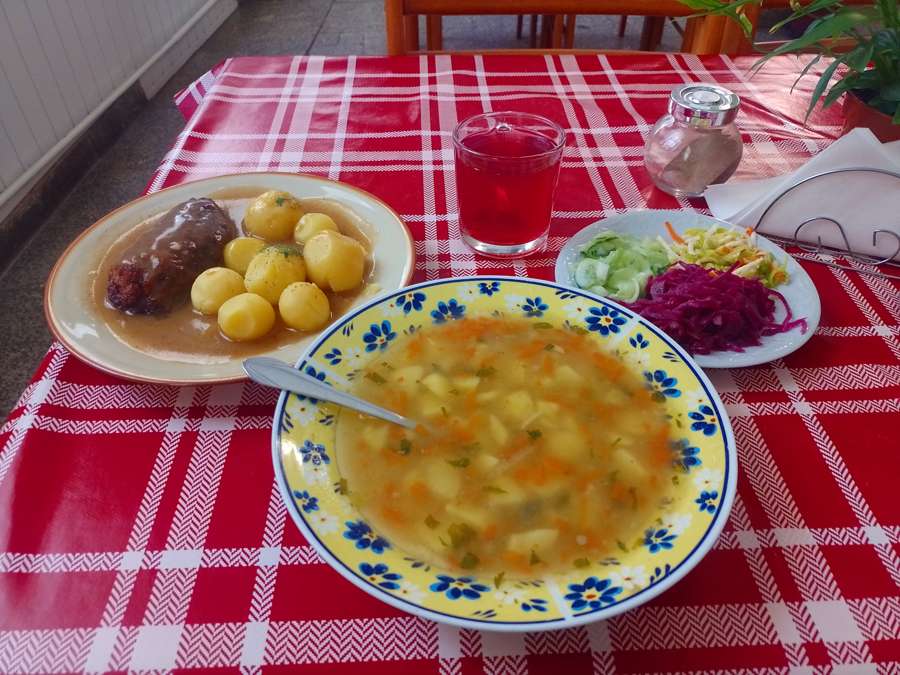
It is 1 pm on a Tuesday and the queue at the counter moves fast: a pensioner with exact change, two office workers, a student, a man in a suit. Behind the hatch, someone shouts "Jajecznica!" and a plate of scrambled eggs appears. On the wall, a yellow board lists tomato soup, pierogi ruskie, naleśniki and bigos at prices that seem to belong to another decade. Welcome to the bar mleczny - the Polish milk bar, the country's most democratic dining room and, for an expat, the cheapest honest meal in town.
What a milk bar actually is
A bar mleczny is a self-service, cafeteria-style eatery serving homestyle Polish food at rock-bottom prices. The name comes from the original dairy-heavy menus - milk, eggs, cereals, potatoes - because meat was the expensive ingredient. Each bar is independent (there is no chain), and many still receive state subsidies that keep dairy- and vegetable-based dishes especially cheap. The deal in exchange: no table service, a menu on a wall board, communal tables, and you bus your own tray.
That bargain is the whole charm. Nobody is performing hospitality, nobody is upselling you, and nobody cares who you are. The clientele is the cross-section of Poland: pensioners stretching a fixed income, students, builders in work clothes, tourists who read about it, and office staff who just want soup. For an expat learning the country, an hour in a milk bar at lunch tells you more about Polish daily life than a week of restaurant meals.
From an 1896 dairy shop to a national institution
The first milk bar, Mleczarnia Nadświdrzańska, opened in Warsaw in 1896, founded by Stanisław Dłużewski, a dairy farmer from the landed gentry, selling cheap milk- and egg-based meals. The concept spread across Poland after independence in 1918 and proved its worth in the Depression of the 1930s. Under the communist People's Republic, most private restaurants were nationalized or closed, and milk bars became the default canteen for workers whose companies had none - and, during the meat rationing of martial law in the early 1980s, a mostly dairy-and-vegetable lifeline. The idea even traveled: Yugoslavia opened its first mlečni restoran in Belgrade in 1959.
At their peak, thousands of bars fed the country. They were not glamorous - fluorescent light, chip-resistant plates, soup ladled by the gallon - but they were dependable, and they belonged to everyone. Ask any Pole over forty and you will get a childhood memory: a grandmother's Sunday naleśniki, a school trip's compulsory kompot, the smell of fried potato pancakes carrying down the stairwell.
After 1989, most milk bars went bankrupt, unable to compete with private restaurants and the new kebab-and-burger wave. The survivors came back in the early 2010s on a tide of PRL nostalgia and demand for cheap, real food. They are now trendy enough that students born after communism eat shoulder-to-shoulder with pensioners - and valuable enough that activists fight gentrification to keep central locations open. One glorious footnote: in 2015, regulators briefly told milk bars they could season food with only water and salt; after public outrage, the marjoram won.
How to order without stress
The ritual is fixed and simple once you know it:
1. Read the jadłospis - the menu board on the wall - before you queue. Older bars have handwritten, Polish-only boards; Google Lens on your phone camera translates them instantly. Modernized bars often post English too.
2. Order and pay at the counter. Some older bars are still cash-only, so carry a little złoty; cards are increasingly common.
3. Take your receipt to the kitchen hatch and wait for your dish to be called. In busy bars the ladies call out dish names; listen for yours, or just hover and watch the hatch.
4. Sit anywhere - at lunch peak you will share a table with strangers. This is normal.
5. Return your tray to the zwrot naczyń (dish return) when done. This step is mandatory, even if nobody reminds you.
Expect speed over small talk from the panie z baru - the formidable bar ladies who run the counter. It is not rudeness; it is throughput.
What to order
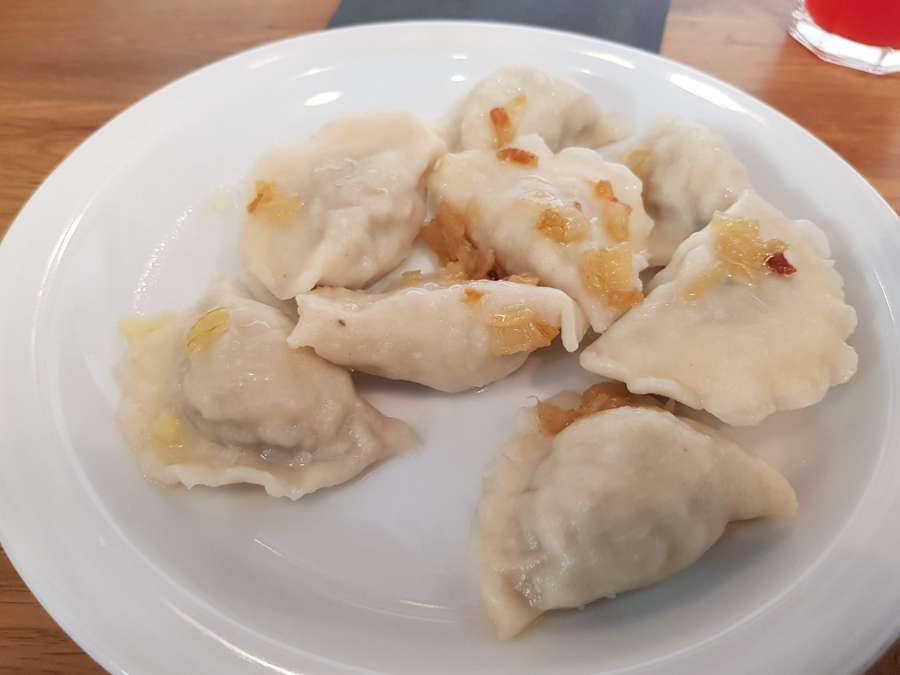
The menus repeat a comforting national rotation. Pomidorowa (tomato soup with rice or noodles), barszcz, pierogi ruskie (potato-and-quark dumplings), naleśniki (pancakes, sweet or savory), bigos (hunter's stew), kasza gryczana (buckwheat), egg dishes from jajecznica to egg cutlets, and kompot to drink. A lunch set like the one on the cover - soup, a main with potatoes and salads, a glass of kompot - is the classic order. Round it out with placek po węgiersku (potato pancake under a ladle of goulash), leniwe (quark dumplings under butter and breadcrumbs), gołąbki (cabbage rolls), or kotlet mielony (minced cutlet) with a mound of surówka - the raw shredded-vegetable salads that appear with every hot plate. Seasonal specials rotate: fruit dumplings in summer, żurek and white barszcz around Easter.
Two warnings: popular dishes sell out, so come before the late-lunch wave - by 2 pm the good stuff is gone - and while vegetarians eat very well here, vegans will find butter, cream and eggs in nearly everything, soups included.
What it costs
Exact prices vary by bar and city, but the gap with restaurants is the point: a full milk-bar meal costs a fraction of a sit-down equivalent. In 2016 a full meal (starter and main) went for around 8 złoty, with pierogi at about 6 złoty and coffee at 2 - prices have climbed since with inflation, but milk bars remain the cheapest cooked food in Poland by a wide margin, with soups and dumplings still priced for pensioners' budgets. The subsidy structure intentionally keeps the dairy-and-vegetable core cheapest, a design left over from the rationing era. Portions are generous rather than dainty; the plates are not pretty, but you will not leave hungry.
Where to try one
Every Polish city has milk bars; they just don't advertise. In Kraków, first-timers do well at Milkbar Tomasza (Świętego Tomasza 24, near the Main Square) or Pod Temidą on Grodzka, while Bar Mleczny Centralny in Nowa Huta offers the full time-capsule version. Warsaw's classics include Prasowy and Bambino, both institutions. Gdańsk, Wrocław, Poznań and Łódź all have their own, usually a short walk from the main square or the university. The simplest search is the name itself: type "bar mleczny" into your map app and the nearest one will appear, often in a basement or an unglamorous ground floor you have walked past a dozen times. A small tip for orientation: if the decor was modernized and the menu has a printed English version, you are in the gentrified end of the spectrum; if the board is handwritten and the chairs are red vinyl, you are in the real thing. Both feed you well - the second one feeds you cheaper. The bars in this article's photos - Europa in Katowice and Kolorowa in Nowa Ruda - show the breed at its most authentic: yellow menu boards, red chairs, and lunch for less than a coffee chain charges for a sandwich. For wider eating-out customs, our Polish social etiquette guide covers the rest of the table manners.
Cover photo: a lunch set at Bar Mleczny Kolorowa in Nowa Ruda, by Gaj777, CC BY-SA 4.0. Photo above: the counter and menu boards at Bar Mleczny Europa in Katowice, by Gaj777, CC BY-SA 4.0.
Frequently asked questions
What does "bar mleczny" mean?
Literally "milk bar". The name comes from the original 19th-century menus built on milk, eggs, cereals and potatoes, because meat was the costly ingredient. Today's bars serve full Polish home cooking, not just dairy.
Are milk bars really that cheap?
Yes - they are Poland's cheapest cooked meals, partly because many receive state subsidies that keep dairy- and vegetable-based dishes especially low-priced. A full lunch costs a fraction of a restaurant equivalent in the same city.
Do milk bars take cards?
Increasingly yes, especially modernized ones - but some traditional bars are still cash-only. Carry some złoty on a first visit, or check for a card-terminal sign at the counter.
Do I need to speak Polish to eat at one?
It helps but is not required. Modernized bars near city centers often have English menus; traditional ones have Polish-only wall boards, which a translation app on your phone camera handles fine. Pointing politely works everywhere.
What is the etiquette inside?
Decide before you queue, order and pay at the counter, take the receipt to the hatch, share tables at busy times, and always return your tray to the zwrot naczyń. Don't expect small talk from staff during the lunch rush.
Are milk bars good for vegetarians or vegans?
Vegetarians do very well - the menu's dairy-and-vegetable core is historically meat-light. Vegans struggle: butter, cream and eggs appear in most dishes, including soups and pierogi fillings.