Old furniture and mattresses in Poland: bulky waste and PSZOK
The essentials: Check your address-specific bulky-waste schedule or the local PSZOK rules before moving furniture. Confirm the collection place, timing, item category, limits, documents and transport. Municipal collection does not automatically include carrying items out of your flat.

An old sofa does not become ordinary rubbish because moving day is tomorrow. In Poland, furniture and mattresses usually need a bulky-waste collection or a municipal PSZOK, not an improvised place beside the bins. The practical rules depend on your municipality, address, building and item. Find the route before carrying anything downstairs.
The Polish terms to look for are odpady wielkogabarytowe, often shortened to gabaryty, and harmonogram odbioru, the collection schedule. PSZOK means a selective municipal-waste collection point. A scheduled collection, a drop-off point and a private removal service are different arrangements: acceptance at a municipal facility does not promise free transport from your flat.
This guide was checked on 27 October 2026, Poland time. It uses official municipal examples to explain what to verify. The examples are not nationwide collection times, prices or eligibility rules. Check the current instructions for the address where the waste was generated before booking a van or putting items out.
Cover photograph: sofa and coffee tables in Toronto, Sophia Baboolal, Wikimedia Commons, CC0 1.0. Resized. Illustrative furniture, not a Polish collection site or a claim that these items are waste.
First check who owns the furniture
If the flat came furnished, do not assume the old mattress, wardrobe or chair is yours to discard. Check the inventory and agree any replacement with the landlord in writing. Take photographs and settle whether the item will be stored, collected, reused or disposed of before buying a replacement that leaves you with two large objects and no agreed destination.
For your own furniture, consider whether someone can use it before treating it as waste. A sale or giveaway needs an actual taker and a confirmed handover, not a note saying "free" beside a communal bin. Describe its condition honestly. Do not advertise a damaged or contaminated mattress as ready for another home merely to avoid arranging disposal.
If reuse falls through, the municipal rules still apply. Plan a fallback that works before the tenancy ends. Your last day in the property is not necessarily a bulky collection day, and another neighbour's pile does not prove that your item can be left there too.
Identify the item accurately
Warsaw's published bulky-waste guidance includes old furniture, including dismantled furniture, upholstered items and mattresses. Its exclusions include electrical equipment, renovation waste, sanitary fixtures, window frames, doors, tyres and unflattened large cartons. The distinction is about the waste category, not simply whether the object is too big for a bin.
Łódź's list includes furniture, mattresses, carpets, empty suitcases and several other large household objects, while separately excluding building and renovation parts, electronics and vehicle parts. These examples show why it is better to describe the precise object than ask whether "big rubbish" is accepted.
A wardrobe and a removed interior door can both be wooden and awkward to carry, yet the local system may treat them differently. Similarly, a washing machine is not ordinary furniture because it stood next to a cabinet. Keep electrical equipment separate and use the applicable e-waste route. For mixed loads, list every category before assuming one collection will take everything.
Ask the municipality about unusual items, substantial glass, upholstered furniture with a specific contamination problem or a load containing renovation materials. Do not break an item into smaller pieces on the assumption that this automatically makes it suitable for ordinary containers. The appropriate route should be settled first.
Find the schedule for your actual address
Start with the municipality's official waste page and search for your street or property. In a block, ask administracja or the zarządca, the building administration or manager, which schedule and collection place serve the building. A calendar for another district or a neighbouring house may not apply to your entrance.
Confirm the date, the earliest permitted set-out time, the latest time items must be accessible and the exact place. Warsaw's published guidance says bulky items should not be left earlier than 24 hours before the scheduled collection. Sośnicowice's instructions say items must be out by 6 a.m. on collection day and accessible without the crew entering the property. These are local examples, not a single national timetable.
Ask whether the collection point is a designated area, a temporary container or another agreed location. Warsaw says the property administrator should tell residents where bulky waste belongs. Do not choose the pavement, car park or space immediately outside a bin enclosure just because it seems convenient.
Save the relevant schedule and the manager's instructions. Check again if your collection is near a public holiday or the municipality announces a change. An old screenshot is useful for planning, but it is not stronger than a newer official notice for the same address.
Collection does not mean carrying it out of your flat
Before arranging help, establish who takes the item from the room to the agreed point. A municipal collection from a waste area should not be read as a promise that staff will enter your flat, dismantle furniture or carry a sofa down several flights. Ask specifically about access and preparation rather than treating the word "collection" as a complete removal service.
Measure the item and route before moving it, and arrange appropriate help rather than risking injury. Do not obstruct stairs, exits or other people's access while waiting for the date. Keep the item in an agreed safe place until the permitted set-out window.
If you employ a private carrier, confirm the scope in writing: dismantling, carrying, transport, the destination and total charge. Check what happens if the proposed facility cannot accept the load. A quote for driving to a PSZOK is not useful if the van, driver or waste does not meet that point's access rules.
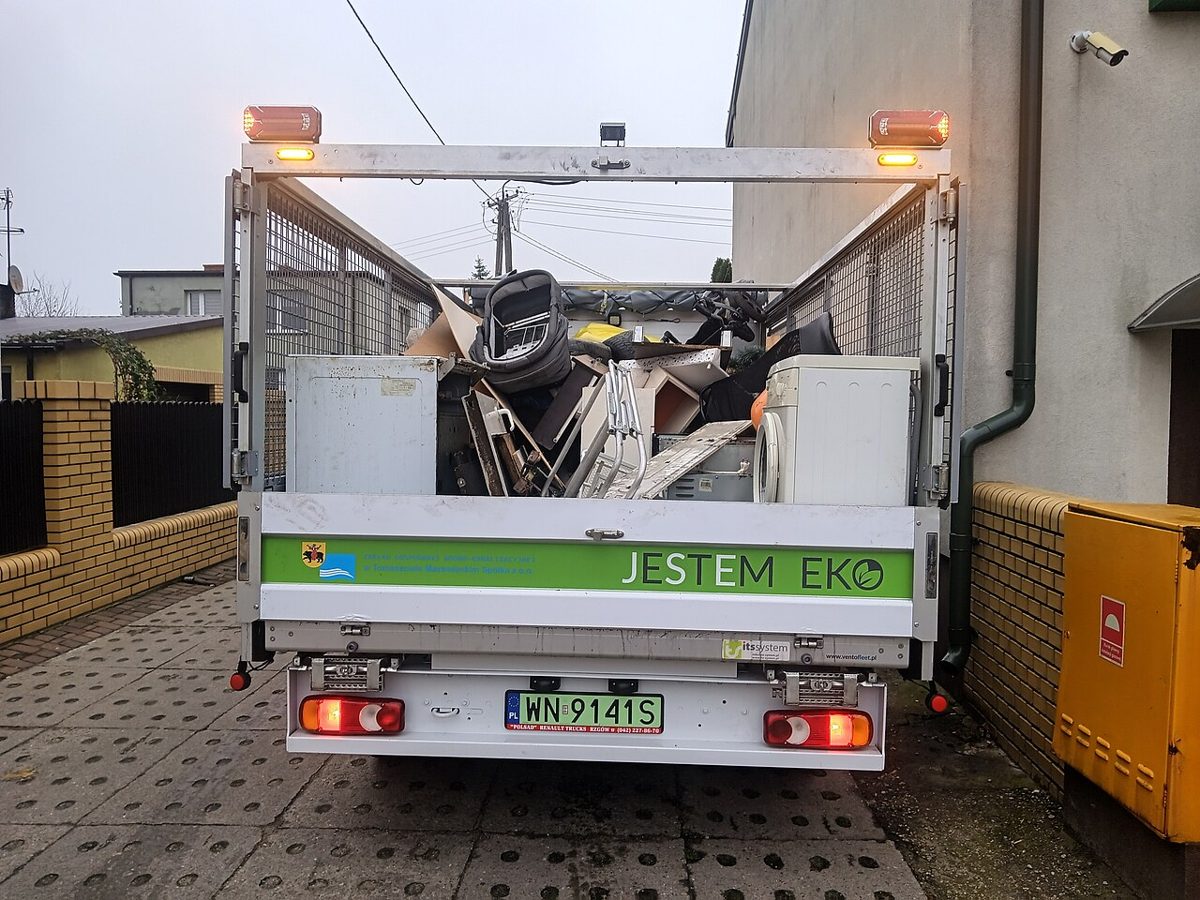
Photograph: WrS.tm.pl, Wikimedia Commons, released by the author into the public domain. Resized. Historical illustrative collection in Tomaszów Mazowiecki, not confirmation of the categories accepted by your own municipality.
Use a PSZOK when the scheduled date does not work
A PSZOK can be an alternative to waiting for a street or building collection, but check its rules before loading the vehicle. Ask which items it accepts, what limits apply, which vehicles may enter, what proof of entitlement is required and whether someone else can deliver the waste for you. Check current opening arrangements, including holiday closures.
Warsaw 19115's page, updated on 27 January 2026, lists a limit of 150 kg for furniture and other bulky waste delivered on a given day in a single delivery. It also specifies delivery by passenger car or passenger car with a light trailer. Do not turn that into a Poland-wide weight allowance or assume that a hired commercial van will be admitted.
The same Warsaw page distinguishes stationary PSZOKs from mobile MPSZOKs. Its mobile-point exclusions include bulky waste. A mobile stop near your home is therefore not automatically the place to bring a mattress, even though its name resembles the stationary facility's name.
Describe your intended load and vehicle to the particular point if there is uncertainty. Ask before paying for transport, not after the carrier has arrived. Separate the items in advance so that waste does not have to be sorted for the first time at the gate.
Renters should check documents and authorisation
Do not assume that speaking Polish, having a PESEL number or showing a passport alone answers a facility's eligibility requirements. The relevant question is the local waste system and the property's entitlement, with whatever documents or authorisation that municipality requires. Ask the landlord or building manager for help where the declaration is not in your name.
Lubliniec provides a clear example of a local procedure. Its municipal page says that from 1 April 2026 PSZOK admission uses the local resident card or e-card, with authorisation routes for residents and other entities delivering on behalf of the entitled property owner. It defines that owner by reference to the waste declaration and payment of the municipal waste charge.
The page also says an owner's authorisation for other entities must be submitted to the municipal office at least seven days before the planned delivery. That is a reason to prepare early, not a seven-day rule for every Polish PSZOK. If you are renting or using a removal company, check the exact route for your circumstances rather than arriving with a generic letter downloaded elsewhere.
Ask about extra collections, but do not assume them
Some municipalities publish options outside the ordinary schedule. Łódź's page describes additional bulky collections requested through the city's resident-contact service, with a date assigned within two weeks and an entitlement for each property owner to use additional collections twice a year. Confirm eligibility and arrangements before relying on that option for your move.
Wrocław's English municipal FAQ explains that an out-of-schedule bulky-waste container can be requested through Ekosystem by the property administrator, property owner or housing-estate council. It does not describe every tenant as independently entitled to summon a container to any location. In a block, the practical first step is often asking administration to coordinate it.
These examples are useful questions to take to your own municipality: is there an additional service, who can request it, what limits apply and when is it actually confirmed? They are not a guarantee of urgent, free, door-to-door furniture removal across Poland.
If the item is not collected
Keep the collection date, location and instructions so you can make a precise report. Ask the manager or municipal waste service whether the problem was a missed collection, wrong set-out time, blocked access, excluded item or load limit. Each calls for a different fix.
Do not respond by adding more items or moving the pile to another building's containers. If the category or timing was wrong, arrange the correct route and ask where the item should be kept meanwhile. If you paid a private company, retain its order, invoice and written destination arrangements.
For a move, the simplest plan is an early decision about ownership, a confirmed route for each category and a backup before handover day. That usually matters more than finding the shortest translation of "take away my sofa" after it is already on the pavement.
Frequently asked questions
What is bulky waste called in Polish?
Use "odpady wielkogabarytowe" or "gabaryty". Give the actual item name or a photograph as well, because large electronics and renovation materials may need different routes.
Can I leave a mattress beside the bins?
Only use the place and timing specified for your address. Ask building administration or the municipality. An existing pile is not evidence that an unscheduled deposit is allowed.
Will municipal staff carry a sofa downstairs?
Do not assume that. Confirm the scope of collection and arrange carrying or dismantling separately if needed. A designated collection-point service is not automatically an in-flat removal service.
Is any PSZOK available to anyone in Poland?
Check the particular municipality's eligibility, documents, limits, vehicle rules and authorisation arrangements. The examples in this guide are local, not a nationwide entitlement to use any point.
Can a mobile Warsaw MPSZOK take a wardrobe?
Warsaw 19115 lists bulky waste among the mobile points' exclusions. Check the stationary PSZOK route or your address's bulky collection instead, including applicable limits.
Sources
- Warsaw bulky-waste guidance, 23 August 2019 (checked 27 October 2026)
- Lodz collection schedules and additional bulky pickups (checked 27 October 2026)
- Lubliniec PSZOK, rules from 1 April 2026 (checked 27 October 2026)
- Sosnicowice bulky collection guidance (checked 27 October 2026)
- Wroclaw English waste FAQ, 7 November 2024 (checked 27 October 2026)
- Warsaw 19115 PSZOK/MPSZOK, updated 27 January 2026 (checked 27 October 2026)