Gdynia Aquarium: Tickets, Winter Hours and the Accessible Route
The essentials: Gdynia Aquarium costs 43 zł for ordinary admission in September-April and 48 zł in May-August. Winter Mondays close from November through January; a lift outage currently changes the accessible route.
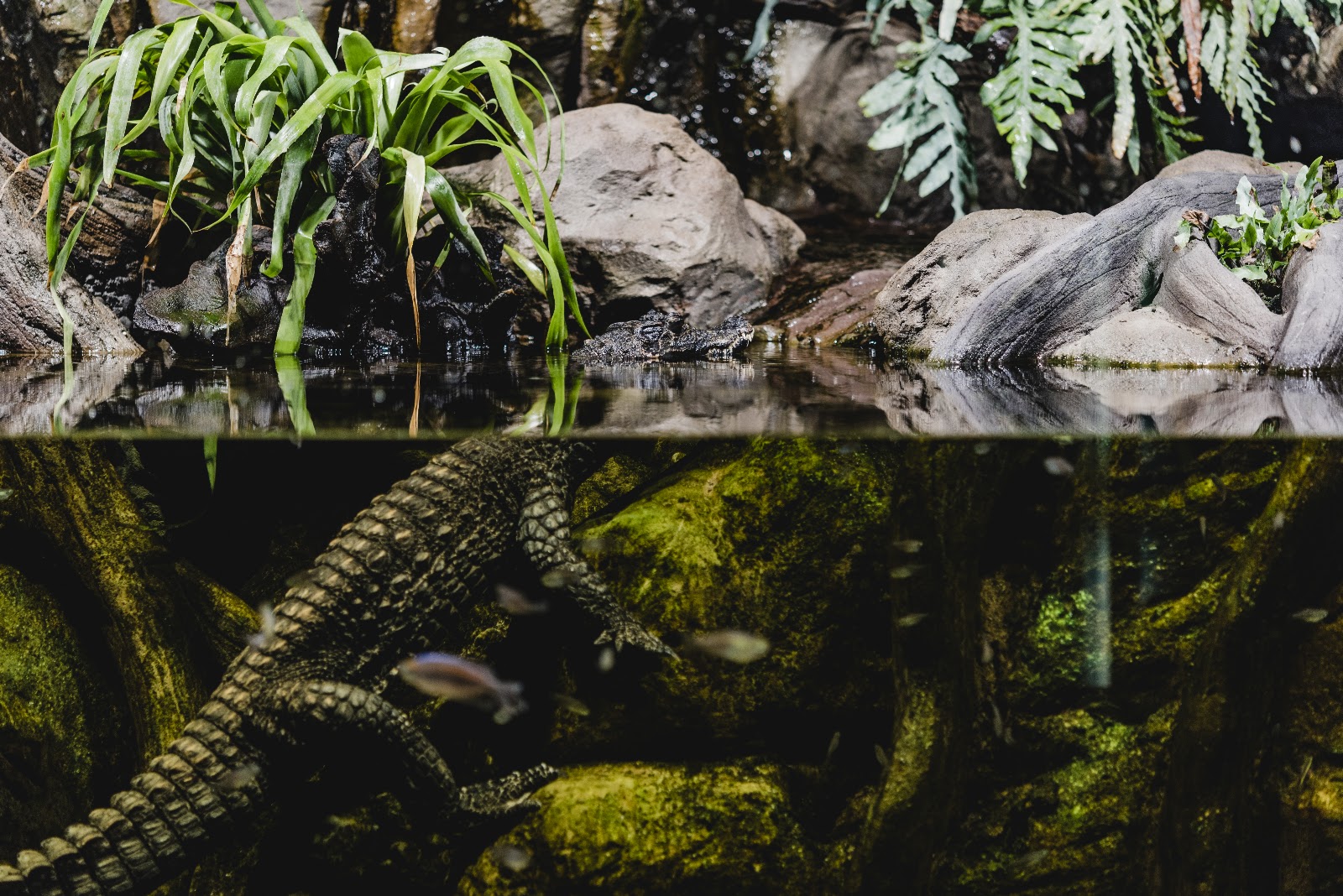
Cover: Weronika Podlesińska, source photograph, Operator permission for publications and promotional materials. Image unchanged. Dwarf crocodile at Gdynia Aquarium, from the operator’s media album; an animal photograph, not a promise of visibility on a visit.
Gdynia Aquarium is an indoor animal attraction at the seaward end of the city's central waterfront, but treating it as a single room of fish tanks undersells both its subject and its practical demands. The operator describes eight exhibition rooms across five floors, with more than 200 aquatic and water-associated species. Your visit can move between Amazonian habitats, coral reefs, Pacific waters, the Baltic and the cold northern Atlantic. That makes it a useful choice when you want an introduction to marine environments rather than simply somewhere to escape a shower.
For an English-speaking newcomer, three details matter before choosing a day: winter Mondays are closed, the ticket price changes with the season, and a lift outage currently changes the accessible route. These are more useful planning facts than a promise that every family will love every tank. This guide uses the Aquarium's current visitor information, not an account of a personal visit. Animal visibility, queues and equipment availability can change on the day.
Choose the month before the arrival time
The published October-March hours are 10:00-17:00, with the ticket office and entry closing at 16:30. From the beginning of November through the end of January, the exhibition is closed on Mondays. Do not assume an indoor attraction is open every day throughout winter. The listed holiday closures also include 1 November, 24-25 December, 31 December, 1 January and Easter Sunday. Check the operator's current calendar if a holiday is central to your plans.
The spring and summer pattern is different. April-May and September run 09:00-19:00; June runs 09:00-20:00; July-August runs 09:00-21:00. In each case, the advertised ticket-office and entry cutoff is half an hour before closing. That is an admission deadline, not a sensible target arrival for a complete visit. The Aquarium gives about 80 minutes as its average visiting time. Allow more if you want to listen to the guide, pause with children or move slowly between levels.
The FAQ identifies 11:00-15:00 as the busiest period and says summer rain can bring queues. An earlier or later arrival may suit visitors who dislike crowds, but that is not a guarantee of a quiet building. In winter, a late start also leaves less usable time before closing. Work backwards from the amount of time your party needs rather than choosing the last possible ticket simply because it exists.
Understand the seasonal ticket prices
The ordinary adult ticket is currently 43 zł from September through April and 48 zł from May through August. The corresponding concession ticket is 30 zł or 34 zł. The concession description includes children from their fifth birthday, pupils and students up to age 26, pensioners and retirees. Bring the document supporting the category you intend to use. The Aquarium checks entitlement before entry; a discounted online purchase is not a substitute for evidence.
Children who have not reached their fifth birthday enter free, but need a free admission card from the ticket office. There is also a separate published rate for visitors with disabilities, 21 zł in the September-April period and 23 zł in May-August, while their carers are included among the free-entry categories. Read the current entitlement list for your circumstances rather than assuming every companion is free. A family with several different age bands may need more than one ticket category.
Family tickets apply to children aged 5-18. In September-April, the published combinations are 107 zł for two adults and one child, 128 zł for two adults and two children, and 149 zł for two adults and three children. May-August equivalents are 119 zł, 142 zł and 165 zł. Compare your actual party against those definitions. Do not buy a family bundle solely because the word sounds cheaper; under-five children already have free admission and still need their cards.
Online availability is not the whole ticket supply
Tickets are sold at the entrance and through the Aquarium's online shop. The operator explicitly says the ticket office has a separate allocation: if online tickets are no longer available for your chosen day, tickets may still be bought at the window. That is different from a reservation guarantee. The Aquarium does not take admission-ticket reservations, and an on-site purchase can still involve waiting.
The FAQ says advance online sales open two weeks ahead. Buying online can remove the ticket-purchase step from a busy arrival, but check how free-entry cards and concessions work for your party. Keep the ticket accessible on your phone and bring the required documents. The entrance ticket is also different from an educational booking. Workshops and laboratory activities have their own prices and require prior arrangements; they should not be assumed to come with ordinary admission.
For a repeat visitor, the current named annual ticket costs 130 zł and lasts 365 days from purchase. It requires a free admission card to be collected on each visit, with the annual ticket and photo identity document shown. It may be worth comparing with several individual visits, but first check the current conditions and your realistic visiting pattern. It does not remove opening-day restrictions.
Use the free English guide deliberately
The Aquarium's eGuide is a browser-based application, not an app you must install. It is available in Polish and English, and the operator asks visitors to bring their own headphones. QR codes and numbers beside the tanks lead into the guide. The information page explains that an initial login screen does not require personal details. This can make the visit easier for someone who cannot follow Polish display text, without arranging a private guide.
Charge your phone before arriving and decide how much listening your party wants. One person playing audio aloud is not a good substitute for headphones in a confined exhibition. The FAQ says the Aquarium does not have staff whose role is to provide guided tours. Use the eGuide and maps for the ordinary self-guided visit; ask the education team separately about an organised session if that is what you need.
The cold-water room, opened in 2024, is in the basement and connects the northern Atlantic with the Baltic. Including it helps distinguish this attraction from an entirely tropical aquarium. Rather than racing to identify the most colourful animal, use the habitat changes as the organising idea: what differs between cold and warm water, and between a river environment and a reef? Those are suggested questions for looking, not claims about a scheduled demonstration.
Check the changed lift route
The current accessibility page reports two lift shafts but says one lift is out of service. Visitors who need a lift must therefore follow a changed route; a revised map is provided by the operator. Do not translate the existence of lifts into a promise that the usual circuit is step-free in its usual order. Before travelling, consult the current accessibility page and contact the Aquarium if a particular floor or connection is essential.
The Aquarium does not currently provide wheelchairs for visitors to borrow. Stairs have handrails, but no stair platforms are listed. Accessible toilets are on the ground-floor level, including facilities near the entrance/education corridor and in the Amazonia area. Ask staff about the best route to these facilities rather than assuming the next toilet lies ahead on a one-way circuit. The route needs of a wheelchair user and a family with a large buggy may differ.
A quiet room is available, with a sofa, a sea-facing window, ear defenders and a blanket. There is also a parent-and-child room with a changing table, milk warmer and feeding chair. These are useful practical supports, but not a guarantee of a quiet visit elsewhere. The operator warns that confined exhibition space can become noisy, especially in summer, and suggests autumn-winter visits or summer evenings for people sensitive to noise.
Travel to the right end of the waterfront
The address is al. Jana Pawła II 1. The Aquarium's access information gives approximately 1.9 km on foot from Gdynia Główna station. Since September 2026, it identifies bus 119 to the Przystań Żeglugi stop opposite the Aquarium. Check a current journey planner for your actual travel day, particularly if a replacement service or holiday timetable would affect the connection. A map pin is more reliable than simply heading towards the sea and hoping the building is nearby.
There is no private visitor car park. The operator points to municipal paid parking around Skwer Kościuszki and warns that summer spaces may be occupied. Do not budget on free parking because you have bought admission. If combining the visit with another attraction, leave time for the return walk or bus rather than treating all waterfront destinations as the same entrance.
Pack for tanks, not a luggage stop
The FAQ says a cloakroom operates outside the summer season, but luggage is not stored. A suitcase between trains therefore needs a separate plan. Photography and filming are allowed, but flash must be turned off in rooms with live animals. Ordinary pet dogs cannot enter, including small dogs carried in bags; only assistance and guide dogs meeting the published documentation and harness requirements are admitted.
A summer terrace food point is seasonal, so do not rely on it for a winter meal. Carry the essentials your party needs, keep headphones handy and leave a little flexibility in the schedule. A successful first visit is one where everyone can follow the route and take time over the habitats that interest them. It does not require seeing every animal move, reaching every tank at the same pace or filling an entire day with indoor attractions.
Related: Gdynia weekend guide.
Frequently asked questions
Is Gdynia Aquarium open on winter Mondays?
No. The published schedule closes Mondays from the start of November through the end of January.
Is the English guide included?
The browser-based eGuide is free and available in English and Polish. Bring your own headphones.
Does no online availability mean no tickets?
The operator says the ticket office has a separate allocation. On-site purchase can still involve a queue; it is not a reservation.