Poland Plans PLN 3bn for School and Hospital Energy Upgrades
The essentials: NFOŚiGW plans to open school and hospital energy-upgrade applications on 11 January 2027. The PLN 3 billion package combines grants and loans for eligible institutions, not direct household payments.
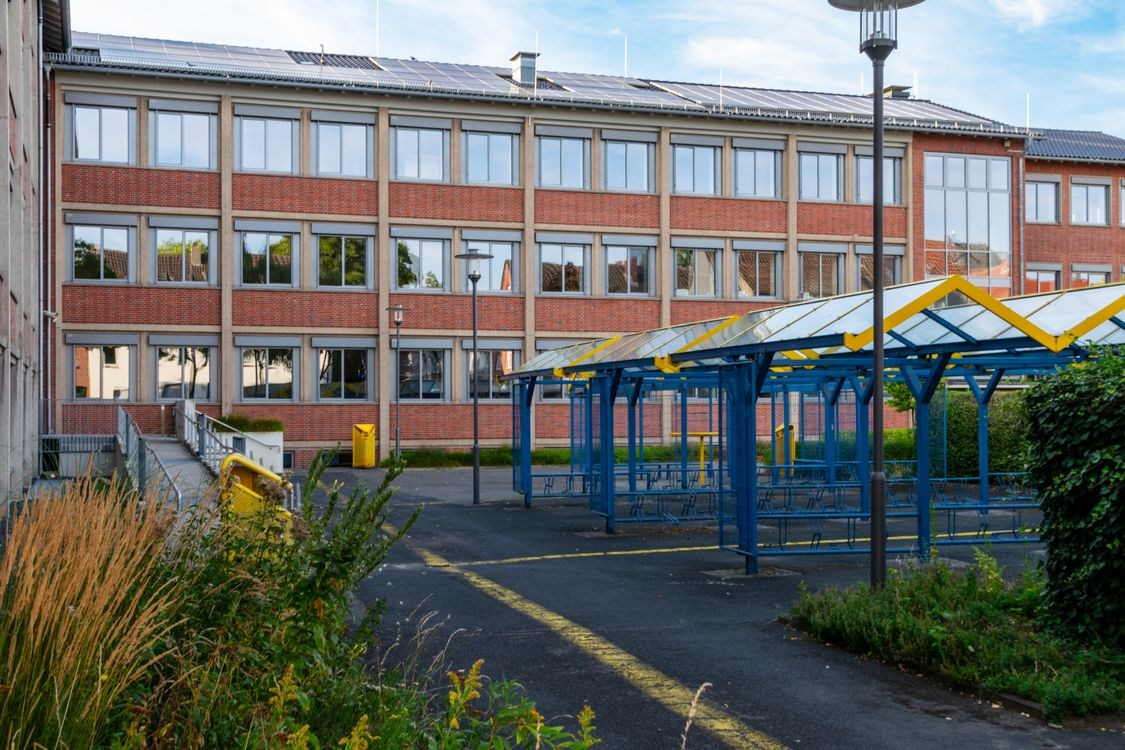
Illustrative school building with rooftop solar panels, not a confirmed Polish grant recipient. Photo: Sergej ***** / Pexels.
Poland has announced PLN 3 billion for energy upgrades to educational and hospital buildings, with applications in both programmes planned to start on 11 January 2027. The announcement on 26 November 2026 concerns institutional investment, not a payment that parents, patients or tenants can claim personally.
The split is PLN 2 billion for educational buildings and PLN 1 billion for hospital buildings. NFOŚiGW, the National Fund for Environmental Protection and Water Management, will run the programmes using Modernisation Fund resources. Grants and loans have different roles, and the advertised maximum grant is not an automatic award for every school or hospital.
For international families, the practical question is whether the body responsible for their school, kindergarten or local hospital plans an eligible project. The announcement alone does not identify your building as a recipient, set a construction date or change an appointment or school timetable. Those details need a separate local decision and notice.
The January date is a planned opening
Both the climate ministry and NFOŚiGW's 26 November announcement give 11 January 2027 as the planned start of applications. That is the newer timetable to use when reading an older schedule. The Fund's general call schedule, marked as current on 19 November, still described these programmes as planned for the fourth quarter of 2026.
The difference is worth noticing, rather than combining the dates into a claim that applications are already open. Programme pages updated on 20 November publish the programme framework; the hospital page also says remaining launch documentation will appear in a later communication. The formal call notice and application rules remain the place to check the actual submission route and deadlines.
The programmes run through 2030. The framework provides for agreements to be signed by 31 December 2029 and funds to be spent by 31 December 2030. These are programme-level limits, not a promise that work at every participating building will start in January or continue for the full period.
Who can apply for educational buildings?
The educational programme names local-government units and other legal persons that are the governing bodies of an eligible school or institution, subject to the programme's conditions. It covers more than ordinary school classrooms: the listed building uses include kindergartens, continuing and vocational education, and specified specialist educational and support institutions.
A parent, pupil or teacher is not the applicant simply because they use the building. The relevant conversation is with the governing body, known in Polish as the organ prowadzący. Ask who owns the investment decision and whether an energy audit and application are being prepared. A school receptionist may not hold the financing details.
Do not assume that any privately run or international school qualifies merely because the framework mentions other legal persons. The programme does not provide state aid. Its conditions limit the annual capacity assigned to economic activity, as understood under EU competition law, to 20% of the infrastructure's total annual capacity. The operator needs to assess that condition and the other eligibility rules for its own activities.
The education budget consists of up to PLN 1.8 billion for non-repayable support and PLN 200 million for repayable support. These are overall programme budgets. They are not individual allocations to a city, a school chain or a particular child, and this article cannot infer a local award from the national total.
The hospital route is tied to local government
The hospital programme has a narrower applicant structure. It identifies local-government units or their associations with the specified relationship to a hospital: for example, the founding body of a public healthcare institution or a hospital operating as a local-government budgetary unit.
For the company route, the detailed programme requires the specified local-government holding of at least 51%, with the relevant majority voting control. That is more precise than saying that any hospital with some public ownership qualifies. The framework sets out how the holding is measured for different company forms.
The supported building must be used for hospital services over at least 80% of its temperature-controlled area. The detailed document also requires projects for hospitals above level I of the hospital security system to use the ESCO/EPC model. Those conditions mean an ordinary clinic or an arbitrary healthcare building should not be described as covered without checking its actual use and status.
The hospital budget is up to PLN 900 million for grants and PLN 100 million for loans. For a patient, an energy-efficiency investment does not itself change NFZ eligibility, referral requirements, waiting-list position or entitlement to treatment. Keep those healthcare questions separate from the building's investment finance.
What does a grant of up to 85% mean?
The standard headline is a grant of up to 85% of eligible costs, not 85% of every bill a project happens to generate. The programme distinguishes eligible expenditure, project assessment and unit-cost limits. A maximum is a ceiling subject to conditions, not the percentage every applicant can enter into a budget as guaranteed income.
For the ordinary route, the programmes use a minimum score of seven points for the higher grant level. Projects below that threshold and ESCO/EPC projects have a grant ceiling of 49%. In education, projects removing inefficient heat sources using solid fossil fuels have a specified exception from the points-based quality assessment. ESCO/EPC projects also have their own assessment treatment.
The ordinary eligible-cost limits per square metre of temperature-controlled area are PLN 2,000 for educational buildings, PLN 2,500 for hospital buildings and PLN 3,000 for hospitals in historic buildings. The ESCO/EPC route is exempt from those unit-cost limits. A building's classification and project route therefore matter alongside its total floor area.
A loan can supplement the grant up to the specified combined financing ceiling, normally 85% of eligible costs. Combined support can reach 100% for ESCO/EPC projects in both programmes and for the specified education projects removing inefficient solid-fossil-fuel heating. This does not turn the whole package into a 100% grant. The loan portion remains repayable.
Loans and energy-performance contracts
The current programme documents provide for a fixed 1% loan interest rate and financing of up to 15 years. They also allow a capital-repayment grace period within stated limits. The loans are not subject to cancellation, and there is no obligation to combine a grant with a loan. Applicants should model the actual borrowing and repayment terms rather than treating concessional finance as free money.
ESCO/EPC is an energy-performance arrangement involving an energy-services company and contractual energy-saving commitments. The Fund's announcement describes it as a model in which investment costs are repaid from the savings achieved. It has different funding limits from the ordinary route, so a lower maximum grant percentage does not necessarily mean the same project-financing structure.
For governing bodies, the choice needs technical and financial work. Ask which savings are guaranteed, how they will be measured, who bears performance risk and what the contract requires over time. The national announcement is not enough to choose a contractor or approve borrowing for a particular institution.
An energy audit comes before a project claim
Both detailed programme documents require the modernisation scope to follow an energy audit showing at least a 30% combined reduction in primary-energy demand and at least a 25% reduction in final-energy demand compared with the existing state. These are two separate thresholds. Meeting one does not establish that the other has been met.
The programmes can support wider work than insulation alone, including renewable energy, energy storage, heat-source upgrades and building energy management where the rules allow. They also accommodate climate-adaptation measures. The detailed cost rules matter: not every optional improvement is covered on the same basis, and fossil-fuel heat-source installation or modernisation is excluded from eligible costs.
The documents rule out support for an investment completed before the application and prohibit financing the same costs twice from the specified public sources. An eligible-cost period starting before the planned call does not override those restrictions or guarantee reimbursement. Institutions should check the current rules before committing expenditure on the assumption that a grant will arrive.
How many buildings are expected?
The current education programme document and the Fund's announcement use a target of 420 educational buildings. The climate ministry's same-day account says about 500. These official sources do not match on that headline number, so this guide uses the programme document's 420 as the education target rather than presenting both as settled facts.
The sources agree on a target of 110 hospital buildings. Neither target is an approved list of addresses. The announcements also discuss earlier support for 500 educational institutions under the separate KPO programme. That older figure should not be added to, or confused with, the new programme's target.
What families and local residents can ask now
Ask the school governing body or local authority whether it intends to apply, whether an audit exists and which building would be included. If a project is selected later, ask for a local work schedule, arrangements for access and any changes to normal use. Do not assume a national funding announcement means a closure, relocation or new parental charge has been decided.
For a hospital, use its ordinary patient information for access and appointment updates. The funding news is about a possible investment route, not a notice to cancel care. The useful next milestone is the actual call documentation and then a named local project, with a clear distinction between an application, a funding agreement and completed work.
Frequently asked questions
Can a parent or patient apply personally?
No. The programmes name institutional applicants, including eligible school governing bodies and local-government hospital structures.
Are applications already open?
The newer 26 November announcement plans the opening for 11 January 2027. Check the formal call documentation for the actual submission rules.
Is the whole investment covered by a grant?
No. Grant ceilings and repayable supplementary loans are different. The maximum depends on the project route and programme conditions.
Sources
- NFOŚiGW:26November announcement and January planned opening
- Education programme framework
- Current amended education programme
- Hospital programme framework
- Current amended hospital programme
- Climate Ministry same-day announcement,education target differs
- Older19November timetable,not the newer opening date