Eggs in Poland: Codes, Sizes and Shopping Labels
The essentials: Read the housing code, weight class and best-before date separately. A, M and 0 describe different features. Shell colour does not determine egg quality or taste.
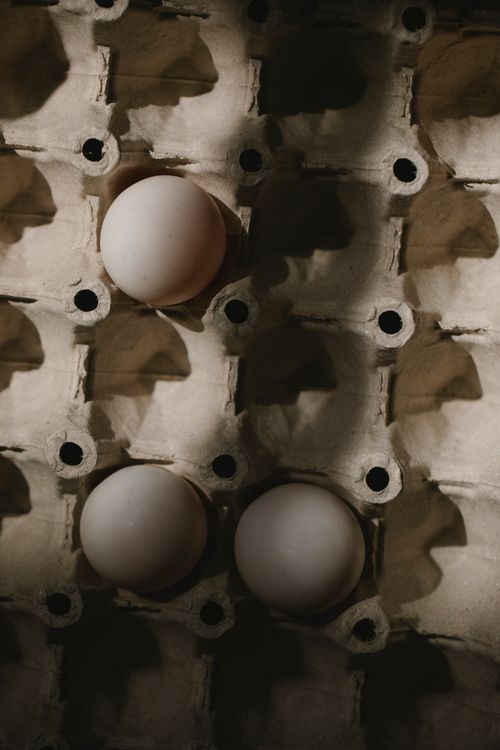
Cover: Klaus Nielsen, Pexels source photograph, Pexels License. Image unchanged. Eggs in a carton, shown as food-shopping context. This stock photograph does not verify a Polish shell code or production method.
Buying eggs in Poland becomes easier once you stop treating the carton as one long quality claim. The letter A, the size M and a shell stamp beginning with 0 answer different questions. None replaces the date or the practical question of how many eggs you will use.
This guide is about ordinary hen eggs. Poland's food-quality inspectorate, IJHARS, published a consumer guide in March 2026 that separates quality classes, weight classes, housing methods and date information. Those distinctions let you compare two cartons without guessing from a farmhouse picture or translating every advertising sentence.
Start with a carton-reading routine
Read the product description, count, weight class and best-before date before the marketing line. Then check the housing method and the explanation of the shell code. Finally, look at the eggs and packaging for obvious damage. You do not need to decode every farm number to make a sensible purchase.
A useful shopping note is quantity, size and housing preference. Six medium free-range eggs gives you three separate checks. If you ask only for good eggs, the assistant cannot know whether you mean the production method, the size or a particular cooking task. A specific question works better than a vague quality request.
A is a quality class, not a size
IJHARS explains that hen eggs are divided into quality classes A and B. Class A eggs are intended for consumers; class B eggs go to industry. An A on a supermarket carton is not a premium-size promise or a ranking that makes the carton superior to every other retail carton.
The inspectorate describes class A requirements including a clean, undamaged shell and the absence of foreign smells. Those are commercial quality requirements, not an instruction to taste a questionable egg or ignore storage directions. Keep class and size in separate mental boxes. An A egg can still be small.
S, M, L and XL describe weight ranges
The current IJHARS guide gives four weight classes: S is below 53 g; M is at least 53 g and below 63 g; L is at least 63 g and below 73 g; XL is at least 73 g. An egg weighing 63 g belongs to L, not M. These are egg weights, not the amount of liquid egg remaining after removing the shell.
Look for the number of eggs as well as the letter. A larger carton does not necessarily contain larger eggs. When following a recipe, buying the requested class is a cleaner first step than substituting by eye. A recipe specifying a weight of beaten egg needs that weight rather than a guess based on the number of shells.
Some packs contain mixed sizes. IJHARS says these should carry wording such as jaja różnej wielkości, meaning eggs of different sizes, together with the minimum net egg weight. That can suit flexible everyday cooking. It is less convenient when a recipe specifies one size. Mixed does not itself mean poor quality.
The first shell digit describes housing
For ordinary marked hen eggs, the code begins with a digit describing how the hens were kept. The 2026 official guide gives 0 for organic production, 1 for free range, 2 for barn housing and 3 for enriched cages. Useful Polish phrases include chów ekologiczny, wolny wybieg, chów ściółkowy and klatki ulepszone.
This digit is not a countdown of freshness or a cooking instruction. It helps you apply your production preference. If that matters to you, compare the code with the carton wording instead of relying on pastoral packaging. A photograph of a field cannot tell you what the shell stamp actually says.
PL and the remaining numbers identify the producer
IJHARS presents the Polish code in a pattern beginning X-PL, followed by producer-identification numbers. PL is the member-state code. The remaining Polish number identifies administrative and business details, including the producer. The carton should explain the code on its outside or inside surface.
Do not confuse shell information with the address of the business responsible for packing or selling the product. They answer different questions. The inspectorate's 2026 guide records labelling problems involving inconsistencies between the farm indicated on eggs and information elsewhere on the label. When origin matters, check the stamp rather than assuming a Polish-language carton contains Polish-laid eggs.
Find najlepiej spożyć przed
The official guide says the date is expressed as a best-before date using najlepiej spożyć przed. Find the actual printed date, not merely the place where the carton says it will be printed. If a stamp is faint, choose a clearly marked pack or ask the retailer. Do not mistake a nearby batch number for a date.
IJHARS advises refrigerated storage after purchase. Follow the carton instructions and plan the trip home around keeping groceries in suitable conditions. A shop display is not a reason to invent your own home-storage rule. Nor should a general online tip override the directions on the product you bought.
Extra fresh has a specific meaning
Ekstra or ekstra świeże is not simply another way of saying that the producer likes its eggs. IJHARS explains that this description applies up to the ninth day after laying and advises looking for laying-date information. That is separate from the weight class and housing code.
When comparing packs, do not assume the biggest freshness slogan means the longest remaining shopping window. Read the dates. For preparations with special safety requirements, use an appropriate tested recipe and relevant food-safety advice. A shell stamp does not guarantee that raw egg is suitable for every person or dish. This is a shopping guide, not permission to ignore those requirements.
Shell colour is a poor shortcut
The inspectorate states that shell colour is genetically determined and does not determine egg quality or taste. White eggs are not automatically inferior, and brown eggs are not automatically more natural. If you grew up where one colour dominated, familiarity can feel like a quality judgment when it is only familiarity.
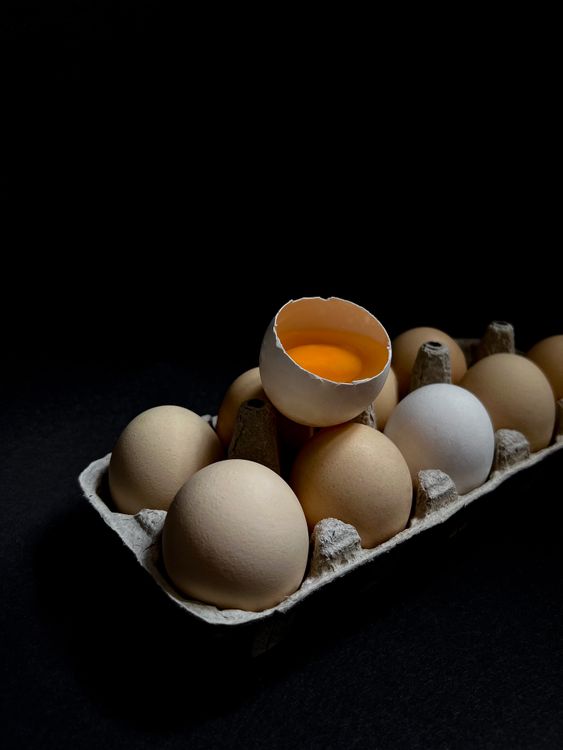
Use the same checklist for both colours: date, size and production method. There is no need to pay for a colour on the assumption that it proves something the inspectorate says it does not. This guide's photographs illustrate eggs, not a comparison test between farms, breeds or shell colours. Neither photograph verifies a Polish producer code.
Loose eggs require visible information too
For eggs sold loose, IJHARS says information should be visible and readable at the point of sale. This includes quality and weight class, housing method, code explanation and best-before date. Look for it rather than assuming that the absence of a carton means the absence of labelling duties.
There are specific direct-sale exemptions. The 2026 guide describes an exemption for producers with no more than 50 hens selling directly in the stated local area, with producer or farm identification supplied. An unmarked egg is therefore not enough by itself to diagnose an unlawful sale. Ask who produced it and where the relevant information is displayed.
Ask a practical question in Polish
Czy są jajka w rozmiarze M? means: Are there medium eggs? Czy te jajka są z wolnego wybiegu? asks whether they are free range. Gdzie jest data minimalnej trwałości? asks where the best-before date is. These questions keep the conversation useful without requiring a translation of the entire carton.
At a farm stall, Kto jest producentem? asks who the producer is. Pointing to the stamp and asking Co oznacza ten kod? is easier than pronouncing every administrative number. Keep a photograph of a carton you liked for your next shop, but check the new date each time. A saved photo is a shopping aid, not proof about today's pack.
Choose for the meal, then compare fairly
For a flexible breakfast, weight class may matter less to you than quantity and production preference. For baking, the recipe's size or weight deserves more attention. Neither use requires pretending that a housing code is a flavour score. Make the choice that answers your actual cooking question.
Compare the same count, similar size and the production system you want. A cheaper carton with fewer eggs or another size is not a direct comparison. You can still choose it, but do so knowingly. For the wider weekly shop, our supermarket guide explains the retail setting rather than promising that one chain always stocks every carton type.
Make the first purchase easy to repeat
Buy a modest pack matching the meals you intend to make, read its code explanation at home and note the useful Polish terms. That creates a reference point without committing you to a large quantity. Next time, compare another pack against an understood label rather than against a vague impression of the shelf.
If a grocery delivery offers a substitute, check what changed: quantity, size, housing method or all three. A substitute can be acceptable without being identical. If one of those features was the reason you ordered that carton, decide whether the replacement still meets your need before treating the order as settled.
The main skill is keeping separate claims separate. A describes quality class, M describes weight, the first shell digit describes housing and the date supplies another piece of information. Once you can read them independently, the carton becomes a useful shopping tool rather than a language test. You can choose on purpose without memorising every brand.
Related: Supermarkets in Poland.
Frequently asked questions
Does a brown shell mean a better egg?
No. IJHARS says shell colour is genetically determined and does not determine egg quality or taste.
Does M mean medium quality?
No. M is a weight class: at least 53 g and less than 63 g per egg. A is the consumer quality class.