What Is a Polish Notary (Notariusz), and When Do Expats Need One?
The essentials: A notariusz is a state-appointed lawyer who certifies major legal acts in Poland. Expats need one to buy property, set up a company, sign a marital property agreement or a notarial will. Fees are capped by regulation - an 800,000 PLN flat purchase costs at most 1,985 PLN plus VAT, plus 2% PCC tax and court fees.
A Polish notary - the *notariusz* - is one of those institutions that expats meet at the biggest moments of their lives here: buying a flat, setting up a company, getting married, writing a will. Yet the Polish notary is a very different animal from a British notary public or an American notary at a shipping store. A notariusz is a highly qualified lawyer appointed by the Minister of Justice, and their signature carries near-evidentiary force in Polish law. This guide explains what a notary actually does, which of your expat milestones require one, and - with the official 2026 fee table - what a visit will cost.
What a Polish notary actually is
Under the *Prawo o notariacie*, the Notarial Law of 14 February 1991, a notary in Poland acts as a "person of public trust" (*osoba zaufania publicznego*) and enjoys the legal protection of a public official when performing notarial acts. In plain terms: the state authorises the notary to certify that you are who you say you are, that you understand what you are signing, and that the transaction follows the law. Documents prepared as a notarial deed (*akt notarialny*) are treated by Polish courts and offices as official evidence of what happened in the notary's office.
Notaries are not civil servants. They run their own offices (*kancelaria notarialna*), earn their income from regulated fees, and are personally and financially liable for mistakes. Every notary must belong to the notarial self-government: the regional chambers (*izby notarialne*) and the National Council of Notaries (*Krajowa Rada Notarialna*, KRN) in Warsaw, which also runs the official registers - including the notarial register of wills and the register of inheritance proceedings.
Becoming a notariusz requires a law degree, a multi-year apprenticeship (*aplikacja notarialna*), a state exam, and appointment by the Minister of Justice to a specific vacancy. That is why the notary's stamp on your flat purchase is not a formality - it is the guarantee that makes the deed enforceable.
*Data source: Izba Notarialna w Krakowie, "Notariat w Polsce" and Krajowa Rada Notarialna, krn.org.pl, accessed October 21, 2026.*
When expats actually need a notary
Some Polish transactions are legally void unless they are done as a notarial deed, and for expats several of the biggest ones fall in that category.
Buying or selling property. This is the classic one. The sale of a flat or house must be signed as a notarial deed - a contract in any other form is invalid. The notary checks the land and mortgage register (*księga wieczysta*), explains the documents, collects the civil-law transactions tax (PCC) on behalf of the tax office, and files the court applications to register you as the new owner. If you buy with a mortgage, establishing the bank's mortgage in your favour is also documented before a notary, normally in the same or a follow-up appointment.
Setting up a company. The articles of association of a limited liability company (*sp. z o.o.*) and a joint-stock company (*S.A.*) must be executed in notarial form. If you sign the paperwork remotely through the S24 online system you may skip the notary, but any company formed on negotiated, tailored statutes goes through a kancelaria.
Marriage and family property. A marital property agreement - for example separating your finances from your spouse's - requires notarial form, as do donations (gifts) of real estate.
Wills and inheritance. A handwritten will is valid in Poland, but a notarial will is safer, faster to execute after a death, and automatically entered in the national register of wills. Notaries also conduct inheritance certification proceedings and prepare deeds of inheritance certification (*akt poświadczenia dziedziczenia*).
Powers of attorney and certifications. Many everyday errands - authorising a lawyer to represent you, certifying that a copy of your passport is true to the original, certifying a signature for a foreign bank - are one-visit notarial acts. Some powers of attorney technically do not need a notary, but institutions abroad and Polish offices alike tend to accept notarised versions without argument.
*Data source: Krajowa Rada Notarialna, "Czynności notarialne - broszura informacyjna" (May 27, 2022), krn.org.pl, accessed October 21, 2026.*
What you do not need a notary for
Just as useful: the everyday expat checklist items that need no notary at all. Applying for a PESEL number, registering your residence (*zameldowanie*), filing for a residence permit at the voivodeship office, opening a bank account, signing an employment contract, renting a flat, and dealing with ZUS or the tax office are all done directly with the institution - sometimes with a sworn translator or an apostille on foreign documents, but not with a notariusz. If a middleman tells you a notary is required for one of these, be sceptical.
What a notary costs in 2026
Notarial fees are capped by regulation - the Justice Ministry's regulation on maximum notarial fees, in the consolidated text published as Dz.U. 2024 poz. 1566. A notary may charge less than the cap, and some do for straightforward matters, but may not charge more.
For most transactions the maximum fee (*taksa notarialna*) follows a tiered scale based on the value of the deal:
- up to 3,000 PLN - 100 PLN
- 3,000 to 10,000 PLN - 100 PLN + 3% of the excess over 3,000 PLN
- 10,000 to 30,000 PLN - 310 PLN + 2% of the excess over 10,000 PLN
- 30,000 to 60,000 PLN - 710 PLN + 1% of the excess over 30,000 PLN
- 60,000 to 1,000,000 PLN - 1,010 PLN + 0.4% of the excess over 60,000 PLN
- 1,000,000 to 2,000,000 PLN - 4,770 PLN + 0.2% of the excess over 1,000,000 PLN
- over 2,000,000 PLN - 6,770 PLN + 0.25% of the excess over 2,000,000 PLN, capped at 10,000 PLN (7,500 PLN for deals between the closest family members)
Two important discounts soften the scale. For the sale of a residential property - the deed most expats will sign - the maximum is half the standard rate. For a mortgage securing a bank loan for a home, house or business premises, the maximum is one quarter of the standard rate. Some acts carry flat caps instead: a simple will costs at most 50 PLN, a will with an ordinary legacy 150 PLN, revoking a will 30 PLN, and a marital property agreement 400 PLN.
A worked example, current as of October 2026: buying an 800,000 PLN flat, the full tiered fee would be 1,010 PLN + 0.4% of 740,000 PLN = 3,970 PLN, but the residential half-rate caps the notary's fee at 1,985 PLN. A 600,000 PLN bank mortgage deed comes to at most 3,170 PLN ÷ 4 = 792.50 PLN.
On top of the fee, add 23% VAT, so the flat-purchase notary fee above becomes roughly 2,421 PLN with tax. And the notary fee is only one of three cost layers, as the Kraków notarial chamber explains: you also pay (1) taxes the notary collects as a remitter - for a secondary-market flat that is the 2% PCC tax on the price - and (2) court fees for the land-register entries, which the notary files and pays on your behalf. Budget for all three lines, not just the taksa.
*Data source: Rozporządzenie Ministra Sprawiedliwości w sprawie maksymalnych stawek taksy notarialnej, consolidated text Dz.U. 2024 poz. 1566 (eli.gov.pl) and Izba Notarialna w Krakowie, "Ile to kosztuje", accessed October 21, 2026.*
What an appointment looks like
Appointments are booked in advance, by phone or email. Bring your passport (or EU national ID card); the notary verifies identity for every person signing. The deed is read aloud in Polish and signed in Polish. If you do not speak Polish comfortably, tell the office when booking - a sworn translator (*tłumacz przysięgły*) should attend so the reading can be interpreted, and the translator's participation is recorded in the deed.
The notary explains the legal effect of what you are signing and must refuse to execute an act that breaks the law. Payment is due at the desk - most kancelarias take cards. You leave with an official copy of the deed (*odpis aktu*), and the notary keeps the original in the office archive.
Many notaries in Warsaw, Kraków, Wrocław, Gdańsk and Poznań work comfortably in English, and some publish English-language pages, but this varies by office - ask when booking. The KRN runs an official notary search on krn.org.pl where you can filter offices by city and specialisation.
*Data source: Krajowa Rada Notarialna, krn.org.pl (notary search and notarial registers), accessed October 21, 2026.*

Frequently asked questions
Do I need a notary to buy a flat in Poland?
Yes. The sale of real estate must be executed as a notarial deed; without it the transfer of ownership is invalid. The notary also collects the 2% PCC tax on a secondary-market purchase and files the application to enter you in the land and mortgage register. Source: Izba Notarialna w Krakowie, "Ile to kosztuje", kin.pl, accessed October 21, 2026.
How much does a notary charge for buying an 800,000 PLN flat?
At the statutory cap: half of the standard tiered rate for a residential sale, which works out to 1,985 PLN plus 23% VAT - about 2,421 PLN - plus the 2% PCC tax and land-register court fees. The cap is a maximum, so the office may quote less. Source: Rozporządzenie MS, Dz.U. 2024 poz. 1566, §3 and §6, eli.gov.pl, accessed October 21, 2026.
Can the deed be done in English?
The deed itself is read and signed in Polish. If you do not speak Polish, arrange with the kancelaria for a sworn translator (tłumacz przysięgły) to attend the appointment and interpret the reading; their presence is noted in the deed. Source: Krajowa Rada Notarialna guidance, krn.org.pl, accessed October 21, 2026.
How much does a notarial will cost?
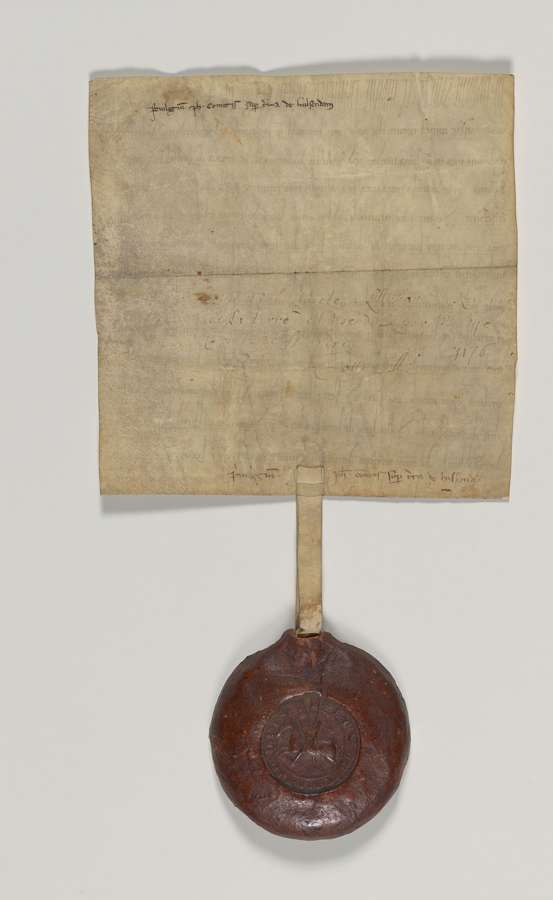
A simple notarial will is capped at 50 PLN, a will with an ordinary legacy or appointment clause at 150 PLN, and revocation at 30 PLN, each plus VAT - one of the cheapest legal documents you will ever buy. Source: Rozporządzenie MS, Dz.U. 2024 poz. 1566, §8, eli.gov.pl, accessed October 21, 2026. * Photos: parchment document and seal of Philip of Alsace, The Metropolitan Museum of Art (CC0); notarial deed of March 3, 1314 by Pedro de Serra and Berenguer Gomar (public domain), via Wikimedia Commons*