Water Leaks in a Polish Flat: Landlord, Evidence and Insurance
The essentials: Put safety first, alert the landlord and building administrator, record the damage once safe, and contact the relevant insurer. A leak from upstairs does not by itself establish who is liable.
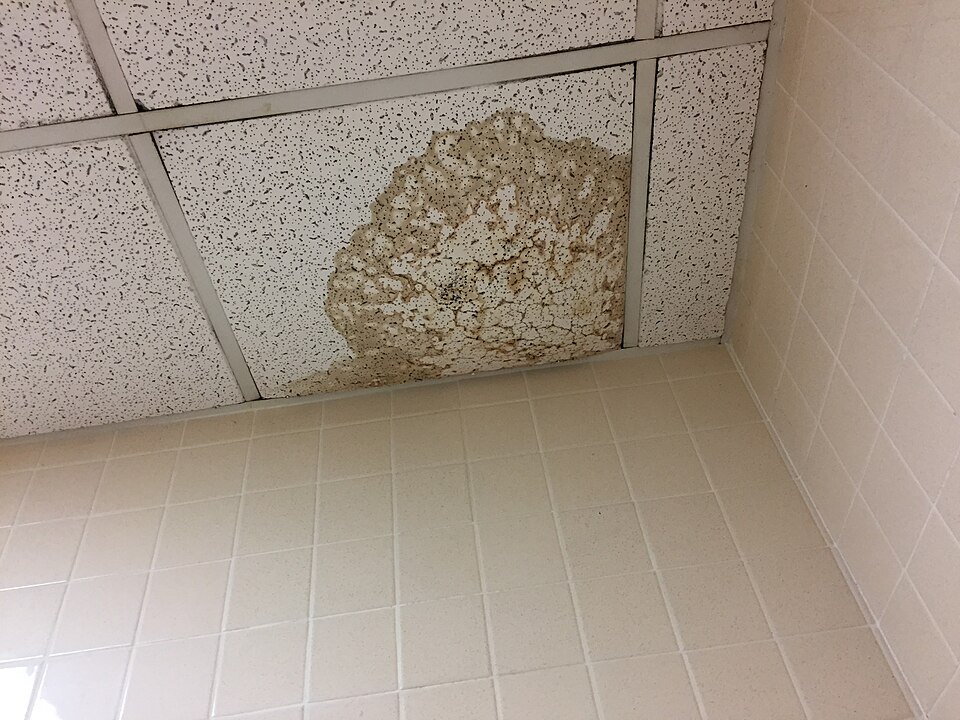
Illustrative ceiling damage from a leaking pipe, photographed outside Poland in 2017. This is not a photograph of a reported Polish incident. Photo: Atomicdragon136 / Wikimedia Commons, CC BY 3.0. Resized and re-encoded.
Water dripping through a ceiling in Poland creates several jobs at once: keep people safe, stop further damage where possible, reach the right building contact and preserve evidence. Deciding immediately that the neighbour must pay is not one of those first jobs. A leaking appliance, a shared pipe, a roof problem and sewage backing up into a basement can require different technical and insurance responses.
This guide was checked on 2 November 2026 against Polish government, sanitary-inspectorate, Warsaw water-company and Financial Ombudsman material. It is practical preparation for renters and owners, not a diagnosis of your building, a repair manual or a guarantee of insurance cover. For an active emergency, follow the emergency services and qualified professionals handling the incident.
Put safety before photographs
If people or property face an immediate threat, call 112. Do not walk into water to reach a socket, appliance or electrical cabinet. Government post-flood advice warns against switching gas or electrical installations back on yourself because they may be damaged. Tell the administrator or emergency service if water is near wiring, a light fitting or powered equipment; an electrician may need to make the installation safe.
A wet ceiling also deserves caution. Do not stand underneath a sagging or unstable area to get a better picture. Keep children and pets away from the affected space. The duty to limit property damage does not mean putting yourself at risk. The Financial Ombudsman's July 2026 advice places people's safety first and damage-limitation work after the immediate danger has passed.
If a known water shutoff is safely accessible, ask the landlord or administrator about isolating the affected supply. Do not force an unfamiliar valve, dismantle a pipe or operate shared building equipment without knowing what it controls. If the source is in another flat or behind a common riser, technical access and coordination may be needed. A photograph of a valve online cannot identify the right valve in your home.
Contact the landlord and building administrator promptly
In a rented flat, tell the landlord what happened and when, then contact the building administrator or emergency maintenance service. Use the building's own posted or previously confirmed contact details. Give the address, flat number, affected rooms and whether water is still entering. If you cannot reach someone, keep a record of the calls and messages while continuing the safe emergency response.
Ask who is arranging the plumber or other technical inspection and who can access the shared installations. If water appears to come from upstairs, alert that resident where possible, but describe the observation rather than presenting an unverified accusation. The visible place where water emerges does not, on its own, establish the defective component or the person legally responsible.
It helps to keep two separate records: a technical note about finding and stopping the source, and an inventory of the resulting damage. Ask the professional or administrator to record what they actually found. A note saying a ceiling is wet is different from a finding that a particular hose failed or a shared pipe leaked. Do not add a cause yourself if nobody has established it.
Know when the water company is the right route
The government lists 994 as the water-and-sewage emergency number. Warsaw's MPWiK says faults can be reported through its free, round-the-clock 994 service. Its page separately describes how to complain about the company's services. Neither statement means that the municipal water company is the repair contractor for every leaking tap, washing-machine hose or internal building pipe.
For an internal-flat or building problem, the administrator, owner and appropriate tradesperson are the practical first contacts alongside any urgent services. For a suspected public-network failure, use the local water operator's official reporting route. Give a precise location and describe what is happening. Do not assume Warsaw MPWiK's complaint channels, opening hours or service area apply throughout Poland.
| Situation | Who to involve | Important limit |
|---|---|---|
| Water near electrical equipment or an unstable ceiling | Emergency services where there is immediate danger, building management and qualified technical help | Do not enter the danger area to document it. |
| A leak inside a rented flat | Landlord and administrator, with a plumber as arranged | Do not assume responsibility before the cause is checked. |
| A suspected shared-pipe or roof problem | Administrator or building manager | Access and repairs may involve common building parts. |
| A suspected water or sewage network fault | The actual local water operator's emergency route | A network report does not replace an insurance claim. |
Document the damage before and after safe action
Once it is safe, take wide photographs showing the affected room and closer pictures of individual damage. Record water marks, flooring, walls, furniture and belongings. Keep the original files with their dates. The Financial Ombudsman's March 2026 guidance recommends pictures and videos before and after damage-limitation work, a list of damaged things and receipts for the work undertaken.
Make an inventory with the item, visible damage and any identifying information you already have. Purchase receipts or earlier photographs may help explain ownership and condition. Do not invent a replacement value or declare an appliance beyond repair without a basis. Separate your belongings from the landlord's fixtures and furniture so that the relevant owner and policy can be identified.
Retain damaged elements for inspection where safe and practical, as the Ombudsman's guidance recommends. That is not a reason to keep contaminated sewage-soaked materials in a living space. Ask the insurer how it wants unsafe items documented before disposal and follow sanitary or emergency instructions. Record what was removed, why and by whom, with photographs when possible.
Limit further damage without waiting for every inspection
The Financial Ombudsman explains that an insured person has duties to protect insured property and reduce the size of a loss. Its July 2026 advice says you do not have to wait for the insurer's assessor before taking appropriate steps to remove the effects of flooding: delay can make the damage worse. That does not authorise unsafe DIY or unnecessary full refurbishment before the cause is documented.
Depending on the circumstances, professional pumping, drying, temporary repairs and moving belongings may be reasonable damage-limitation measures. The Ombudsman's March 2026 material discusses reimbursement of justified, purposeful protective costs, including cases where the measures did not succeed. Keep invoices and evidence of why work was needed. Coverage, limits and the particular contract still matter; the guidance is not a promise that any contractor's bill will be paid in full.
If your policy includes assistance, contact its service before arranging non-urgent work and ask what it can organise. Check authorisation, cost limits and any storage or temporary-accommodation conditions. When urgent action cannot wait, document the need and costs. Do not let a caller's claim to be an insurer-approved contractor replace verification through the insurer's own contact details.
Sewage and floodwater need a different cleaning plan
A clean-water pipe leak and sewage entering a room are not equivalent. Poland's Chief Sanitary Inspectorate warns that sewage can contain disease-causing organisms and chemicals, penetrate porous materials and contaminate furnishings and building elements. Its guidance treats sewage-flooded rooms as a health risk and describes protective clothing, cleaning, removal of unsuitable porous materials and disinfection.
Do not apply that document as a casual recipe for every damp patch, and do not assume a room is safe simply because the visible water has gone. Explain suspected sewage or outdoor floodwater to the administrator and cleaning contractor. Keep people away from contaminated items and follow the relevant sanitary instructions. Drying, contamination removal and checking electrical safety are separate tasks.
The inspectorate also warns against combining chlorine products with other disinfectants or unsuitable chemicals because dangerous chlorine can be released. Avoid improvised chemical mixtures. For serious contamination, use qualified assessment and the official guidance instead of a social-media cleaning shortcut. A fresh coat of paint does not establish that underlying materials are dry or clean.
Report the claim and separate cover from liability
Report an insured loss without unnecessary delay using the procedure in the policy and its general conditions, called OWU. Give the facts known so far, keep the claim number and ask what documents and inspections are required. The landlord's building or flat policy, your contents insurance and liability cover may concern different property and risks. One policy should not be assumed to protect everyone's belongings.
The Financial Ombudsman's renter guidance explains fault-based liability under the general rule in Article 415 of the Civil Code. Damage, a wrongful and culpable act or omission, and a causal connection matter. Its discussion of recovery claims also notes that responsibility may lie with building administration, a contractor or another party, rather than automatically with the resident of the flat above.
If your neighbour's insurer pays them, that does not necessarily end the matter. The Ombudsman explains that an insurer can seek recovery from a person responsible for the loss. Conversely, receiving a demand does not establish that you caused the damage. Pass it promptly to your liability insurer if relevant, preserve the evidence and obtain advice before agreeing to a disputed payment or signing a settlement.
Keep one clear incident file
Bring together the timeline, contact attempts, technical findings, photographs, damaged-item inventory, invoices and insurer correspondence. Ask for explanations in writing where a cause, repair scope or payment is disputed. Keep factual updates going to the landlord and administrator until the leak is stopped and the safe repair plan is clear. Emergency response, drying, final repairs and the claim can finish at different times.
The useful outcome is not a quick admission of blame. It is a safe flat, a checked source of water, records that show what happened and the correct people handling each part. When insurance or responsibility remains disputed, seek case-specific advice rather than treating this general guide as a decision on your claim.
Frequently asked questions
Must I wait for the insurer before limiting water damage?
The Financial Ombudsman says appropriate damage-limitation work need not wait for the assessor. Safety comes first; document the damage and preserve receipts and technical findings.
Is the upstairs neighbour automatically responsible?
No. The cause, fault and causal connection matter. A common pipe, contractor or other source may be involved.
Does the landlord's insurance cover my belongings?
Do not assume so. Building elements, contents, assistance and liability cover can have different insured people, risks and limits.
Can I use wet electrical equipment when the water has gone?
Do not switch damaged or flood-affected installations back on yourself. Follow qualified technical advice and the applicable safety instructions.
Sources
- Financial Ombudsman protective costs,26 March 2026; checked 2 November 2026
- Financial Ombudsman after-damage guidance,8 July 2026; checked 2 November 2026
- Financial Ombudsman renter liability guidance; checked 2 November 2026
- Warsaw MPWiK fault and complaint routes; checked 2 November 2026
- Government regional post-flood safety advice; checked 2 November 2026
- Chief Sanitary Inspectorate sewage-contamination guidance; checked 2 November 2026
- Financial Ombudsman insurer recovery claims; checked 2 November 2026
- Government emergency-number list; checked 2 November 2026