Gęsina: Poland's St Martin's goose season returns 11 November
The essentials: Gęsina is Poland's St Martin's Day goose tradition: roast goose on and around 11 November. The Slow Food Polska restaurant campaign Gęsina na św. Marcina runs 11-29 November 2026, with every participating restaurant serving at least three goose dishes; the venue list appears on gesina.pl.
Every November, just as Poland's Independence Day flags come out, restaurant windows across the country sprout a small goose logo. Behind those doors, chefs serve roast goose with apples, goose breast carpaccio, goose broth and even foie gras ice cream for three short weeks. This is gęsina - Poland's St Martin's goose season - and in 2026 the nationwide restaurant campaign runs from Wednesday 11 November to Sunday 29 November.
If you live in Poland and have never eaten goose, this is the easiest, most social way to fix that. Here is the tradition behind it, how the campaign works, and what to order.
Why goose, and why 11 November?
The tradition hangs on St Martin of Tours, a 4th-century Roman soldier turned monk, famous for cutting his cloak in half for a beggar. Legend says that when the people of Tours wanted to make him bishop, the modest Martin hid in a goose pen - and the geese gave him away with their honking. Martin became bishop, and the goose paid the price: across Europe, his feast day on 11 November became the traditional date of the autumn goose slaughter.
There was a practical side too. Geese hatch in spring and fatten through summer and autumn, so November is when the birds - in Poland famously the gęsi owsiane, oat-fed geese - are at their best. Martinmas also marked the last feast before the old Advent fast, which made it the natural moment for a blow-out meal. Poland took this seriously: in the 19th century, around 3.5 million geese a year changed hands at the Warsaw commodity exchange, most of them exported to Germany, where Polish goose was considered the finest you could buy.
The day generated its own folklore. The saying *"Na św. Marcina najlepsza gęsina"* ("the best goose is on St Martin's") is still quoted every November, and farmers once read the winter ahead from the roast bird: a dark, bluish breastbone promised a harsh, snowy winter, a white one a mild season. Another proverb ties it to Christmas: *"Gdy Marcinowa gęś po wodzie, Boże Narodzenie po lodzie"* - if Martin's goose walks on water, Christmas will come on ice.
The comeback: Gęsina na św. Marcina
By the late 20th century, goose had nearly vanished from Polish tables - chicken was cheaper and faster. Average consumption sank to a reported 17 grams per person per year. The turnaround started in 2010, when Slow Food Polska launched the "Gęsina na św. Marcina" campaign with restaurateurs, goose breeders and processors. According to the organisers, goose consumption has since climbed back to roughly 300 grams per person annually.
The campaign's rules are simple and strictly the same everywhere:
- Every participating restaurant keeps at least three original goose dishes on the menu for the entire campaign - anything from a starter to a dessert counts.
- Participants display the campaign logo in the window, so you can spot them from the street.
- Chefs compete for the best goose recipe of the year, judging each other's entries.
- The official pairing is Wino Świętomarcińskie, a St Martin's wine made for the campaign by Winnica Turnau.
In 2026 the campaign runs 11-29 November. The full restaurant list is published on gesina.pl shortly before the start; as of late October 2026 it is not out yet. The 2025 list had around 50 restaurants, with the biggest clusters in Warsaw (ten) and Kraków (five), plus Poznań, Gdańsk, Sopot, Gdynia, Katowice, Lublin, Opole, Zakopane and hotels in the mountains and on the coast. Many restaurants outside the formal campaign also run their own goose menus through November, so it is worth asking anywhere with a Polish kitchen.
What to order
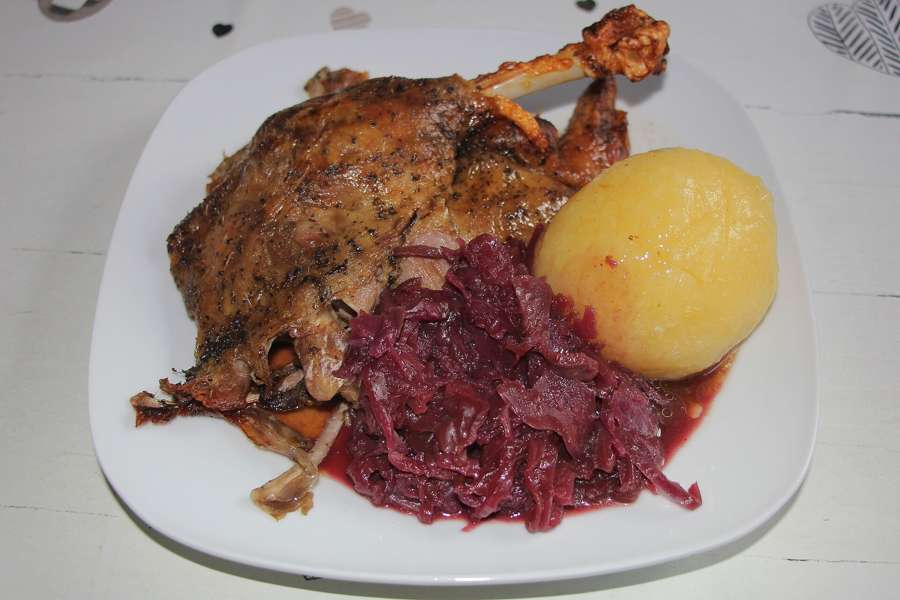
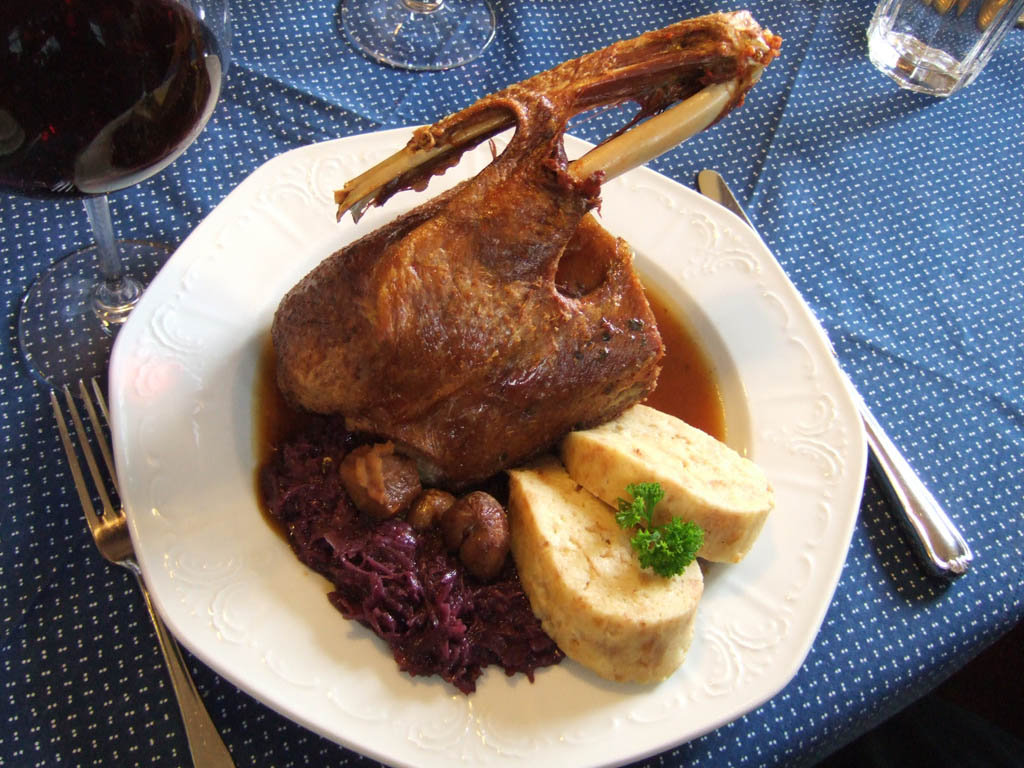
The centrepiece is gęś pieczona - whole roast goose, classically rubbed with herbs, salt and oil, stuffed with apples and onion, roasted for hours and served with dark potato dumplings (*kluski*) and sweet-sour red cabbage (*modra kapusta*). A whole bird feeds four to six people and often needs to be pre-ordered a day or two ahead, which makes it a brilliant group dinner.
For smaller tables, look for:
- Półgęsek - goose breast fillet, served roasted, smoked, or as carpaccio; the connoisseur's cut.
- Czernina (czarnina) - the old Polish sweet-sour soup made with goose or duck blood, dried fruit and vinegar; an acquired taste and a point of regional pride.
- Okrasa - rich goose broth, the classic opener of a Martinmas dinner.
- Confit goose leg or gizzards, goose rillettes, and smalec z gęsi - goose-fat spread with cracklings on rye bread.
- Pierogi z gęsiną - dumplings filled with roast goose, a November special in many milk bars and bistros.
- Foie gras - Polish producers make excellent goose liver, and campaign chefs show off with it.
At home, the working recipe has changed little in a century: a village cook from Kadłub in the Opole region, quoted by the Fundacja Dla Dziedzictwa foundation, describes rubbing the bird with herbs, salt and oil one day, stuffing it with apples and onion the next, roasting it about four hours while basting with its own fat, and serving it with dark dumplings and red cabbage - with the surplus frozen for Christmas. Even the down had a destiny: plucked feathers were dried in sacks and sewn into duvets.
Cooking it yourself
You do not need a restaurant to take part. In the first two weeks of November, whole fresh goose appears in better supermarkets, poultry stalls at market halls and online butcher shops across Poland - look for the words gęś owsiana (oat-fed goose), the premium category. A typical bird weighs 3-5 kg and feeds four to six. The baseline method is the village one described above: salt, marjoram and garlic inside and out, apples and onion in the cavity, a slow roast of around three to four hours, basting with the rendered fat. Save that fat: strained into a jar and refrigerated, it is the best roasting fat you will own all winter. If a whole bird is too much, butchers also sell legs, wings and półgęsek fillets separately, which fit an ordinary oven tray and cook in under two hours.
Planning it as an expat
The dates sit on top of a busy Polish week. 11 November is Independence Day, a public holiday - see our Independence Day guide for what opens and closes - so restaurants fill fast that day and booking ahead is essential. In Poznań, 11 November belongs equally to the St Martin's croissant; our rogal świętomarcinski guide covers that side of the street party, and the goose dinners are the natural sequel. Note that 11 November 2026 falls on a Wednesday, and the campaign covers three weekends, so there is no need to cram everything into the holiday itself.
Prices vary by city, but expect goose mains roughly in the same bracket as duck or beef tenderloin, and whole roast birds priced for groups. Book directly with the restaurant, mention if you want a whole goose, and check the campaign logo on the door or the list at gesina.pl to confirm participation.
Cover photo: Martinmas goose with red cabbage and potato dumpling by Karl Gruber, CC BY-SA 4.0. Photo above: St Martin's Day goose with red cabbage and dumplings by Zyance, CC BY-SA 2.5.
Frequently asked questions
When is the gęsina season in 2026?
The nationwide Gęsina na św. Marcina campaign runs from Wednesday 11 November to Sunday 29 November 2026. Many restaurants outside the campaign serve goose dishes through most of November, and the tradition peaks on St Martin's Day, 11 November.
Why do Poles eat goose on St Martin's Day?
Legend says St Martin of Tours hid in a goose pen to avoid becoming bishop and the honking geese betrayed him, so goose became the Martinmas meal across Europe. Practically, geese fatten through autumn and are at their best in November, and 11 November was the last feast before the old Advent fast.
How do I find a restaurant serving goose?
Check the official list at gesina.pl, published shortly before the campaign starts, or look for the campaign logo in restaurant windows. The 2025 list had about 50 restaurants, with the most in Warsaw and Kraków. Booking ahead is strongly recommended, and whole roast goose usually needs a pre-order.
What goose dishes should a first-timer try?
Start with roast goose leg or półgęsek (goose breast fillet) with red cabbage and dumplings - the classic plate. More adventurous options include czernina (goose blood soup), confit goose gizzards, goose-fat smalec on rye, and pierogi filled with roast goose.
Is gęsina connected to Christmas goose?
Historically yes - families roasted a goose on St Martin's Day and froze the surplus for Christmas, and roast goose remains a Christmas dish in Germany and parts of western Poland. In modern Poland, though, goose is above all a November restaurant tradition.