Kolędy: a guide to Polish Christmas carols you'll hear everywhere
The essentials: Kolędy are Poland's Christmas carols: solemn Nativity songs sung until Candlemas (2 February), distinct from pastorałki, folk shepherds' songs with dance rhythms. The canon includes Bóg się rodzi and Lulajże Jezuniu; hear them at Roraty masses, Pasterka, markets and carolling processions.
From early December, Poland develops a soundtrack. It leaks out of church doors before dawn Mass, drifts across Christmas markets, plays on loop in supermarkets and, after Christmas Eve, follows costumed processions down village lanes. The songs are kolędy - Polish Christmas carols - and knowing a little about them turns a wall of unfamiliar music into one of the warmest parts of the season.
Here is what kolędy are, how they differ from pastorałki, the handful of songs everyone in Poland knows by heart, and where you can hear them.
Kolęda, pastorałka - what is what?
The word kolęda comes from the Latin *calendae*, the first day of the Roman month, when neighbours settled accounts and exchanged wishes. In Poland it came to mean both the visiting custom around the New Year and the songs sung then: religious carols about the Nativity. The oldest Polish kolędy date back to the 15th century, and new ones are still written today.
Pastorałki are the folk cousins. The Franciscans who arrived in medieval Poland brought Christmas mystery plays - lively retellings of the Nativity - and local musicians dressed them in village melodies and dance rhythms: melancholy kujawiaks, dignified polonaises, skipping mazurkas. The result was the pastorałka, a shepherds' song where the Holy Family shares the stage with Maćeks, Stachs and Wojteks - ordinary Polish peasants dropping by the stable with a chicken or a wedge of cheese. If a carol makes you want to tap your foot, it is probably a pastorałka.
The canon everyone knows includes:
- Bóg się rodzi ("God is born") - the "queen of carols". Poet Franciszek Karpiński wrote the words in 1787 and published them in 1792; the melody is a stately polonaise attributed to Karol Kurpiński, possibly older. The poet Jan Lechoń reportedly called it Poland's true national anthem.
- Lulajże Jezuniu ("Sleep, little Jesus") - the great Polish lullaby, in a swaying 3/4. Chopin wove its melody into his Scherzo No. 1 in B minor, which is why a fierce concert piece suddenly turns tender in the middle.
- Wśród nocnej ciszy ("Amid the night's silence") - the early-19th-century shepherd carol sung at midnight Mass.
- Gdy się Chrystus rodzi ("As Christ is born") - short, bright, and the one children learn first.
- Przybieżeli do Betlejem ("They hurried to Bethlehem") and Dzisiaj w Betlejem ("Today in Bethlehem") - classic, cheerful pastorałki.
- Oj maluśki, maluśki ("Oh, tiny one") - a highland pastorałka from Podhale with 18th-century roots, known as John Paul II's favourite.
- Mizerna cicha ("Poor and quiet") and Z narodzenia Pana ("On the Lord's birth") - the older, more solemn end of the repertoire.
Much of this repertoire survived because one man wrote it down. Oskar Kolberg, the 19th-century ethnographer and composer, spent decades travelling Polish villages notating melodies, lyrics and customs in his monumental collections *Pieśni ludu polskiego* and *Lud*. Hundreds of carols that lived only in village memory entered his books - and from there, hymnals, schoolbooks and choirs carried them back out to everyone.
Carols with a spine of steel
Kolędy are gentle songs, but in Poland they have repeatedly doubled as coded protest. The final verse of *Bóg się rodzi* asks the Christ child to "bless our beloved homeland" (*błogosław Ojczyznę miłą*) - under the partitions, censors made singers swap *Ojczyznę* (homeland) for the neutral *krainę* (land). During martial law in the 1980s, an interned priest added a verse asking Jesus to comfort "the burning country" and bless Solidarity. Singing the old words in church became a quiet way of voting.
Kolędowanie: when the carols come to you
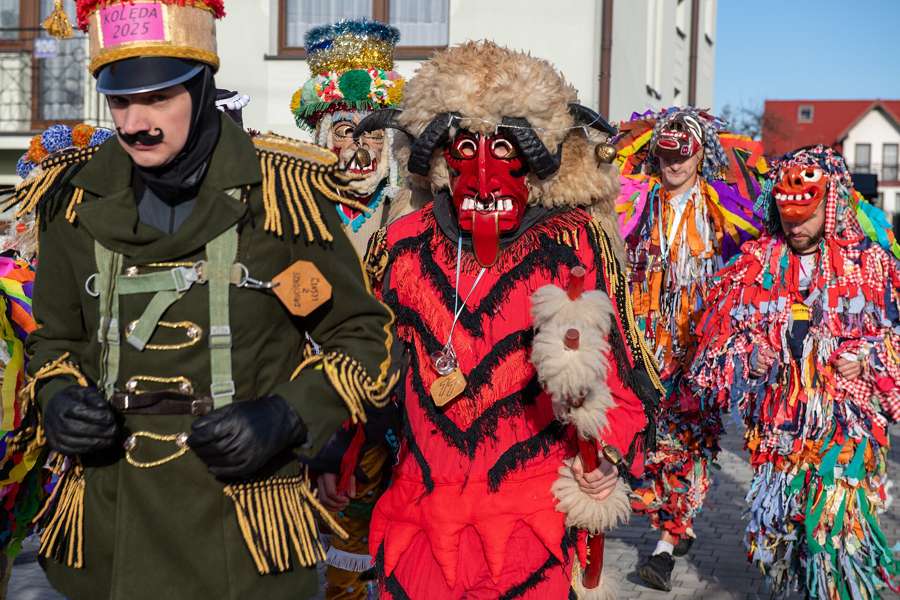
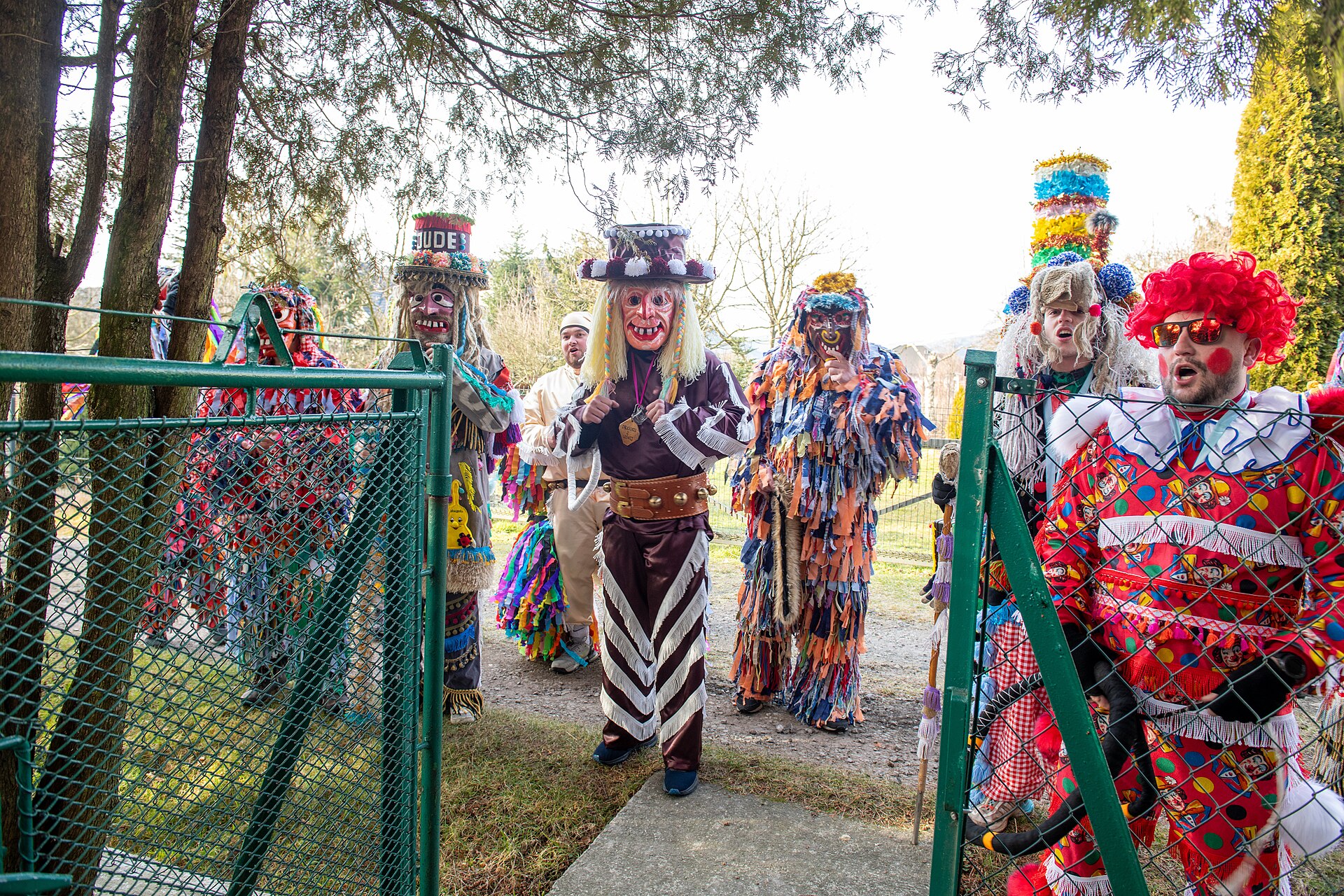
The songs also travel. From St Stephen's Day, 26 December, village groups of kolędnicy - carollers - start walking house to house, a custom that runs through the Christmas season all the way to Candlemas, 2 February. Depending on the region the procession carries a star on a pole, a miniature szopka nativity theatre (Kraków's version is an art form of its own - see our szopka guide), or drags along a Turoń, a shaggy snapping beast who dies and is resurrected for laughs. In the Beskid and Żywiec highlands the groups wear wildly colourful homemade costumes and masks, as in the photos here. Carollers sing a few verses, receive wishes and a small gift, and move on. If a group shows up at your building, opening the door and listening for a minute is the done thing; a coin or a sweet is welcome but not required.
Two lines worth learning
If you want to join in rather than hum, start with the openings everyone sings loudest:
- "Bóg się rodzi, moc truchleje" - "God is born, the powers tremble". The first line of the queen of carols; rise for it, it functions like a hymn.
- "Wśród nocnej ciszy głos się rozchodzi" - "Amid the night's silence a voice goes forth". The midnight Mass moment, usually sung as the procession moves.
- "Lulajże, Jezuniu, moja perełko" - "Sleep, little Jesus, my pearl". The lullaby; grandparents will mist up.
Polish pronunciation is consistent once you know the letters: ę is a nasal "en", ó sounds like "oo", ś and ć are soft "sh" and "ch". One evening with any lyrics sheet and a YouTube recording is genuinely enough to keep up on the choruses.
Where to hear kolędy as an expat
- Roraty. The dawn Advent Masses are built around Advent songs and the first kolędy, lanterns included - our Advent guide explains how to join one.
- Pasterka, the midnight Mass on Christmas Eve. Even occasional churchgoers fill the pews, and the carolling is the point: *Wśród nocnej ciszy* and *Bóg się rodzi* with a full church behind them are something else.
- Christmas markets. Stages in Kraków, Wrocław, Gdańsk and other cities host school choirs and folk groups singing kolędy through December.
- January carol concerts. Parish churches, philharmonics and city halls put on free or cheap *koncerty kolęd* in early January; community sings (*wspólne śpiewanie kolęd*) welcome anyone who can hum.
- 6 January. The Epiphany processions (Orszak Trzech Króli) in most big cities are sung all the way - our Three Kings' Day guide has the details.
You will not be expected to know the words. But learning the first line of *Bóg się rodzi* - "Bóg się rodzi, moc truchleje" - before Christmas Eve will earn you a genuinely warm reaction at any Polish table.
Cover photo: a kolędnicy group with a Turoń processing through Leśna, Lower Silesia, by Robert Garstka / Regionalny Instytut Kultury, CC BY 4.0. Photo above: carollers visiting homes in Leśna, by Robert Garstka / Regionalny Instytut Kultury, CC BY 4.0.
Frequently asked questions
What is the difference between a kolęda and a pastorałka?
A kolęda is a solemn religious carol about the Nativity, some dating to the 15th century. A pastorałka is its folk relative - a shepherds' song born from medieval mystery plays, full of village characters, humour and dance rhythms like the kujawiak and mazurka. In practice Poles call both "kolędy" in December.
When are kolędy sung in Poland?
The first appear at Roraty dawn Masses in Advent. The main season runs from Christmas Eve through to Candlemas on 2 February, when the Christmas season formally ends. Carolling groups (kolędnicy) visit homes from 26 December through January.
Do I have to be religious to go to a carol concert?
No. January carol concerts and community sings in churches, philharmonics and city halls are cultural events as much as religious ones, and plenty of non-churchgoing Poles attend for the music. The same goes for hearing kolędy at Christmas markets.
Who wrote "Bóg się rodzi"?
Poet Franciszek Karpiński wrote the words in 1787 in Dubiecko and published them in 1792. The polonaise melody is attributed to Karol Kurpiński, though some argue it is a much older coronation polonaise. The song is often called the queen of Polish carols and functioned almost as a national anthem under the partitions.
What is the difference between kolędowanie and the kołęda priest's visit?
Both words come from the same root but they are different customs. Kolędowanie is the carolling itself - songs and costumed groups. The kołęda (or kolęda) home visit is the parish priest's pastoral round to bless homes, usually in January. Our separate kołęda guide on the site explains that visit in detail.
What is the Turoń in carolling processions?
The Turoń is a shaggy, horned beast costume that accompanies carollers in parts of southern Poland. It claps its jaws, misbehaves, dies theatrically and is revived - a comic survival of pre-Christian winter ritual folded into the Christmas rounds.