Ostatki and kulig: Poland's carnival season explained for expats
The essentials: Poland's carnival (karnawal, ostatki) runs from Epiphany to Shrove Tuesday - 6 January to 9 February in 2027. Highlights: kulig sleigh-ride parties near Zakopane (from 180 zl per person in 2026/27), carnival balls and folk mask processions. Ash Wednesday, 10 February 2027, ends it and opens Lent.
Poland does not go straight from New Year into gloomy winter waiting for spring. Between Epiphany and Ash Wednesday runs the karnawal - the carnival season, called mięsopust in the old folk calendar - a stretch of balls, parties, sleigh rides and fried pastry that ends, abruptly and completely, when Lent begins. For expats it is one of the most fun and least documented seasons of the Polish year. In 2027 the season runs from 6 January to 9 February, when Shrove Tuesday closes it and Ash Wednesday, 10 February, opens forty days of Lent that end at Easter on 28 March.
The shape of the season
The logic is old and simple: feast before the fast. Catholic Lent historically meant no meat, no alcohol, no dancing and no weddings, so the weeks before it carried all of those at once. The final days - from Fat Thursday on 4 February 2027 through Shrove Tuesday on 9 February - are the zapusty or ostatki proper, the concentrated finale.
Old Poland took this seriously, and the official culture ministry's history of the final carnival week is the best window into it. The government culture portal's history of the last carnival week describes balls that opened with a polonaise and ran until the white mazur at dawn, with dance cards - karnety - recording which gentleman had claimed which dance. Carnival was also the matchmaking season: a winter of balls was the recognized market where couples met, and marrying during carnival was the norm because weddings stopped for all of Lent.
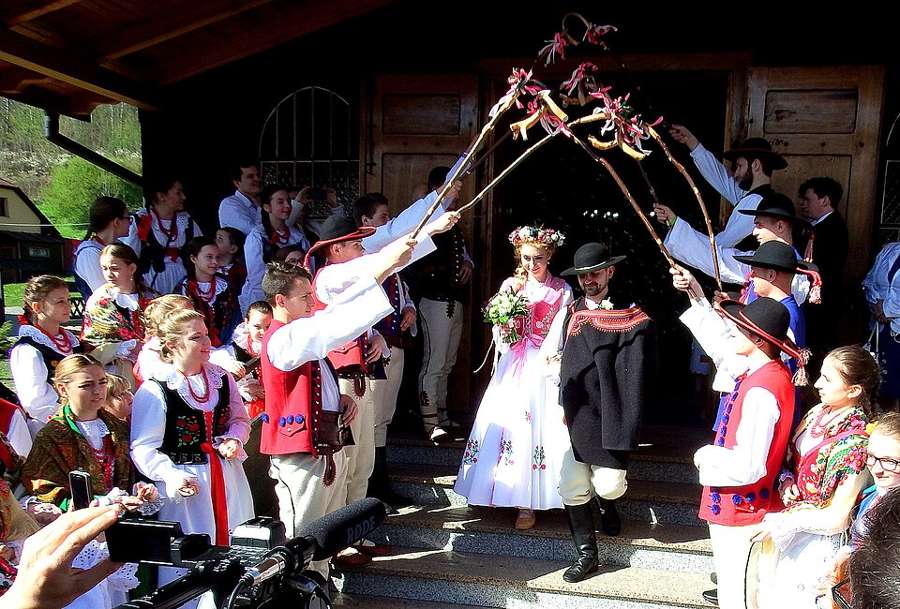
The countryside had its own parallel calendar. Costumed processions went house to house led by figures like the turon - a shaggy, clattering beast-head - the bear, the wolf and the stork, collecting sausage, cheese and eggs. The zapust, the carnival masker, appeared deliberately wrong: soot-smeared face, clothes inside out, a visitor from beyond the ordinary world who brought luck and fertility. These processions were not entertainment in the modern sense - they were fertility magic, performed so that the fields, the herds and the young couples would prosper in the coming year. Women's revels had their own day: the comber Thursday, our Fat Thursday, when married women hauled the year's new wives to the inn by sleigh and the newcomers had to buy their way into the company of the matrons with vodka and food.
The kulig: Poland's sleigh-ride party
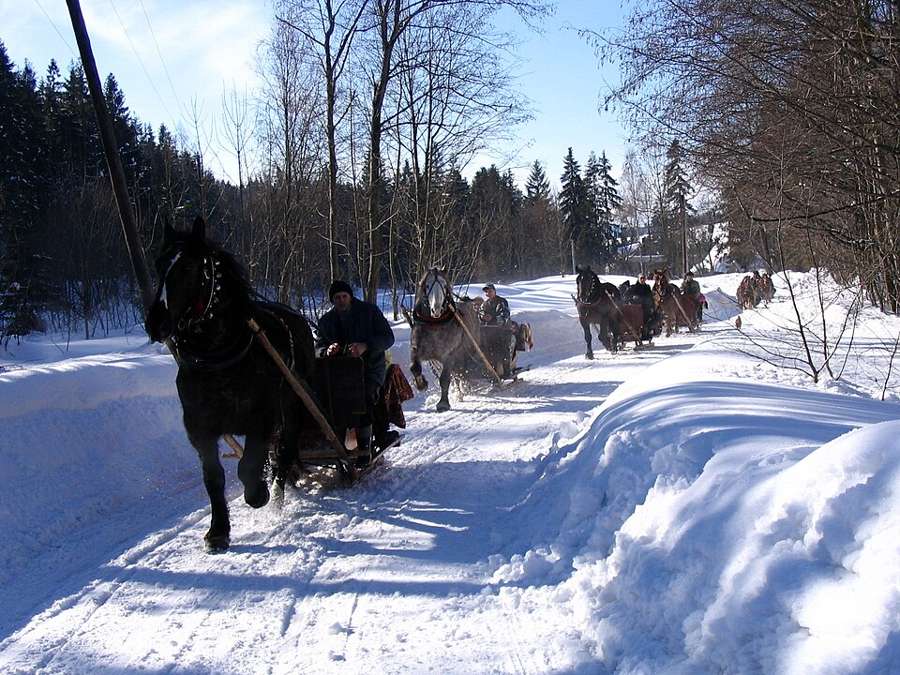
The one carnival custom you can still book today is the kulig - the horse-drawn sleigh ride through snow that ends around a bonfire with sausage, bread, hot drinks and a highland band. It began as the aristocracy's winter entertainment: a cavalcade of sleighs racing from manor to manor over several days of feasting, each stop hosted by a different noble house, the whole caravan growing as it went. Nineteenth-century memoirs describe kuligi that lasted a week and bankrupted hosts with pride. The painter Alfred Wierusz-Kowalski, whose sleigh scenes hang in every Polish museum, made it the country's most romantic winter image.
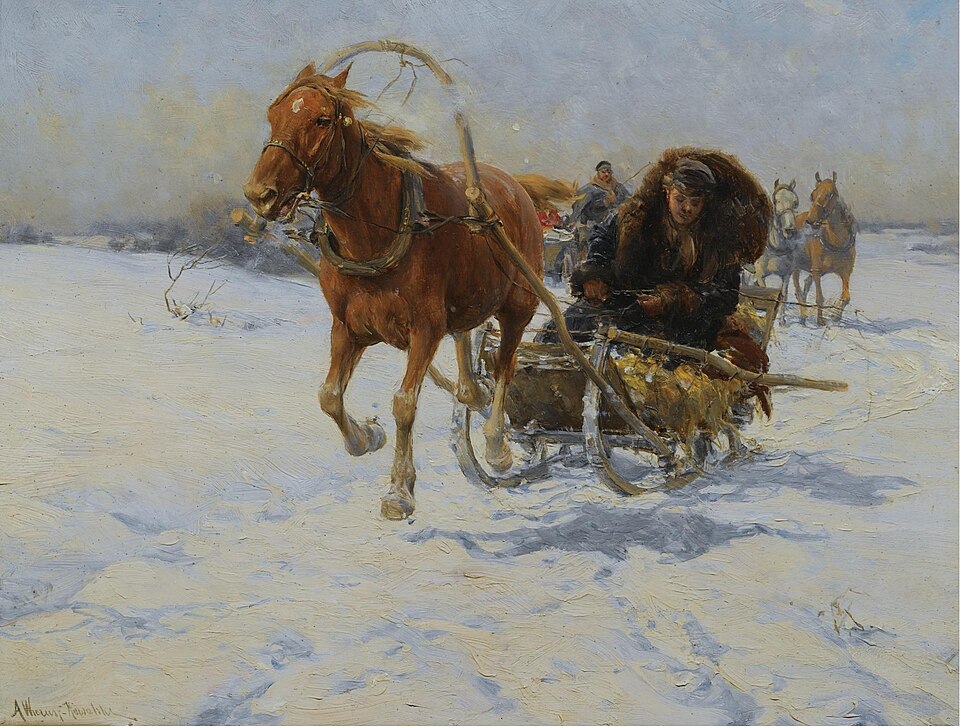
Today the kulig lives in Podhale, the Tatra foothills around Zakopane, and it has become genuinely accessible. For the 2026/2027 season, operator guides list three main routes: Gubalowka from 180 zl per person, Bialka Tatrzanska at 190 zl (250 zl with a two-hour feast), and the quieter Chocholowska Valley at 220 zl per adult and 190 zl per child, where four-person sleds run through the national park. Departures run daily, roughly every hour from 14:00 to 20:00, and the price covers transport, the ride, a highland feast with refreshments and live music. The season lasts from the first lasting snow to the end of March 2027 - and if the snow fails, the same program runs on horse-drawn carriages instead.
Book ahead for weekends and the last carnival days, dress warmer than you think - you will sit still in a moving sleigh for an hour, and wool blankets and sheepskins are part of the equipment - and expect the bonfire half to be the louder, smokier, better half. Most operators handle bookings in English online; the ride itself needs no Polish at all, and the highland band does not sing in any language you will need to answer in. A kulig makes an ideal anchor for a winter weekend in Zakopane.
Ostatki in the city
You do not need mountains to close the carnival, and most Poles close it exactly where they live. The ostatki weekend - in 2027, 6 to 9 February - is when restaurants, clubs and cultural centers across Poland lay on last parties before Lent: carnival balls, concerts, themed club nights. Student cities add their own events, and workplaces sometimes hold small carnival gatherings, the winter cousins of the office party. The single edible constant of the whole season is fried pastry: pączki on Fat Thursday and faworki, the crisp twisted ribbons also called chrust or chruściki, dusted with icing sugar and sold by the bag in every bakery through the entire season. Our Fat Thursday guide covers the pastry side in detail.
For a deeper dive into the folk side, keep an eye on the ethnographic museums: the open-air skansen museums and regional culture centers across Poland stage carnival events most winters - costumed processions, turon figures, sleigh rides and singing workshops - usually on the weekends closest to Fat Thursday. City cultural centers publish their carnival ball and concert programs in December, and the popular ones sell out.
The season opens, fittingly, with the biggest street pageant of the Polish winter: the Three Kings parades of Epiphany on 6 January, when cities across Poland process with camels, carols and crowns - our Epiphany guide has the details. From that day until Ash Wednesday, carnival is officially on.
Why expats should care
Carnival is the Polish season with the lowest barrier to entry. Nobody quizzes your faith at a kulig bonfire, nobody checks your dance card at a carnival ball, and the only real skill required is eating fried pastry in public. It is also the season when regional Poland is most visibly itself - the highlands in full winter dress, the folk customs out of the museums and onto the roads. If your Polish winter has so far been work, home and the tram, this is the five-week window to fix that.
What ends on Ash Wednesday
On 10 February 2027 the switch flips. Ash Wednesday - Sroda Popielcowa - is a church day: Poles queue at churches before work and during lunch to receive the ash cross on the forehead, hearing "remember that you are dust." The ash is made from last year's Palm Sunday palms, burned - the same palmy that were blessed less than a year earlier. There are no parties that night, and the shift is real. Carnival weddings become Lenten quiet; the balls stop; even shop displays calm down. Lent runs until Easter, and the same culture that spent six weeks feasting now spends six weeks restrained - until the Easter table breaks the fast again.
Frequently asked questions
When is the carnival season in Poland in 2027?
From Epiphany, 6 January 2027, to Shrove Tuesday, 9 February 2027. Ash Wednesday on 10 February opens Lent, which lasts until Easter on 28 March 2027. The peak is the final stretch from Fat Thursday, 4 February.
What is a kulig?
A traditional Polish sleigh-ride party: a horse-drawn sleigh ride through snow, ending at a bonfire with grilled sausage, bread, hot drinks and live highland music. Once an aristocratic winter cavalcade, today it is a bookable tourist experience, mainly around Zakopane.
How much does a kulig cost in 2026/2027?
From 180 zl per person on the Gubalowka route, up to 220 zl per adult in the Chocholowska Valley, with children around 190 zl. Prices include transport, the ride, a feast with refreshments and a band. Rides run daily from about 14:00 to 20:00.
What are ostatki?
The final days of carnival - from Fat Thursday to Shrove Tuesday - when the feasting peaks before Lent. The word also names Shrove Tuesday itself, kusy wtorek, the historical day of the last rich meal.
Is carnival in Poland like Rio or Venice?
No. Poland's carnival is a season rather than a single parade: balls, parties, folk customs and sleigh rides spread over five winter weeks, ending at Ash Wednesday. The big street spectacle comes at the start instead, with the Epiphany parades on 6 January.
Can I get married during Lent in Poland?
Civil weddings are legally possible year-round, but the Catholic tradition of no weddings in Lent is why carnival was historically the wedding season. Church weddings in Lent are rare and subdued, and most couples simply wait. <em>Cover: A kulig sleigh cavalcade near Nowy Targ, February 2006 - photo by Robert Wojtowicz, CC BY-SA 3.0, via Wikimedia Commons. Body: "Kulig jednokonny" by Alfred Wierusz-Kowalski, public domain, via Wikimedia Commons.</em>