Kolęda in Poland: the priest's Christmas home visit, explained
The essentials: Kolęda (wizyta duszpasterska) is a Polish priest's visit to a home after Christmas to pray with the family and bless the flat with holy water. It is by invitation, there is no obligation to host, and a small envelope donation is customary but optional.
If you live in Poland through the Christmas season, sooner or later a neighbour will mention kolęda - and they will probably not mean carol singing. In everyday Polish, kolęda also means the wizyta duszpasterska: the annual pastoral visit when the parish priest comes to people's homes, prays with the family and blesses the flat with holy water. For many Poles it is as fixed a part of the season as the Wigilia supper itself, and for expats it is one of those customs that arrives at the door, sometimes literally, before anyone has explained it.
This guide covers what kolęda actually involves, when it happens, how visits are booked, what people prepare, what the famous envelope is about, and - importantly - what to do if you would rather not take part.
What kolęda is
Kolęda is a short pastoral visit to a home by the parish priest, usually accompanied by an altar server or a nun. The core of the visit is religious: a prayer together, the sprinkling of the home with holy water, a blessing, and a few minutes of conversation about the family. The Polish bishops' guide to the custom, summarised by the Catholic weekly Niedziela, describes the visit as a meeting between the priest and the whole household - everyone present is meant to take part, children included. A typical visit lasts around 10 to 20 minutes, and in a single evening a priest may see a dozen or more flats on one staircase.
Two things are worth knowing up front. First, kolęda is by invitation and there is no obligation to host it. Second, it is a parish custom, not a state or legal one - no law or church rule forces anyone to open their door, and canon law does not even fix the dates.
When kolęda happens
Traditionally the visits run from just after Christmas until Candlemas (Ofiarowanie Pańskie) on 2 February - hence the English-language description "the priest's Christmas visit". But the window has been stretching for years. The Church sets no official dates, and parishes schedule the rounds to fit their size and their priests' workload.
Recent Polish reporting shows how wide the spread has become. The news weekly Wprost reported on 12 October 2026 that one Łódź parish, NMP Królowej Pokoju, began its kolęda visits in early October 2026 - a full two months before Christmas - and that the parish priest, ks. Krzysztof Górski, had explained the arrangements in a letter dated 5 October. The Catholic portal Story.pl, reporting on 22 October 2025, listed parishes starting in late November (Rybnik) and even September (Strzelce Górne), and noted that the shrinking number of priests is the main reason visits begin earlier and earlier: fewer clergy have to cover the same number of homes.
Practical takeaway: check your own parish rather than the calendar. Schedules are usually published weeks ahead - on the parish noticeboard, on the parish website or Facebook page, and increasingly by text message or an online sign-up form.
How visits are booked now
The pandemic quietly modernised kolęda. According to Story.pl's reporting, many parishes introduced a formularz kolędowy - a consent form on which you declare whether you want a visit at all, and when. Others run sign-ups by SMS or through online tools; a Polish platform called ZapisyNaKolede.pl exists specifically for booking kolęda slots. Some parishes have moved part of the custom into the church itself: Story.pl described "hybrid" kolędy in Zabrze-Helenka, where families meet the priest for a communal kolęda gathering in the church instead of receiving him at home. Parish pages, like the one published by the Dobry Pasterz parish in Bytom for its 9 January 2026 round, show the typical format: a list of streets and blocks with assigned days and hours.
So the modern rule is simple: if you want a visit, you usually book it; if you do nothing, most parishes will not knock. In some traditional parishes the priest still walks a fixed street list and rings every bell - your neighbours will know which kind yours is.
What happens during the visit
The visit follows a recognisable pattern, as Niedziela's kolęda guide lays it out:
1. The priest is welcomed at the door and led to the room where the family has gathered. 2. Everyone prays together - often a short litany or a carol (this is where the name comes from: kolęda originally means a Christmas carol). 3. The priest sprinkles the home and the household with holy water and pronounces the blessing. 4. A few minutes of conversation follow: how the family is doing, children, work, anything someone wants to raise or ask for a prayer about. 5. Children often receive a small religious gift - a picture, a calendar, sometimes sweets.
Afterwards the priest chalks the letters K+M+B and the year on the door frame in many parishes - the same Epiphany inscription linked to the names of the Three Kings (Kacper, Melchior and Baltazar) that you can read about in our Epiphany in Poland guide. In some parishes the chalking is left for the separate Three Kings blessing on 6 January.
What to prepare (if you host)
Niedziela's guide lists the traditional table arrangement, and none of it is complicated:
- a table covered with a white cloth,
- a crucifix and two candles,
- an open Bible,
- if you have it, a small bowl of holy water and a kropidło (the sprinkler used to scatter it),
- chalk for the door inscription, if the parish does not supply it.
Coffee, tea and a plate of cake or Christmas biscuits are a common courtesy, not a requirement - the guide itself stresses that hospitality should stay modest, and priests doing ten visits an evening often cannot eat at every stop. The whole household being present matters more than the refreshments.
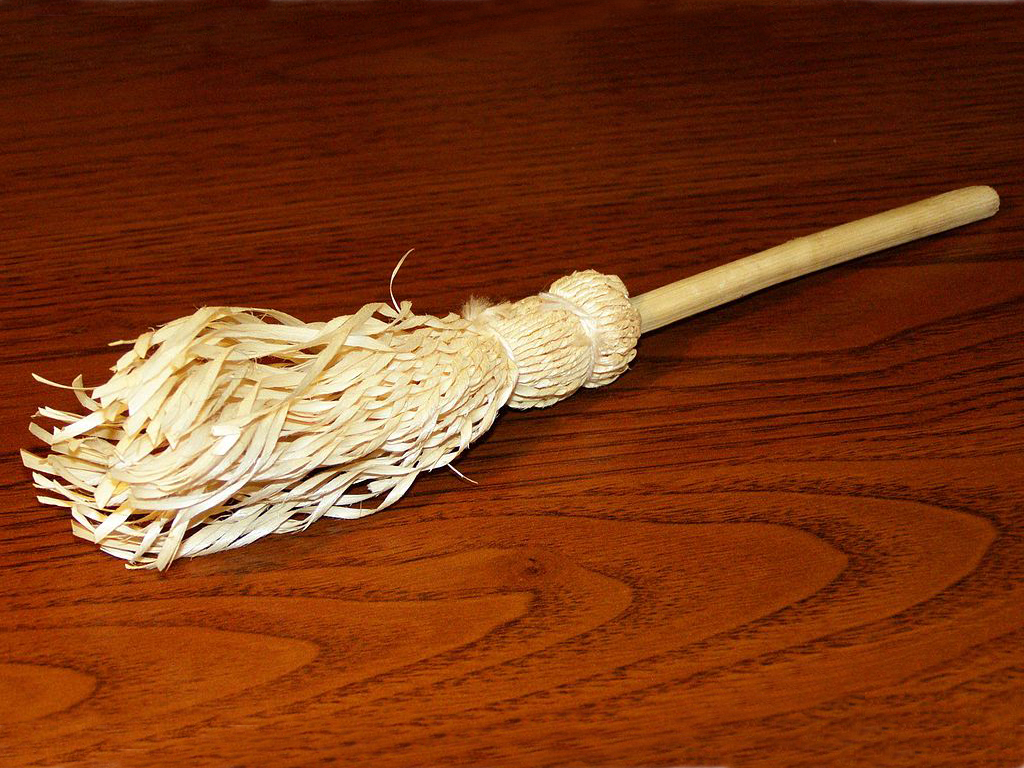
A kropidło, the aspergillum used to sprinkle holy water during the blessing. Photo: Albertus teolog, CC BY-SA 4.0, via Wikimedia Commons.
The envelope question
Every conversation about kolęda among Poles eventually lands on the envelope: a small donation to the parish, discreetly handed over or left on the table during the visit. The Church's position, as Niedziela puts it, is that the gift "nie musi być" - it does not have to be - and some priests have started saying so out loud. In the Łódź case reported by Wprost, the priest announced in his 5 October 2026 letter that he would not accept any offerings during that year's visits at all.
How much do people actually give? A SW Research poll conducted for Wprost in early January 2026 found that among Poles who answered, 29.5% give between 50 and 100 zł, 10.6% planned 100 to 200 zł, 8% give under 50 zł, 2.8% give more than 200 zł, and 5% give nothing. (The shares do not add up to 100% because the rest of respondents did not give a figure.) Treat these as orientation, not a tariff: the custom is a free-will donation to the parish, and no priest may condition the visit on it.
If you are not Catholic - or just do not want a visit
This is the part expats worry about, and the answer is short: nothing happens. Kolęda is by invitation. Not signing up, not returning the formularz, or simply saying a polite "dziękuję, nie skorzystamy" ("thank you, we will pass") is completely acceptable and unremarkable - plenty of Catholic Polish families skip it in a given year because of work, illness or preference. There is no list of refusals and no follow-up.
Conversely, if you are not Catholic but are curious, you are allowed to host. Priests routinely bless homes of mixed families; nobody will quiz you at the door. If you would like the visit but feel unsure about the religious parts, saying so when booking is fine - the core of the visit is the blessing and the conversation, and hosts set the tone. Our Polish social etiquette guide covers the general hosting courtesies that apply here as anywhere else in Poland.
One last practical note for newcomers: if a knock comes from an unexpected "kolęda" visitor you did not book, you are under no obligation to open. Genuine visits are announced in advance through the parish.
Frequently asked questions
Is kolęda obligatory in Poland?
No. It is a voluntary parish custom. Canon law does not fix its dates or require anyone to host, and modern sign-up systems mean visits happen only by invitation in most parishes.
When is kolęda in the 2026/2027 season?
Traditionally from just after Christmas until Candlemas on 2 February 2027, but parishes set their own calendars - Polish media reported parishes starting as early as September and October 2026. Your parish noticeboard or website has the real dates.
How much should I put in the envelope?
There is no set amount and giving is optional. In a SW Research poll for Wprost from early January 2026, the most common answer was 50-100 zł (29.5%), while 5% of respondents give nothing. Some priests now explicitly decline offerings.
Do I have to be Catholic to receive a kolęda visit?
No. Priests visit mixed and non-Catholic households on request. Booking a visit is understood as consent to its religious form - a prayer and a blessing - but you can say what you are comfortable with.
What if I work during the day?
Most parishes offer evening slots precisely for working households, and some run weekend rounds or communal kolęda gatherings in the church as an alternative.
What do the letters K+M+B on the door mean?
They stand for the traditional names of the Three Kings - Kacper, Melchior, Baltazar - and the current year. The chalking is an Epiphany custom often done during or just after kolęda; it is a blessing inscription, not a tally of donations.